














How to Dress a Sliding Glass Door: Complete Guide
A French window is a promise of light and space, yet dressing it can feel like a decorating conundrum. How do you preserve brightness while shielding yourself from prying eyes and temperature shifts? The secret lies in a delicate balance of beauty and purpose. From airy sheers to sleek technical blinds, each option turns your opening into a defining asset. Here, you will find inspiration to weave together privacy, comfort and style, without ever compromising the view that shapes your everyday.
The French window is the dream architectural element, a transparent border that floods the interior with light and offers a breathtaking view of the outside. Yet, knowing how to dress a French window often represents a significant decorative challenge. How can you reconcile the light intake, the necessary privacy, thermal control, and, of course, aesthetics? This is not simply a question of curtains, but a full-fledged interior design project. Between current trends that promote fluidity and innovative technical solutions, the possibilities are immense. This article guides you step by step to transform this spectacular opening into a major asset for your interior decoration, exploring all types of window dressings, from timeless classics to the most modern installations.
Understanding the Stakes: Much More Than a Decor Question
Before choosing a fabric or a blind, it is crucial to analyze the specifics of your French window and your needs. This preliminary reflection is the key to a successful and lasting choice.
The orientation of the window determines its sun exposure. A south-facing window will be demanding in terms of solar control solutions, while a north-facing orientation will favor heat retention. The view is another essential parameter: should it be fully preserved, filtered, or sometimes obscured? Finally, the use of the room guides the required level of privacy. An open-plan living room may want flexibility, while a bedroom will require total blackout.
The Multiple Functions of Window Dressings
Dressing a French window meets both practical and aesthetic requirements. Managing natural light is paramount to avoid glare and protect furniture from UV rays. Thermal and acoustic insulation is often underestimated; a good dressing can significantly reduce heat loss in winter and overheating in summer. Of course, privacy remains a major concern, as does pure decoration, which allows you to assert a style and structure the space.
Timeless Classics: Curtains and Sheers
Curtains remain the most popular solution for dressing a French window, offering an incomparable feeling of softness and warmth. Their versatility is their major strength.
For a French window, installation is strategic. It is generally recommended to place the rod well above the frame, up to the ceiling if possible, and to extend it generously on each side. This trick visually enlarges the window and allows the view to be completely cleared when the curtains are open. Choose sturdy rail or rod systems capable of supporting the weight of often substantial fabrics.
The Winning Duo: Lining and Sheer Curtains
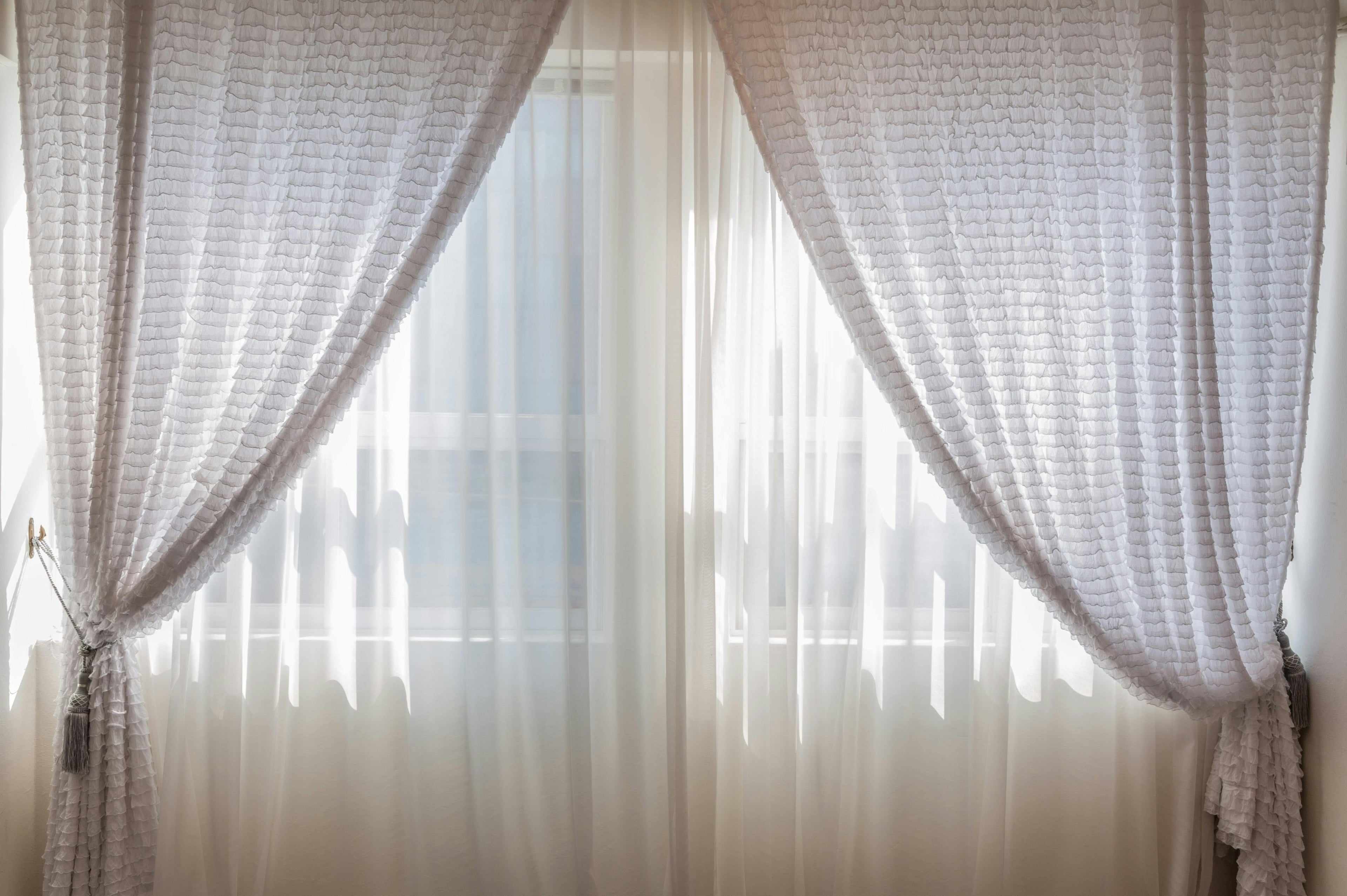
The current trend for how to dress a large French window relies on layering. A fine sheer curtain, almost vaporous, is installed in the foreground. It filters the light, preserves a certain privacy during the day, and softens the outlines. Behind it, you find full-length curtains with more pronounced properties: thick fabrics for blackout, linen for a natural style, velvet for a luxurious and insulating touch. This double layer offers perfect flexibility for managing light and privacy at any time.
Modern and Technical Solutions: Blinds and Screens
The world of blinds has undergone a revolution, moving from purely functional options to true design elements. They are perfect for a clean and contemporary look.
Roman blinds or roller blinds, in technical fabrics, are a safe bet. Today, versions with an integrated cassette offer an ultra-clean finish. Solar fabric blinds, which filter light without darkening, are particularly suitable for exposed windows. For millimeter-precise light control, nothing beats Venetian blinds. The large-width version, with extra-wide slats (50mm to 120mm), brings a graphic and modern touch, ideal for large glass surfaces.
Innovation at the Service of Decor: Screen and Zebra Blinds
Screen blinds represent technical excellence. This micro-perforated fabric, stretched over a frame or a roller system, allows you to see from the inside out while limiting visibility from the outside. It filters up to 90% of UV rays and reduces glare, without ever completely blacking out. Zebra blinds, or duettes, alternately combine bands of opaque fabric and translucent fabric. By playing with the alignment, you achieve a very fine gradation of light and privacy, an ingenious solution for dressing a French window with style.
Tailored Elegance: Sliding Japanese Panels
Inspired by traditional shoji, sliding panels have become a leading trend for large openings. They bring structure, minimalism, and sculptural elegance.
Their principle is simple: independent panels, suspended from a top rail, slide in front of each other. You can thus fully open the window or cover it partially. The choice of materials is vast: stretched fabrics (from linen to velvet), natural wood, lacquered wood, or even innovative materials like reed or paper. Their strength lies in their ability to divide the space flexibly and create plays of light and texture.
For a French window, the effect is spectacular. The panels act as mobile and decorative partitions. They are particularly suitable for contemporary, Scandinavian, or Japanese-inspired interiors. The investment is more substantial, but the result, entirely custom-made, radically transforms the ambiance of a room.
The Perfect Alliance: Mixing Dressing Styles
Why choose when you can combine? The most seasoned decorators don't hesitate to do so. Combining different types of window dressings allows you to meet all needs with great sophistication.
The most common and effective combination is that of a technical blind and a decorative curtain. For example, a Venetian blind or a screen provides daily light control and privacy. Over it, you install linen or velvet curtains, which you draw only at night or to add a touch of warmth and texture. This layering adds depth and character to the room.
Another trendy idea is to mix fixed or sliding panels on the sides with a central roller blind. This creates an architectural frame for the window. The idea is to play with textures and transparencies to create a unique and personalized French window dressing, far from standardized solutions.
The Crucial Choice of Materials and Colors
The material and color of your dressing influence not only the style but also the light ambiance of the entire room. This is a choice to be considered based on the desired effect.
For a soft and natural ambiance, natural fibers reign supreme. Linen, with its irregularities and texture, brings an organic and contemporary touch. It beautifully filters light. Cotton and hemp are also excellent choices for a relaxed look. For more luxury and insulation, velvet is making a strong comeback, especially in deep shades like navy blue or forest green.
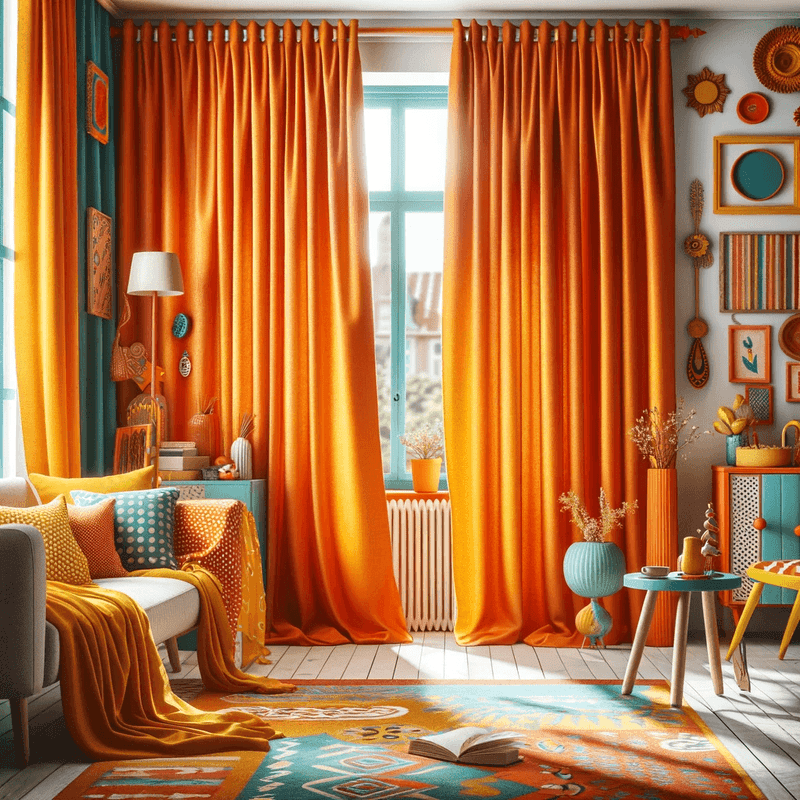
In terms of colors, the current trend is towards natural shades and measured contrasts. Off-white, taupe, greige, and terracotta tones blend harmoniously. For a stronger impact, you can dare a block color on the dressing, contrasting with neutral walls. A navy blue or sage green blind or curtain then becomes the elegant focal point of the room.
Thinking About Finishes and Details That Make the Difference
The proof is in the details. Accessories and finishes are the jewels that elevate the dressing of your French window.
The choice of rods and poles is paramount. A thin, discreet rod in brushed metal (gold, black, nickel) suits modern styles. A solid wood bar, with ornate tiebacks, leans towards a classic or rustic-chic style. Rail covers or profile covers are essential for a professional and clean finish, especially for roller blinds or sliding systems.
Don't forget the handles or pull cords for blinds, which can be customized. Finally, lighting plays a key role. Integrating adjustable spotlights or a discreet fairy light garland behind the sheers can create a magical ambiance in the evening, transforming your French window into a true light stage.
Practical Case: Dressing Atypical French Windows
Not all windows are rectangular and standard. Sliding doors, bay windows, or arched windows require a custom approach.
For a large sliding glass door opening onto a garden, the ideal is often an exterior blind (sunshade, awning) coupled with a light interior dressing, such as double curtains or sliding panels. This allows the sliding doors to remain operational without hindrance.
A bay window (rounded projecting window) is an architectural gem. To highlight it, you can opt for a custom-made blind fitting each section, or create a theatrical effect with enveloping curtains on a curved rail. The goal is to follow the shapes without breaking them.
Windows with an integrated French door require treating the whole as a single unit. A single blind or curtain across the entire width is often more elegant than separate treatments. Ensure the dressing does not obstruct the door's opening.
Trends for 2026 for Stylish French Windows
Interior decoration evolves, and the dressing of French windows follows the movement. Here are the strong trends dictating current choices.
Biophilia, this desire to reconnect the interior with nature, greatly influences choices. Natural materials (linen, jute, wood), earthy colors, and organic patterns are favored. Blinds made from plant fibers, like bamboo or reed, are highly sought after.
Smart minimalism is also in the spotlight. Integrated, discreet, and multifunctional solutions are sought after. Motorized and connected blinds, controlled by smartphone or integrated into the home's home automation system, embody this trend. They offer ultimate comfort and a design without visible wires.
Finally, textile audacity manifests itself through discreet graphic prints (fine vertical stripes, geometric relief patterns) and pronounced textures, like bouclé or ribbed fabric. The idea is to bring character without cluttering the space.
FAQ: Answers to the Most Frequent Questions
Do you have practical questions about how to dress your French window? This section answers the most common questions to help you see more clearly.
What is the best choice for insulating my French window?
For optimal thermal and acoustic insulation, layering is key. Opt for lined curtains with a thick thermal lining, in velvet or quilted fabric. Thick sliding panels in wood or fabric stretched over insulation are also very effective. Don't forget that side seals (guides or well-fitted tiebacks) are essential to avoid thermal bridges.
How to dress a very large French window without it being too costly?
For large surfaces, roller blinds or large-width Venetian blinds are often more economical than custom-made long curtains. Choosing a solar fabric rather than a blackout fabric can also reduce the cost. A decorative trick: dress only the two lateral thirds of the window with long curtains, leaving the center clear with a simple blind. This creates volume at a lower cost.
Can I install heavy curtains on a sliding glass door?
Yes, but with an adapted installation. You must absolutely use a sufficiently robust ceiling rail and position it so that the curtains, once drawn, do not cover the passage area of the sliding door. Leave significant lateral clearance. An elegant alternative is to use curtains with rings on a rod, which can be easily fully drawn aside when the door is used.
Are motorized blinds really useful?
Beyond the gadget aspect, they bring undeniable comfort and safety, especially for high or hard-to-reach windows. They allow precise light management throughout the day and can be programmed. For home automation integration, they are ideal. Their cost has dropped significantly, making them accessible for a major renovation project.
How to choose between an interior blind and an exterior blind?
The exterior blind (awning, shutter) is the most effective for controlling heat before it enters through the glass. It also protects the glass. The interior blind acts on light and ambiance once the heat is inside. For very exposed south or west-facing windows, the ideal is often to combine both: an exterior awning for thermal performance and an interior dressing (sheer, screen blind) for visual comfort and privacy.
Conclusion: Make Your French Window the Jewel of Your Interior
Dressing a French window is a unique opportunity to express your style while optimizing the comfort of your home. Whether you opt for the timeless softness of double curtains, the technical precision of a screen blind, or the architectural elegance of sliding panels, the essential thing is to make a choice that meets both your practical needs and your aesthetic desires. Don't be afraid to mix textures, materials, and systems for a custom-made and unique result.
Take the time to carefully analyze your space, your light, and your lifestyle. Don't hesitate to ask for samples to see fabrics and materials on-site, at different times of the day. A successful dressing is one you no longer notice because it works perfectly in daily life while enhancing your interior. To discover more inspiration and advice on fitting your openings, explore the other complete guides available on ombreinterieur.fr. Check out our article how to decorate a vintage bedroom with diffusers to go further. Find our entire decor universe at Ombre Interieur.
```