















How to Dress a Sliding Window: Complete Guide
Dressing a sliding window means striking a delicate balance between light, privacy and smooth operation. These generous expanses of glass, so flattering to your interior, demand tailored solutions that respect their mechanism while elevating the room. Roller blinds, pleated shades or curtain tracks: each option offers an aesthetic and functional answer to this architectural challenge. You are invited to consider the essential criteria for a choice that will turn your patio doors into a decorative asset, without ever compromising their daily use or natural luminosity.
Sliding windows, those large glass doors that generously open our interiors to the outdoors, are a true architectural blessing. They flood rooms with light, create a sense of space, and often offer spectacular views. However, dressing them presents a significant decorative challenge. How do you reconcile privacy, light control, and aesthetics without hindering their functionality or spoiling their clean lines? Dressing a sliding window requires careful thought, as the choice impacts the room's ambiance, thermal and acoustic insulation, and even ease of daily use. This article guides you through all the options, from classic blinds to custom solutions, incorporating current trends and technical advice to help you make the perfect choice for your space.
Understanding the Specifics of Sliding Windows
Before choosing a dressing, it is crucial to analyze the unique characteristics of your sliding window. Unlike a casement window, its lateral opening mechanism imposes technical constraints. The first is space. The sashes slide past each other or into a wall cavity, limiting the available space on the sides for fixing a system. You must absolutely avoid the fabric or blind interfering with the handle's operation or the sash's movement.
The second specificity is size. Sliding windows are often large, even panoramic. An unsuitable dressing can seem overwhelming or, conversely, lost on such a large surface. Finally, their very function – creating a connection with the outdoors – must be preserved. The ideal is a discreet system that completely disappears when not needed, allowing you to fully enjoy the view and natural light.
Roller Blinds: Discreet and Modern Elegance
Among the most popular solutions for sliding glass doors, the roller blind comes out on top. Its main advantage is its simplicity. When raised, it almost completely disappears into its cassette, maximizing the glass area. There are two main types suitable for large surfaces: the classic roller blind and the roller blind guided by tension wires.
The classic blind, fixed above the door, is perfect for standard-sized windows. For very large doors (over 3 meters wide), it is recommended to opt for a system with multiple fabric panels operated by a synchronized control, to prevent the fabric from warping. The guided blind, on the other hand, is equipped with wires or side guides that keep the fabric perfectly straight and taut, even in windy conditions or over very large heights. It is an aesthetic and high-performance solution.
Choosing Fabric and Opacity
The customization options for roller blinds are vast. For dressing a sliding window, the choice of opacity is strategic. Sheer fabrics (like voiles) filter light while preserving daytime privacy. They create an incomparable soft luminosity. Opaque fabrics (like Blackout) offer total darkness, ideal for bedrooms or home cinemas. Finally, semi-opaque fabrics (like Screen) represent an excellent compromise, softening light and providing privacy both day and night.
Pleated Blinds and Venetian Blinds: Structure and Lightness
If you are looking for a dressing with more texture and structure, pleated blinds (or permanent pleat blinds) are an appealing option. They are raised using a cord or chain system, and their regular pleating adds a graphic touch to the room. Modern and lightweight, they are available in a multitude of colors and materials, from polyester to natural linen.
For ultra-precise control of light and privacy, Venetian blinds in aluminum or wood (like bamboo) are unbeatable. Their adjustable slat system allows you to modulate light intake infinitely. On a large sliding door, opt for motorized models, which avoid having to manipulate long chains that can sometimes be difficult to reach. Wooden Venetian blinds bring natural warmth, while ultra-thin metal models (micro-slats) offer a very contemporary look.
Curtains and Voiles: A Touch of Timeless Elegance
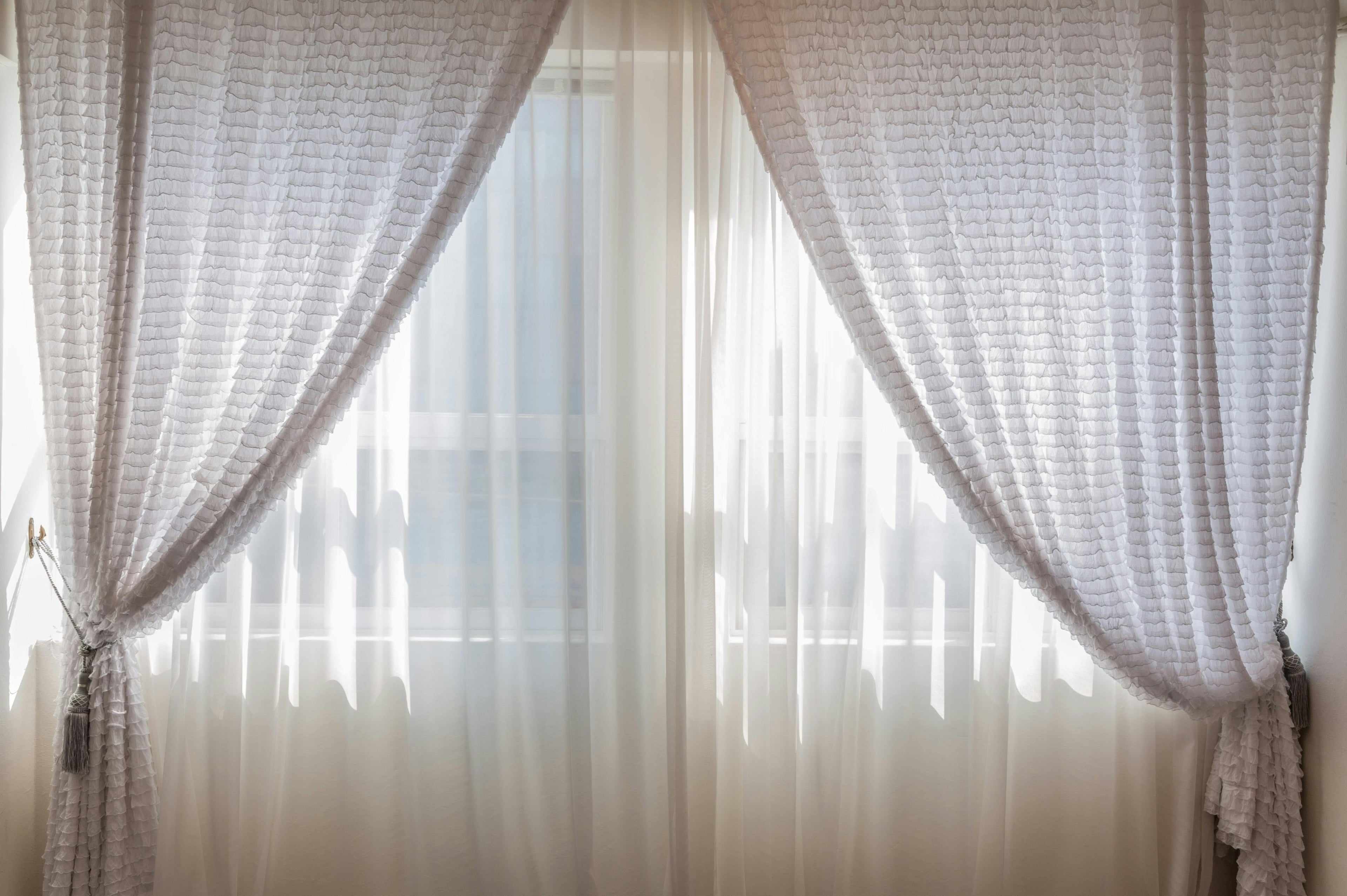
Nothing rivals the softness and movement brought by curtains. For a sliding window, their installation requires special attention. The golden rule is to provide a track or rod long enough so that the curtains can be fully drawn back onto the side walls, completely clearing the glass door when open.
For a spectacular and modern effect, the trend is towards ceiling-mounted sliding tracks. They create a clean visual line and allow curtains to be hung from floor to ceiling, amplifying the ceiling height. Pairing a lightweight voile with thicker curtains (in linen, velvet, or wool) is a winning combination. The voile filters light during the day, while the opaque curtains ensure privacy in the evening and improve thermal insulation.
Tips for a Successful Installation
To prevent curtains from blocking the window opening, several solutions exist. You can opt for a curved track that follows the wall angle and allows the curtains to sit perfectly to the side. Another tip is to choose curtains with sliding rings, which are easier to handle over large widths. Finally, motorization is becoming an increasingly accessible option, offering unparalleled comfort, especially for large or high windows.
Custom and Innovative Solutions
For sliding windows with atypical shapes (curved, triangular) or integrated into complex configurations, custom-made is often the only solution. Specialized companies can create blinds or curtains perfectly adapted to the dimensions and shape of your window. Although more expensive, this choice guarantees a perfect aesthetic and functional result.
Among the innovations, projection blinds (or extra-flat blinds) are experiencing a real boom. Ultra-thin and deploying from a discreet cassette, they offer a sleek, high-tech design. Solar control glazing (with integrated film or treatment) is another avenue, although it is not a dressing in the traditional sense. It reduces glare and heat without any moving parts, preserving the view 100%.
The Importance of Motorization and Home Automation
On a large sliding window, manually operating a blind or curtain can become tedious, especially if it is high or wide. Motorization is no longer a gadget but a real asset for comfort and safety. It allows you to control all your dressings via remote control, a smartphone app, or even integrate them into home automation scenarios (gentle wake-up, automatic closing at sunset).
Current systems are discreet, quiet, and can run on batteries (avoiding wiring work). For a reasonable investment, you gain practicality and modernity. Imagine closing all the blinds on your panoramic window simultaneously with a simple gesture from your sofa: that is everyday luxury.
Thermal and Acoustic Insulation: A Decisive Criterion
Window dressing is not just about aesthetics. It plays a crucial role in the energy performance of your home. A large glass surface, even with high-performance double glazing, can be a source of heat loss in winter and overheating in summer.
An opaque blind or thick, lined curtains provide an additional insulating barrier. Roller blinds with specific "thermal" fabrics or wooden Venetian blinds are particularly effective. Similarly, they can attenuate noise from outside, contributing to a more peaceful indoor environment. Do not neglect this aspect, especially if your sliding window faces a busy street.
Harmonizing the Dressing with the Room's Style
Your final choice must integrate perfectly with the decorative style of the room. For a Scandinavian or minimalist interior, prioritize simplicity: white or light grey roller blinds, light wood Venetian blinds, or undyed natural linen curtains. The goal is light and purity of lines.
In an industrial setting, metal blinds or thick canvas curtains on an exposed raw steel track will work wonders. For a bohemian or ethnic interior, dare to use richly patterned and textured curtains, such as ikat or macramé. A classic or luxury contemporary interior will perfectly welcome large cascading curtains in velvet or silk, paired with a fine voile.
FAQ: Most Frequent Questions About Dressing Sliding Windows
What is the least bulky system for a sliding window?
The roller blind is undoubtedly the champion of discretion. Once raised, it fits into a cassette just a few centimeters high, completely freeing the view and light. Extra-flat (projection) blinds offer an even more minimalist alternative, with an often invisible integrated cassette.
Can you put curtains on a sliding patio door?
Absolutely. It is even an excellent solution for adding warmth and volume. The key is in the installation: use a rod or track long enough so that the curtains can be fully drawn back onto the adjacent wall, without obstructing the handle or the door's passage. Ceiling-mounted sliding tracks are perfect for this.
How to dress a large sliding glass door over 4 meters wide?
For such dimensions, it is often necessary to combine multiple panels of blinds or curtains. For roller blinds, plan for several fabrics operated by a grouped control. For curtains, divide the width into several panels sliding on the same track. Motorization becomes almost essential for easy and uniform handling of the whole.
What solution for controlling light without losing the view?
Two excellent options exist. Venetian blinds (in aluminum, wood, or PVC) allow you to angle the slats to protect yourself from the sun while maintaining a clear field of vision. "Screen" or "Vision" type fabrics for roller blinds offer a similar effect: seen from inside, they act as a solar filter, while seen from outside, they preserve transparency and the view.
Can the dressing improve the acoustic insulation of a sliding door?
Yes, significantly. Dense and thick materials absorb sound waves. A combination of double curtains (a voile + a thick velvet or wool curtain) will be very effective. Roller blinds in technical acoustic fabric or removable acoustic panels are also effective solutions for attenuating outside noise.
Conclusion: Finding the Perfect Balance Between Form and Function
Dressing a sliding window is an exercise in balance between sometimes conflicting requirements: aesthetics, functionality, privacy, and light control. There is no universal solution, but a range of possibilities to adapt to your specific needs, the window's orientation, the room's decor, and your budget. Whether you opt for the absolute discretion of a roller blind, the organic warmth of a bamboo blind, or the majestic drape of large curtains, the essential thing is that your choice enhances this opening to the outdoors without compromising its qualities.
Take the time to measure precisely, request fabric samples, and, if necessary, consult a professional. A well-chosen and well-installed dressing will transform your sliding window into a major decorative asset, for years of comfort and visual pleasure. To discover more inspiration and technical advice on fitting out your openings, feel free to explore the other comprehensive guides available on ombreinterieur.fr. Also explore our Sliding Patio Door Curtain collection to vary styles. Need practical advice? Read how to integrate a rug in a small 30 m entrance. Browse our online store to see all our collections.
