
















How to Dress a Living Room Window: Complete Guide
Choosing the window dressing for your living room goes far beyond mere decoration: it is about orchestrating light, safeguarding your privacy, and defining the stylistic signature of your main living space. With so many options available — from curtains and blinds to Japanese panels — fabric and colour become your allies in crafting a bespoke atmosphere. Let the latest trends and stylists’ insights guide you, turning your window into a true asset that is both aesthetic and functional.
Dressing a living room window is much more than just a decorative choice. It is an act of style that defines the soul of your living space, modulates light, protects your privacy, and contributes to thermal and acoustic insulation. Faced with a multitude of choices – curtains, sheers, blinds, Japanese panels – it is easy to feel lost. This article is your complete guide to transforming this opening into a major aesthetic asset. We will explore current trends, preferred materials, installation techniques, and stylist tips to create a custom atmosphere, from the modern living room to the most traditional one.
Understanding the Functions of Window Treatments: Much More Than an Ornament
Before choosing a fabric or a model, it is crucial to define your needs. A living room window fulfills several roles that should guide your selection. Mastering natural light is paramount: do you wish to soften direct sunlight or, on the contrary, let in maximum brightness?
Privacy is another essential parameter, especially on the ground floor or facing neighboring homes. Next, thermal and sound insulation come into play. Specific solutions such as double curtains or blackout blinds can make a real difference to your comfort and energy bill.
Finally, do not forget the purely decorative dimension. Window treatments are a structuring element that can visually enlarge the room, enhance the ceiling height, or create a spectacular focal point. It is this combination of functionality and aesthetics that leads to a successful choice.
The Main Types of Window Treatments: Curtains, Blinds, and Panels
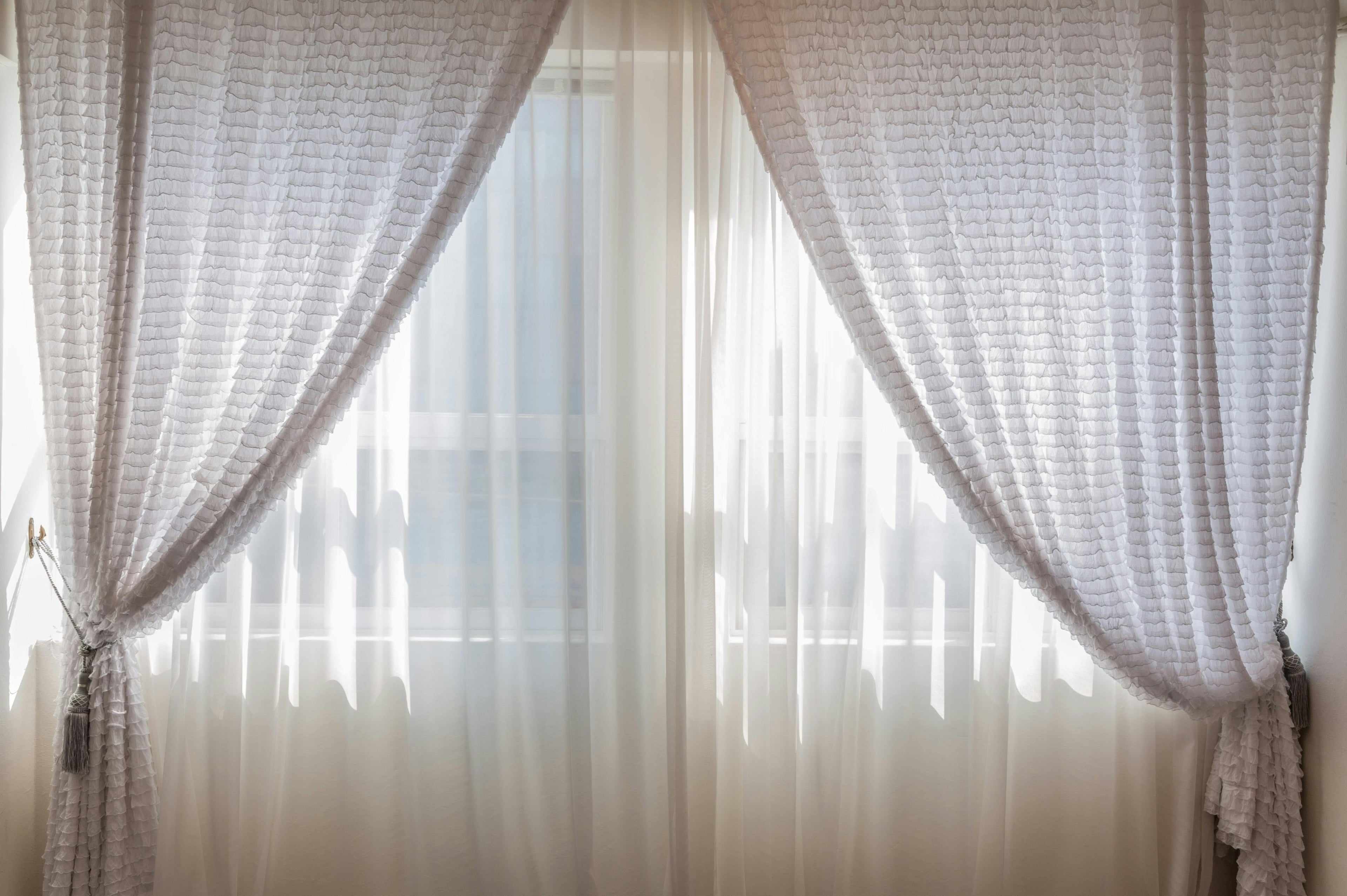
The market offers a range of solutions, each with its own advantages and aesthetic language. Curtains and sheers remain the safe bets for a living room. They bring softness, movement, and great freedom in terms of fabrics and hem styles.
Blinds, on the other hand, often embody a more contemporary and minimalist spirit. Among the strong trends, we find roller blinds, perfect for a minimalist look, and Venetian blinds in aluminum or wood, which allow ultra-precise light control.
Sliding panels, such as Japanese panels, are experiencing a real boom. They appeal with their clean geometric lines, modular aspect, and ability to dress large bay windows elegantly. Choosing the type of window treatment is the first structuring decision for your project.
Choosing the Fabric and Material: The Key to the Atmosphere
The material is what gives all its personality to your window treatment. For a living room, the choice is vast and should match the intended use and atmosphere. Natural fabrics like linen and cotton offer a beautiful texture, a lively appearance, and good light regulation. They are ideal for a bohemian, Scandinavian, or coastal style.
For a more luxurious and structured look, turn to velvet or thick fabrics like gabardine. These materials are perfect for curtains with a majestic drape and contribute to better insulation. Sheers in polyester or very light linen, on the other hand, are essential for filtering light while preserving views and privacy.
Current trends also see the emergence of technical fabrics with interesting properties: flame-retardant, stain-resistant, or UV-treated. Do not forget to consider maintenance: a living room is a living space that may require washable or dust-resistant fabrics.
Colors and Patterns: Playing with Light and Space
The color of your window treatment is a powerful decorative lever. A solid fabric in neutral tones (off-white, gray, beige, taupe) enlarges the space and highlights the rest of your decor. It is a safe and timeless choice.
To infuse character, do not hesitate to opt for bright or deep colors. A navy blue, emerald green, or terracotta can create a spectacular focal point. Patterns are also making a strong comeback. Vertical stripes elongate the room, botanical patterns bring a touch of freshness, and geometric prints animate a contemporary interior.
The golden rule is to consider the impact of light. A dark color will absorb light and create a cozy atmosphere, while a light color will reflect it for a brighter, airier living room. Also think about harmony with your furniture, rug, and walls.
Fixing and Hanging Systems: The Art of Presentation
The way you hang your window treatment is decisive for the final result. The height of the curtain rod is a decorator's secret: to add height to your living room, fix the rod or track 15 to 30 cm above the window frame, and let the curtains touch the floor or even form a slight puddle.
The choice between a rod and a track is also a matter of style. Visible metal rods, especially in black or copper brass, are very trendy and become an integral part of the decor. Tracks, on the other hand, are discreet and perfect for complex sliding systems or Japanese panels.
Rings, hooks, and gliders should be chosen carefully to ensure smooth gliding. For a romantic look, opt for wide ring clips on a visible rod. For a minimalist style, choose eyelet curtains or a hidden pocket system.
Current Trends for Dressing a Living Room Window
Interior decoration evolves, and so does window dressing. Several trends mark the year. The minimalist and clean style favors roller blinds in neutral tones, plain panels without overload, and clean lines.
Conversely, maximalism and the return of patterns are expressed through bold prints, fringes and pom-poms, or double curtains where a light sheer is paired with a patterned curtain.
Natural and sustainable are more relevant than ever. We seek fabrics in natural fibers (linen, hemp, organic cotton), eco-friendly dyes, and blinds in raw wood or bamboo. The idea is to create a connection with the outdoors and prioritize healthy materials.
Finally, technology in the service of comfort is becoming mainstream with motorized blinds and curtains, controllable via smartphone or voice assistant, offering unparalleled comfort and modernity.
Solutions for Atypical Windows: Bay Windows, French Doors, and Small Formats
Not all living room windows are standard. For a large bay window or French door, sliding panels (Japanese or on a track) are often the most practical and elegant solution. They avoid the bulk of curtains that open to the sides.
For a narrow or small window, the trick is to fool the eye. Use a rod much wider than the window itself and curtains that, when open, sit entirely on the side wall. This gives the impression that the window is larger than it actually is.
Corner windows or bay windows require consideration of the track system, often curved, to allow smooth gliding across the entire glazed surface. In these cases, calling a professional for measurements and installation is often recommended.
Combining Multiple Window Treatments: The Layering Technique
To combine perfect functionality with rich aesthetics, the layering technique is king. It involves combining several types of window treatments on the same window. The most classic and effective combination is that of a sheer with a thicker curtain.
The sheer, fixed closest to the glass, filters light during the day and preserves privacy. The thicker curtain is drawn in the evening for thermal insulation and total blackout. You can also layer a Venetian blind or Roman blind with curtains. The blind provides technical light control, while the curtains add a decorative touch and softness.
This approach offers maximum flexibility and allows you to play with textures and transparencies for a deep and personalized result.
Measuring and Installing Like a Professional
A measurement error can ruin the most beautiful project. For curtains, you need to measure width and height accurately. For width, measure the space you want to cover (generally the window width plus an overhang of 15 to 30 cm on each side) and multiply this measurement by 1.5 to 2.5 to get the total fabric width needed. This fullness factor is essential for generous and elegant pleats.
For height, decide if you want a curtain that skims the floor, forms a slight puddle (1 to 3 cm), or stops at the window sill (more modern look). Always measure from the fixing point (the rod). For blinds, measurements must be even more precise, to the millimeter, depending on whether it is an outside or inside mount.
Installation requires wall plugs suitable for the support (drywall, concrete, brick). Use a spirit level for a perfectly straight rod. For complex projects or heavy fabrics, do not hesitate to call an installer.
Maintaining Your Curtains and Blinds
To preserve the beauty of your window treatment over time, regular maintenance is necessary. Frequent vacuuming with the soft brush attachment of the vacuum cleaner removes accumulated dust, especially on thick fabrics.
For washing, always refer to the manufacturer's label. Many synthetic sheers and curtains can be machine washed cold on a delicate cycle. Delicate fabrics (velvet, non-pre-shrunk linen, certain treatments) often require professional dry cleaning.
For Venetian or slatted blinds, use a damp microfiber cloth or special gloves to clean each slat. Fabric roller blinds can be dusted with a soft brush or a hairdryer on a cool setting.
FAQ: Most Frequently Asked Questions About Living Room Window Treatments
What is the current trend for living room curtains?
Currently, trends are polarized. On one hand, there is a return to natural materials and clean lines with roller blinds or Japanese panels in neutral tones. On the other, maximalism is gaining ground with bold geometric or botanical patterned curtains, fringes, and texture combinations. Mix & match, such as an organza sheer with a velvet curtain, is also highly prized.
Should I prefer long or short curtains for a living room?
The absolute trend, and the one that gives the most elegance and height to the room, is the long curtain that touches the floor or forms a slight puddle (1 to 3 cm). Short curtains, stopping at the window sill, have a more casual and modern look, but can visually "flatten" the room. They are often reserved for kitchens or bathrooms. For a living room, long is almost always the winner.
How to choose between a blind and a curtain?
The choice depends on your needs and style. A blind (Venetian, Roman, roller) offers precise light control, a structured and contemporary look, and is often easier to maintain. A curtain brings warmth, texture, movement, and a more organic and traditional dimension. Nothing prevents you from combining them to benefit from the advantages of both.
What color curtain to visually enlarge a small living room?
To enlarge and brighten a small living room, opt for curtains in light and neutral tones (white, cream, very pale gray, beige), preferably in a lightweight fabric that lets light through. Hang them high and wide, well beyond the window frame. Discreet vertical stripes can also help give an impression of height.
Can I dress a large bay window with classic curtains?
Yes, but it requires a suitable installation. You will need a sufficiently long and sturdy rod or track, and plan wall space on each side so that the curtains, when open, do not obscure the view. For more practical operation and a modern look, sliding panels on a track (Japanese style) are often recommended for very large openings, as they slide to the side without encroaching on space.
Conclusion: Creating the Luminous Setting of Your Dreams
Dressing a living room window is an exciting project that blends technique and creativity. By starting from your functional needs (light, privacy, insulation) and combining them with your aesthetic tastes, you can transform this opening into a central element of your decor. Whether you are drawn to the simplicity of a roller blind, the warmth of a double linen curtain, or the graphic design of Japanese panels, the essential thing is to dare a choice that reflects you.
Do not forget the details that make the difference: a well-placed rod, a fabric with a generous fullness factor, a clever combination of textures. Your dressed window should be the perfect frame for your living room life, filtering daylight and creating a warm cocoon when evening comes. To discover more inspirations and tailored advice for every room in your home, explore without delay the other complete guides available on ombreinterieur.fr. Check out our article how to make a window curtain to go further. Browse our online store to see all our collections.
