















How to Dress a Fixed Window: Complete Guide
Your fixed window, a true source of natural light, deserves a dressing that enhances its architecture without compromising its promise. Balancing privacy, light control and aesthetics calls for a subtle equilibrium, where every choice of material and mechanism matters. Far from being a constraint, this glazed surface becomes a decorative playground. Minimalist blinds, airy sheers or technical solutions are yours to explore, turning a challenge into an asset. Let us guide you towards ideas that will reveal the unique character of your bay window, while preserving the magic of the view.
Fixed windows, these picture windows that do not open, are true architectural assets. They flood a room with light, offer panoramic views, and create an incomparable sense of space. However, dressing them can seem like a major challenge. How do you reconcile privacy, light control, and aesthetics without sacrificing the spectacular nature of the opening? Contrary to popular belief, a fixed window is not a constraint, but a unique creative opportunity. This article is your comprehensive guide to transforming this glass surface into a decorative element in its own right, exploring all solutions, from the most classic to the most innovative, for dressing a fixed window with elegance and functionality.
Understanding the Fixed Window: Specific Advantages and Challenges
Before choosing a window treatment, it is crucial to understand the very nature of your fixed window. Also called a "dead window" or "fixed light," it is designed solely to let in light, not for ventilation. It is often found as a complement to a French door, as a transom above a sliding door, or as a large picture window offering a view.
The main advantage is obvious: maximum optimization of natural light and an uninterrupted visual connection with the outdoors. The challenge, however, is threefold. It involves managing privacy without completely obstructing the view, controlling light and heat (greenhouse effect in summer, heat loss in winter), and successfully integrating a decorative element without weighing down or fragmenting the elegance of the glass wall. The key lies in solutions that are often lighter, more textile-based, or more design-oriented than for a standard window.
Roller Blinds: Minimalism and Precise Control
Perfect for fixed windows, roller blinds are the quintessence of functional minimalism. Their discreet mechanism, housed in a cassette at the top of the window, and their fabric that drops perfectly straight make them an ideal choice for modern openings.
Different Fabric Types and Their Uses
The choice of fabric is decisive. Opaque fabrics (Blackout type) offer total darkness and perfect privacy, ideal for bedrooms or home theaters. Translucent fabrics, such as "screen" or "dim-out," filter light while preserving visibility to the outside, softening reflections without hiding everything. Finally, solar fabrics, often light in color, reject a significant portion of infrared rays, limiting overheating in summer, a major advantage for large south-facing glazed surfaces.
Integration and Motorization: The Ultimate Comfort
For perfect integration, the blind can be installed "within the thickness" of the wall or ceiling (recessed installation) for an ultra-discreet finish. Motorization, now very accessible, provides unparalleled comfort. Controllable by remote control, smartphone, or even integrated into a home automation system, it allows you to adjust the light with a single click, even for the highest or hard-to-reach windows.
Sheer Curtains and Double Curtains: The Magic of Textiles
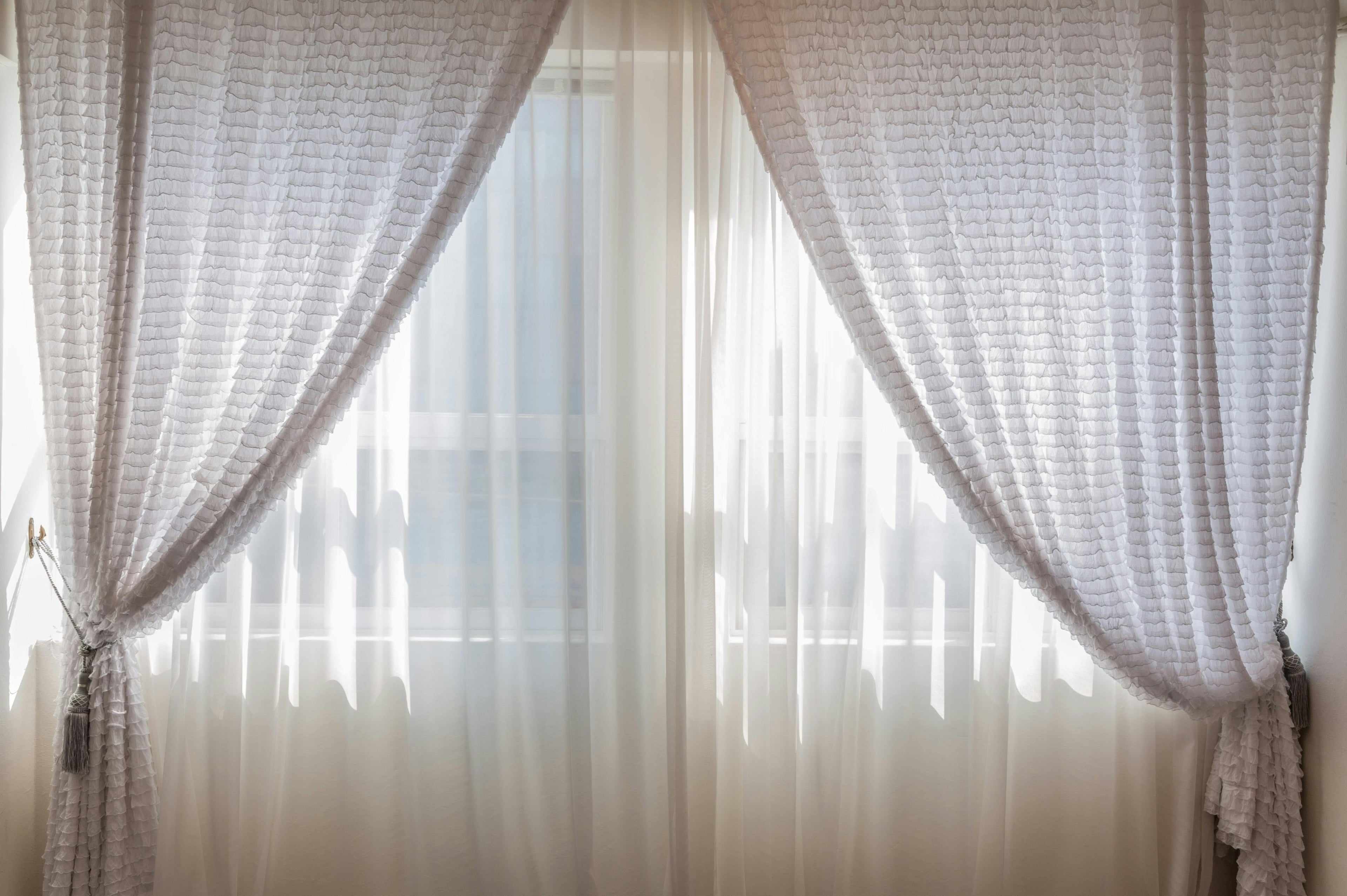
Nothing rivals textiles for bringing warmth, texture, and movement to a fixed window. The combination of sheer curtain + curtain remains a safe bet, offering absolute versatility.
The sheer curtain, in fine linen, airy cotton, or polyester, plays a crucial role. It diffuses natural light, creating a soft, subdued ambiance, while preserving a certain level of daytime privacy. For a fixed window, opt for sheers mounted on a slim rod or a grommet bar, and let them fall from top to bottom without interference for an elegant, fluid effect.
The double curtain serves as a complement. For the opaque layer, current trends favor noble materials and clean cuts. Linens (linen-cotton blends) with generous folds, corduroy velvets for a cocooning touch, or technical flame-retardant and UV-resistant fabrics for very sunny rooms are perfect. The trick to not overwhelm the window? Choose a generous fabric width (at least 1.5 to 2 times the window width) and install the rod well beyond the frame, up to the ceiling if possible. This adds height to the room and allows the entire window to be revealed when the curtains are open.
Japanese Panels and Room Dividers: The Elegance of Straight Lines
Inspired by traditional shoji screens, sliding Japanese panels are immensely popular for dressing large openings. They are particularly well-suited for wide, modern fixed windows.
This system consists of several textile panels, sliding on a discreet rail fixed to the ceiling or frame. Their great advantage is their modularity. You can open only one section, group them on one side, or close them completely. Available fabrics range from very light voile to opaque fabric, including intermediate materials like linen or fiberglass. The aesthetic is clean, graphic, and integrates perfectly into contemporary, Scandinavian, or minimalist interiors. It is a solution that is both design-oriented and highly functional for dressing a large fixed window without losing modernity.
Adhesive Window Films: A Discreet and Multifunctional Revolution
Sometimes, the best solution is the one that goes unnoticed. Adhesive window films represent an incredibly effective technology for fixed windows. They are applied directly to the glass, like a sticker, and require no mechanism or textile.
Their functions are numerous. "Mirror" or tinted films (gray, bronze, blue) offer total privacy from the outside during the day, while allowing you to see out from the inside. Patterned films (geometric, botanical, frosted) provide permanent decoration and stylized privacy. Finally, and crucially, solar control films reject up to 80% of solar heat and block 99% of UV rays, protecting your furniture and regulating indoor temperature. This is an economical, durable, and surprisingly design-oriented solution for transforming the look of a fixed window.
Shutters and Louvers: The Return of a Classic Revisited
Shutters, whether in wood, PVC, or aluminum, are not reserved for opening windows. For a fixed window, one often opts for a fixed model, without an opening system, or for adjustable louvers mounted in a frame.
Their strength lies in the micrometric control of light and privacy. By tilting the louvers, you can let in light while protecting yourself from prying eyes, or conversely, close them completely. Materials have evolved significantly. Wood (oak, pine, exotic) brings warmth. Lacquered aluminum, available in an infinite range of colors (matte black, anthracite, white, bright colors), offers an industrial or very contemporary look. Shutters can be installed on the perimeter of the window (surface mount) or within the thickness of the wall (recessed mount) for a perfect fit.
Custom Solutions and the Art of Framing
For fixed windows with unusual shapes (arched, triangular, trapezoidal) or very large sizes, custom-made is often the only option. Specialized companies can create blinds or panels perfectly adapted to the geometry of your opening.
At the same time, do not underestimate the power of framing. The treatment of the walls around the fixed window can itself constitute a window treatment. Creating a deep alcove, lining the sides and lintel with paneling, stone, or a textured covering, can highlight the glass like a painting. Installing a banquette or a countertop under a large fixed kitchen window integrates it perfectly into the living space and makes it a pleasant focal point.
Combining Solutions for a Perfect Result
The golden rule for dressing a fixed window with sophistication is often layering. Combining two systems allows you to meet all needs. The most common and effective combination is a solar roller blind (for technical control of light and heat during the day) with thick double curtains (for privacy and a warm ambiance in the evening).
One could also imagine a frosted adhesive film on the lower part of the glass for privacy, complemented by light sheers over the full height to soften the light. Or, opaque Japanese panels on one part of the window, leaving another part free for the view. Let your creativity run free based on the room's use.
FAQ: Most Frequent Questions About Dressing Fixed Windows
How to dress a very large fixed window without it being too costly?
For large surfaces, adhesive films are often the most economical solution. For textiles, opt for light, fluid sheers mounted on a simple rod, which have a moderate cost per meter. Standardized roller blinds in large widths can also be a less expensive option than complex custom-made solutions. Also consider covering only a strategic part of the window (the lower half for privacy) rather than the whole thing.
Can a fixed window have an interior blind without drilling into the wall?
Yes, absolutely. Many systems exist. Roller blinds or Japanese panels can be fixed with high-adhesion adhesive brackets (check the supported load) directly onto the glass or onto the PVC/aluminum/wood frame, without drilling. Tension curtain rods (spring-loaded) that wedge between two walls are also a temporary or lightweight solution. However, for a heavy and durable installation, fixing with wall plugs remains the safest.
What is the best solution for controlling heat on a south-facing picture window?
Combating overheating is essential. A combined approach is excellent. First, a high-performance solar adhesive film will block heat at the source, directly on the glass. In addition, an exterior roller blind (if possible) or an interior one with a light-colored reflective solar fabric will be very effective. Opt for white or silver fabrics that reflect rays, unlike dark fabrics that absorb them.
Can you put curtains on a fixed transom window (very high up)?
Transoms are tricky. Classic curtains would be disproportionate. Turn to integrated solutions: a roller blind recessed into the transom frame itself is ideal. Otherwise, a small surface-mounted blind, or even a decorative adhesive film (geometric or frosted pattern) that lets light through while uniformizing the glass's appearance, are judicious and aesthetic choices.
How to clean a fixed window behind a fixed blind or curtain?
Accessibility is a point to anticipate. For roller blinds, allow enough space between the fabric and the glass to pass your hand with a cloth. Sliding Japanese panels allow easy access to the entire glass surface. For curtains, choose a rod that allows them to be pulled wide away from the wall. In all cases, opt for easily removable window treatments (clip-on fabrics, ring curtains) for occasional deep cleaning.
Trends 2026: Dressing Fixed Windows Becomes an Art
Interior decoration is seeing strong trends emerge for fixed windows. Biophilia translates into large-format botanical pattern fabrics or adhesive films with foliage cutouts. Textured and artisanal materials are popular: unbleached raw linen sheers, bouclé or loose-weave curtains.
Color is making a strong comeback. We dare to use colored fabric roller blinds (terracotta, deep green, teal blue) that become a decorative wall element when rolled up. Smart home technology is becoming widespread, with motorized and connected window treatments that automatically adapt to sunlight. Finally, mixing and matching materials is king: combining the rigidity of a frosted film with the softness of an organic sheer curtain.
Conclusion: Your Fixed Window, A Canvas to Decorate
Dressing a fixed window is much more than a simple matter of practicality. It is an opportunity to play with light, sculpt space, and assert your decorative style. Whether you opt for the technical purity of a motorized roller blind, the poetic warmth of a double linen curtain, the contemporary graphics of Japanese panels, or the discreet innovation of an adhesive film, each solution can enhance this unique opening.
Do not be afraid to combine ideas and personalize. Your fixed window, once perfectly dressed, will no longer be a simple hole in the wall, but the luminous and stylish heart of your room. To discover more inspiration and tailored advice for every room in your home, explore the numerous resources available on ombreinterieur.fr without delay. Discover the product Unique Winter Travel Posters Elegant Wall Decoration for a Warm Ambiance to finalize your decor. Our guide how to integrate a candle in a small 20 m bedroom helps you make the right choice. Find our entire decor universe on Ombre Interieur.
