
















Complete guide to choosing the perfect tablecloth
Laying a cloth on your table is far more than a practical gesture: it shapes the mood of your meals, from everyday suppers to grand celebrations. The choice of fabric, its dimensions and intended use, can transform a simple gathering into a harmonious space of shared warmth. Are you seeking to express your personal style while balancing beauty with everyday ease? This exploration invites you to consider the essential details for dressing your table with precision and grace, where texture and proportion work together to create an inviting atmosphere that never compromises your comfort.
Choosing a tablecloth may seem like a simple act, a mere accessory to cover a table. Yet, this piece of textile decor is far more than just a surface protector. It is a true actor in the scenography of your interior, capable of defining the ambiance of a meal, revealing the style of a room, and transforming the ordinary into the extraordinary. Between everyday meals, Sunday brunches, and festive dinners, the tablecloth is the backdrop against which conviviality plays out. But faced with a multitude of materials, shapes, colors, and patterns available, the choice can quickly become a headache. How do you select the perfect tablecloth that will meet both your practical needs, your aesthetic, and your lifestyle? This article guides you step by step through all the essential criteria, from current trends to care advice, to make your table a harmonious and welcoming space.
Understanding Usage: The First Question to Ask
Even before contemplating colors or fabrics, it is essential to define the primary use of your future tablecloth. This initial consideration will determine all your other choices. A tablecloth for daily use in the kitchen will not have the same requirements as a formal tablecloth for special occasions.
For everyday life, priority will go to practicality and durability. Easy-care materials, such as thick cotton or synthetic blends resistant to stains, are to be preferred. Conversely, for special events, you can allow yourself more delicate and prestigious materials like pure linen, silk, or satin, which bring an immediate touch of elegance.
Also consider the frequency of meals. A family with young children will naturally opt for a machine-washable, even waterproof tablecloth, while a couple without children may turn to more fragile models requiring specific care. By clearly defining the context of use, you immediately eliminate a large portion of unsuitable options.
Dimensions and Shape: The Art of Perfect Dressing
A poorly sized tablecloth can ruin the desired effect. Too small, it gives an impression of stinginess; too large, it seems cumbersome and impractical. The golden rule for a rectangular or square table is to leave an overhang (the part that drapes over the sides) of 25 to 30 centimeters on each side. This allows hiding the table legs while providing comfort for guests.
For a round table or oval table, the ideal overhang is between 25 and 35 centimeters. Always measure your table at its maximum dimensions, especially if it has extensions. Today, many brands offer extendable tablecloths or sets of matching tablecloths in different sizes to fit a modular table.
Choosing the Shape Adapted to Your Table
The shape of the tablecloth should match that of the table. Rectangular or square tablecloths are made for tables with right angles. Round tablecloths perfectly dress round tables, without unsightly folds at the corners. For oval tables, a rectangular tablecloth can work if the angles are sufficiently rounded, but a custom-made oval tablecloth will be the most elegant option.
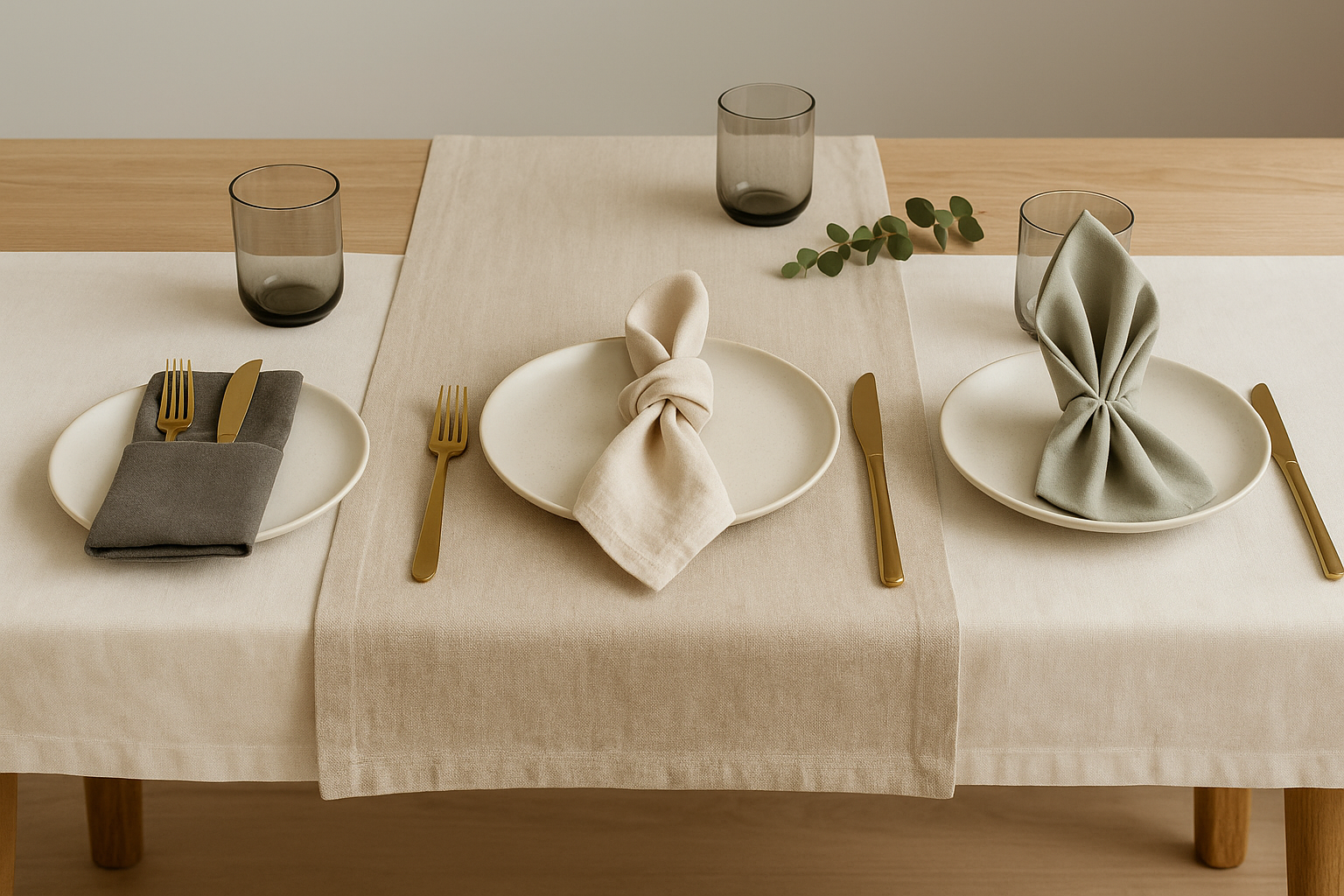
Don't forget so-called "Italian-style" or "runner" tablecloths. They are designed to cover only the center of the table lengthwise, leaving the wood visible on the sides. Very trendy, they bring a relaxed and modern touch, perfect for family lunches or side tables.
The Crucial Choice of Material: Between Aesthetics and Functionality
The material is the heart of the tablecloth. It determines its feel, appearance, durability, and care. Each textile has its personality and advantages.
Cotton is the timeless classic. Versatile, durable, and easy to care for, it suits all uses. Quality cotton (like jacquard, percale, or twill) offers a beautiful drape and good resistance. It comes in multiple finishes, from raw cotton to waxed cotton, very practical for its stain resistance.
Linen is the noble material par excellence. Known for its coolness in summer, its slightly wrinkled appearance gives it an inimitable and relaxed charm. Increasingly popular, linen is also an ecological and durable fiber. It requires a bit more care (ironing with a damp iron) but its aging is beautiful.
Synthetic materials like polyester or blends (cotton-polyester) are safe bets for intensive use. They resist friction and stains well and iron easily, sometimes even needing no ironing for some wrinkle-resistant treated fabrics. They also allow for very vivid pattern prints.
For a festive effect, shiny materials like satin or fabrics with metallic reflections are perfect. Finally, new generations of technical fabrics, such as waterproof and machine washable at 60°C tablecloths, are revolutionizing family daily life, combining design and absolute practicality.
Colors and Patterns: Express Your Style and Create Ambiance
This is where decoration comes into play. The color and pattern of your tablecloth are powerful levers to transform the atmosphere of your dining room or kitchen.
Solid-colored tablecloths offer great freedom. Neutral tones (off-white, ecru, taupe, gray) are timeless basics that go with everything and allow playing with dishes and accessories. Vibrant colors (duck blue, terracotta, emerald green) or pastels, on the other hand, bring a touch of personality and energy.
Patterns tell a story. Stripes, checks (gingham, tartan), and polka dots are classics that transcend eras. Floral patterns, from delicate small prints to large botanical flowers, bring a romantic and spring-like note. Geometric or ethnic patterns (ikat, batik) are perfect for a contemporary or bohemian style.
The current trend is towards personalization and boldness. We no longer hesitate to mix patterns (stripes and flowers) or opt for deep, saturated colors, like navy blue or forest green, even for large tables. The idea is to make the tablecloth a central element of the decor, not just a discreet accessory.
Current Trends in Tablecloths
The world of table decoration is evolving rapidly, influenced by fashion, environmental concerns, and new lifestyles. Several strong trends are currently emerging.
Sustainability and ecology are at the forefront. Consumers are looking for tablecloths made from natural, organic materials (organic cotton, linen) and produced ethically. Linen, whose cultivation requires little water and no pesticides, is particularly popular.
The "handmade" and artisanal style is on the rise. Tablecloths in raw linen, hand-embroidered borders, jacquard woven patterns, or traditional techniques like batik are highly sought after for their authenticity and unique character.
Aesthetically, the return of vintage and 70s patterns is notable. Earthy colors (ochre, mustard, rust), bold geometric patterns, and rich textures are everywhere. Conversely, refined minimalism persists with tablecloths with structured finishes, beige tones, and very graphic contrasting hems.
Finally, multifunctionality is key. Tablecloths that also serve as picnic blankets, reversible models (two looks in one), or tablecloths accompanied by matching napkin sets are very successful, meeting a need for flexibility and practicality.
Care: An Essential Criterion for Longevity
A beautiful tablecloth must remain so over time. Care instructions must therefore be considered from the moment of purchase, otherwise your investment may deteriorate quickly.
Always check the care label. Most cotton and linen tablecloths can be machine washed at 30° or 40°C, with moderate spin. It is recommended to wash them before first use to remove the finish and allow the fabric to shrink slightly if needed.
For stains, act quickly. A red wine, oil, or grease stain should be pretreated immediately with an appropriate stain remover or Marseille soap before washing. For white tablecloths, soaking in hot water with washing soda crystals can work wonders.
Ironing is often the most dreaded step. For linen, iron it slightly damp, on the reverse side, with a very hot iron. Cotton irons more easily at medium temperature. A little tip: don't let the tablecloth dry completely on the rack, remove it while still a bit damp to make ironing easier.
For storage, avoid folding the tablecloth always in the same places to avoid marking the fabric. Instead, roll it around a cardboard tube or hang it on a suitable hanger. Store it in a dry place, away from direct light to prevent yellowing, especially for whites.
Accessorizing and Composing Your Table
A tablecloth does not live alone. Its harmony with the rest of the table decoration is paramount. The interplay of associations creates the final ambiance.
With a heavily patterned tablecloth, opt for plain and clean tableware. Conversely, a solid-colored tablecloth allows you to bring out your patterned or colored plates. Cutlery, glasses, and napkins should complement the whole without overloading it.
Runners (long, narrow strips of fabric) and individual placemats are excellent complements. Placed on a solid-colored tablecloth, they add a touch of color or texture. On a bare wood table, a central runner may be enough to dress the space for a casual meal.
Don't forget the centerpiece. A low bouquet, candles, a composition of fruits, or decorative objects crown the setting. The important thing is to maintain a certain stylistic coherence (rustic, modern, romantic) among all the elements.
FAQ: The Most Frequent Questions About Choosing a Tablecloth
What is the best material for a tablecloth used every day?
For intensive daily use, thick quality cotton (like jacquard or percale) or a cotton-polyester blend is ideal. These materials are resistant to friction, machine washable at high temperatures, and withstand ironing well. New technical waterproof fabric tablecloths are also an excellent option for families with young children, offering maximum protection without sacrificing aesthetics.
How can I prevent my white tablecloth from yellowing over time?
Yellowing is often due to exposure to light, poor detergent, or insufficient rinsing. To avoid it, wash your white tablecloths with a detergent suitable for whites, avoid fabric softener which can leave a film on the fibers, and ensure good rinsing. Always store them away from light in a dry place. To restore shine to a dull white, a soak with sodium percarbonate (hot water + product) is very effective.
Can you put a rectangular tablecloth on a round table?
Technically, it's possible, but rarely aesthetic. A rectangular tablecloth on a round table will create unsightly folds and a surplus of fabric in a triangular shape at each corner, which can bother guests. The ideal is always to choose a tablecloth whose shape matches that of the table. For a round table, prefer a round tablecloth or, at a pinch, a square tablecloth if the table is of small diameter.
What size tablecloth for a table with extensions?
This is a common situation. The simplest solution is to measure your table in its largest configuration (with all extensions out) and choose a tablecloth to those dimensions. If you use the table more often without extensions, you can opt for two tablecloths: one for the standard size and a larger one for occasions. Some retailers also offer extendable tablecloths with ingenious strap or button systems to adapt to different sizes.
Are linen tablecloths really that difficult to care for?
Linen has a reputation as a delicate fabric, but it is somewhat exaggerated. Modern quality linen is often machine washable at 40°C. Its naturally wrinkled appearance is part of its charm, which saves you from perfect ironing (a simple smoothing with a warm iron on the reverse side may suffice). Its great advantage is that it does not pill, becomes softer with each wash, and is hypoallergenic. With simple steps, a linen tablecloth can last for decades.
Conclusion: Your Table, the Reflection of Your Art of Living
Choosing a tablecloth is much more than a utilitarian purchase; it is an act of decoration that engages the personality of your interior. By reviewing usage, dimensions, material, colors, and trends, you give yourself the keys to making an informed and lasting choice. Remember that the table is the heart of the home, the place for exchanges, laughter, and sharing. The tablecloth you spread on it is its first message, an invitation to sit down and enjoy the present moment. Whether it's in wrinkled linen for a sunny lunch, waxed cotton for a joyful snack with the children, or satin for a festive evening, it helps create memories. To discover an inspiring selection of tablecloths and accessories that will dress your tables for all occasions, feel free to explore the universes and advice available on ombreinterieur.fr. Fall in love with the Fringed Jacquard Blend Tablecloth for an Elegant Table, a real plus for your interior. Check out our article how to choose a poster for a hallway in a chic country style to go further. Discover our entire decor universe on Ombre Interieur.
