















How to make hidden tab top curtains
The art of hanging is often what separates a polished interior from a purely functional setup. With hidden-tab curtains, you achieve a finish of rare precision, where the eye glides over the fabric uninterrupted by hooks or rings. This technique, favoured by decorators, enhances the drape and lends your windows a discreet, almost architectural elegance. To master this precise gesture and give your room a bespoke look, let the essential steps guide you in transforming a sewing project into a true decorative signature.
In the world of interior decoration, details make all the difference between an ordinary interior and a space that exudes true elegance. Among these details, the way curtains are hung plays a major role. Curtains with hidden tabs represent the archetype of a neat and discreet finish, offering a perfectly clean line and a seamless integration into the room's architecture. This technique, which involves concealing the fixing tabs (or hooks) behind the fabric, is much more than a simple installation trick; it is a confident aesthetic choice that elevates the window and the entire decor. If you aspire to a custom, streamlined, and professional look, mastering the creation of curtains with hidden tabs is a valuable skill. This article guides you step by step, from technical prerequisites to the most refined finishes, to transform your windows with decorator expertise.
Understanding the principle and advantages of hidden tabs
Before embarking on the making, it is essential to grasp the principle of curtains with hidden tabs. Unlike a classic installation where hooks or rings are visible on the front of the curtain, this method conceals them behind the heading. The curtain is thus hung from the back, creating the illusion that it floats freely along the rod or track. This approach offers undeniable advantages.
Aesthetically, it provides a perfectly clean suspension line, without visual interruption. The eye is drawn to the beauty of the fabric, its natural folds (the drape), and the elegant silhouette of the whole, rather than the hanging system. It is the hallmark of high-end interiors and carefully crafted decoration projects. From a practical standpoint, this technique often allows for smoother gliding along the rod, as the tabs are guided precisely. It is particularly suitable for lined curtains or thick fabrics, where the curtain heading needs to be reinforced and structured.
Essential materials for successful curtains with hidden tabs
The success of your project depends on choosing the right materials. Do not skimp on quality, as they guarantee the hold, durability, and professional finish of your curtains with hidden tabs.
The suspension system: rod or track?
The choice between a rod and a track is paramount. For curtains with hidden tabs, the track is often preferred by professionals. Discreet, it attaches to the ceiling or wall and allows for precise and robust hanging, ideal for heavy curtains. Tracks can be equipped with specific gliders for hidden tabs. Rods, on the other hand, add a more decorative touch. In this case, opt for slim rods (like tension cables or metal rods) and ensure that the hooks or gliders you choose are compatible with the rod's diameter and the hidden fixing method.
Specific tabs and hooks
This is the key element. There are so-called "clip" or "pinch" hooks specifically designed for hidden tabs. They generally consist of a part that attaches to the track glider and a clip that firmly grips the reinforcement band at the back of the curtain. Their particularity is that they are completely concealed once the curtain is in place. Make sure to buy enough (one hook every 10 to 15 cm is a good average for a beautiful drape).
Fabric and sewing supplies
Choose a fabric suitable for the room's function (linen for a natural ambiance, velvet for a cozy and soundproofing effect, technical fabric for total blackout). Plan the necessary width: generally allow 1.5 to 2.5 times the width of your track for generous pleating. You will also need a reinforcement band for the curtain heading (pleater tape or rigid fusible interfacing), matching thread, pins, and ideally, an iron.
Calculating dimensions and cutting the fabric precisely
This step is crucial. A measurement error can compromise the entire project. For curtains with hidden tabs, the calculations are slightly different from a standard installation.
Start by measuring the desired length, from the hanging point (the top of the hook on the track) to where you want the curtain to end (on the floor, slightly floating, or on the windowsill). This is the finished length. To this measurement, you must add the hem allowance for the bottom (usually 10 to 15 cm) and the allowance for the curtain heading. For the heading, the addition depends on the reinforcement band used. With a standard pleater tape, add approximately 8 to 10 cm. The goal is that the band, once sewn and folded, sits entirely behind the curtain, invisible from the front.
For the width, multiply the width of your track by the pleating coefficient (1.5 for a light pleat, 2 for a standard pleat, 2.5 for a very generous pleat). Do not forget to add the side seam allowances (2 to 3 cm on each side). Cut your fabric carefully, ensuring the selvedges (woven edges) are straight and parallel.
Step-by-step making: from hemming to the curtain heading
Now it's time for the making. Follow these steps in order for an impeccable result.
Preparing and sewing the sides (the selvedges)
Start by treating the vertical sides of the curtain. Fold the seam allowance (1.5 cm) over to the wrong side of the fabric and press. Fold this allowance a second time over itself to enclose the raw edge, and press again. Then machine stitch all the way along, close to the inner edge of the fold. This technique, called a "rolled hem" or double hem, ensures a neat and durable finish.
Making the bottom hem
The bottom hem gives weight and structure to the curtain. For a professional result, proceed step by step. On the wrong side, first fold up 2 to 3 cm from the bottom and press. Then, fold up a second time the desired hem height (e.g., 10 cm). Pin and press carefully. For an invisible finish on the right side, you can sew this hem by hand with a blind stitch (slip stitch). For time-saving and good hold, a machine stitch near the top edge of the hem is also perfectly acceptable.
Creating the curtain heading for hidden tabs: the key to success
Here is the heart of the technique for curtains with hidden tabs. On the wrong side of the top of the curtain, fold the planned allowance (e.g., 8 cm) down and press well. This space will house the reinforcement band. Position your pleater tape or rigid fusible interfacing inside this fold, aligning its top edge with the folded edge of the fabric. The band should be centered, and its eyelets or hook markers should be facing downwards (towards the bottom of the curtain).
Pin or baste to hold everything in place. On the right side of the curtain, stitch along the bottom of this created "pocket", 1 to 2 mm from the edge, to secure the fabric and the band. This stitching will be visible on the right side, but it will be perfectly straight and discreet. Then, on the wrong side, stitch along the top edge of the band to fix it permanently. You thus obtain a reinforced curtain heading, with a row of hidden pockets or eyelets at the back.
Installing the hooks and hanging the curtains
The finish is near. Turn your curtain to the wrong side. Carefully insert the specific "hidden tab" hooks into the pockets or eyelets of the reinforcement band. Follow the manufacturer's instructions: generally, the hook's clip attaches to the band, while the hanging part remains outside. Space the hooks regularly, every 10 to 15 cm, for harmonious pleating. Place a hook at each end of the band.
Once all hooks are in place, gently hang them onto the gliders of the track or rod. The curtain should now hang in front of the hooks, completely masking them. Adjust the distribution of the pleats by slightly moving the gliders. Let the curtain hang for a few days so the fabric stretches and natural folds form before making any final hem adjustments.
Current trends and style ideas
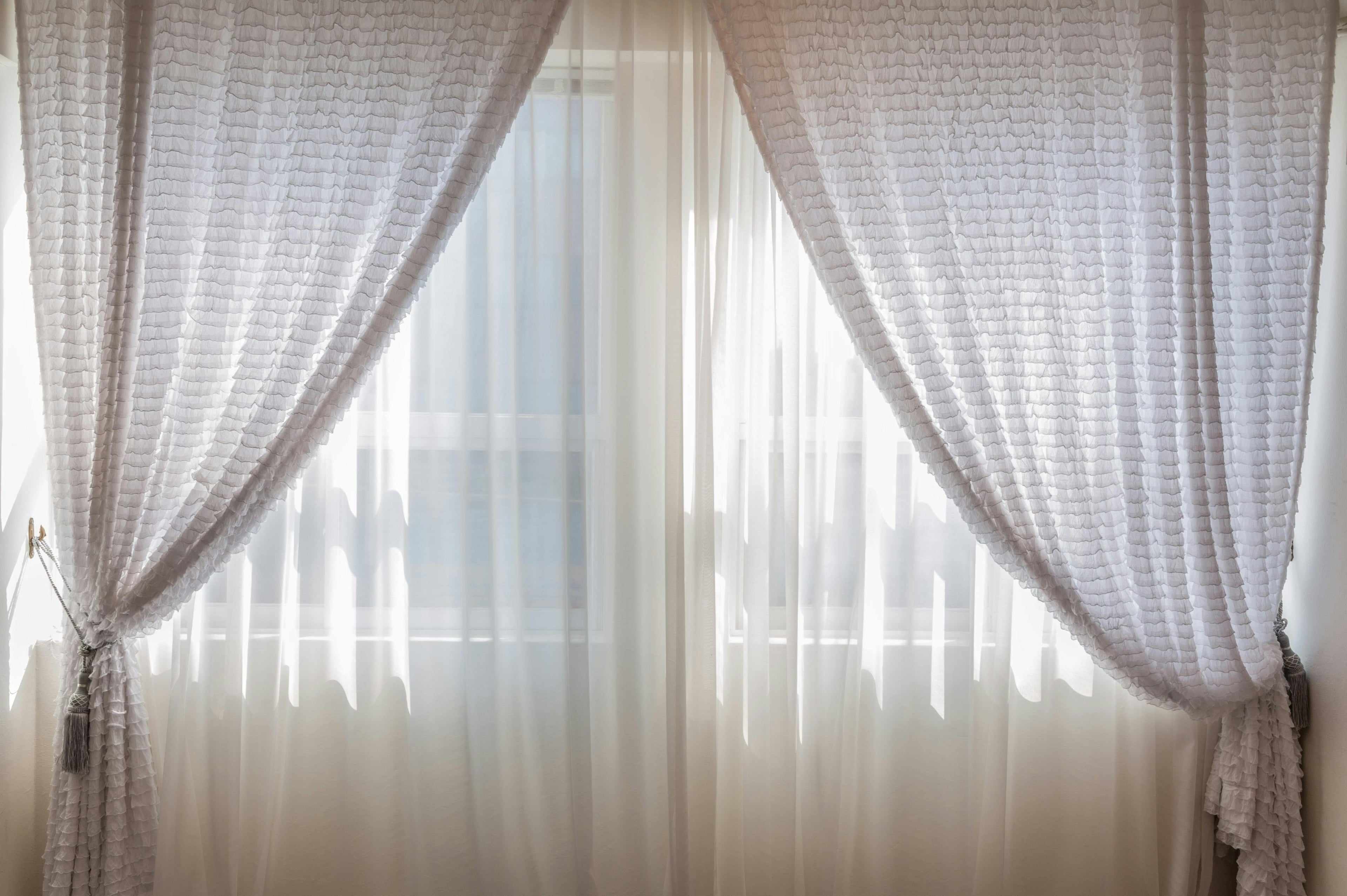
Curtains with hidden tabs adapt to all decorative styles, from the most classic to the most contemporary. The current trend leans towards minimalism and texture. They are seen adorning large bay windows with light and transparent linens, creating a refined play of light and shadow. In Scandinavian interiors, thick linen fabrics in neutral colors, suspended by this discreet system, reinforce the impression of calm and serenity.
For a more dramatic and theatrical style, opt for opaque and deep velvets, such as cotton or linen velvet. Curtains with hidden tabs here allow highlighting the richness of the material without distraction. Another strong trend is the use of double curtains: a sheer curtain with hidden tabs to filter light, paired with a blackout curtain, also with hidden tabs, on the same rod or a double track. This adds depth and great versatility in controlling privacy and light.
Pro tips for a perfect result
- Iron at every step: Careful ironing after each fold and before each seam is the secret to a neat and professional finish.
- Test the system: Before sewing the curtain heading, do a test with a piece of fabric and a hook to check the necessary fold depth and ease of hanging.
- Consider lining: To improve thermal and acoustic insulation, and protect the main fabric from UV rays, consider lining your curtains. The hidden tab technique works very well with lined curtains; simply treat both fabric layers as one when creating the heading.
- Use a level: To install your track or rod, a laser or spirit level is essential to guarantee perfect horizontality, especially over large widths.
FAQ: Answers to common questions about curtains with hidden tabs
Are curtains with hidden tabs suitable for all types of rods?
They are primarily designed to work with glider tracks or very slim rods (cable or rod type). Decorative rods with visible rings are not compatible with this technique, as the principle is precisely to conceal the hanging system. Always check the compatibility of the "hidden tab" hooks with your suspension system before purchasing.
Can curtains with hidden tabs be made without pleater tape?
Yes, it is possible but less easy. An alternative is to create a simple pocket in the curtain heading and insert a thin plastic or metal rod to stiffen it, then make eyelets by hand or with a pliers tool. However, pleater tape or fusible interfacing is highly recommended as it is designed for this purpose, offers regular hook distribution, and optimal hold over time.
Is this technique suitable for very heavy curtains?
Absolutely. This is even one of its strengths. The reinforcement band distributes the weight evenly across the entire width of the curtain. The key is to choose a suspension system (track and gliders) and hooks suitable for heavy-duty use and high weight. Opt for aluminum tracks and ball-bearing gliders for smooth operation.
How to maintain and wash curtains with hidden tabs?
Maintenance depends on the fabric. For most, regular dusting with a vacuum cleaner using a soft brush is sufficient. If washing is necessary, you will generally need to carefully remove all hooks. Check if the reinforcement band is removable (some are sewn in, others held by snaps). Follow the fabric's washing instructions (dry clean for silk or wool, gentle machine wash for cotton or linen). Iron carefully after washing before reinstalling the hooks.
What is the difference with a curtain with hidden eyelets?
The principle is very similar, and the two terms are often used interchangeably. Technically, "hidden eyelets" refer to a curtain heading where metal or plastic eyelets are installed on the reinforcement band, but always at the back of the curtain. "Hidden tabs" use a clip hook system. The visual result is identical: a curtain suspended without any visible element on its front face.
Conclusion: The discreet elegance of technical mastery
Making curtains with hidden tabs is within the reach of any sewing and decoration enthusiast willing to follow precise steps. This project, more demanding than a standard installation, offers immense satisfaction and radically transforms the perception of a room. It combines the beauty of a perfect drape with the intelligence of a discreet installation, highlighting the fabric and architecture without compromise. By mastering this technique, you give yourself the freedom to create custom curtains that perfectly meet your aesthetic and functional desires. To discover more inspiration, detailed tutorials, and expert advice for every room in your home, feel free to explore the other resources available on ombreinterieur.fr. Your interior deserves this touch of excellence. Our guide how to hang curtains helps you make the right choice. Visit ombreinterieur.fr to explore the full catalog.
```