















How to Make Wave Curtains: Complete Guide
The fluid rhythm of a window dressed in regular, graceful folds, like gentle waves, transforms the atmosphere of a room. This contemporary style, both clean and sophisticated, demands precise technique to reveal its full elegance. Would you like to master this art? From selecting the right track to sewing the correct hem, every step matters for a professional finish. Let us guide you in creating your own wave curtains, a project that marries design with craftsmanship to elevate your interior.
In the world of interior decoration, curtains are no longer just about hiding or dressing a window. They have become a design element in their own right, capable of defining the atmosphere of a room. Among the most sought-after styles for their timeless elegance and remarkable fluidity, wave curtains stand out. This hanging technique, characterized by its regular and graceful folds that evoke waves, brings a touch of sophistication and modernity to any interior. If you aspire to transform your openings with a clean and structured aesthetic, learning how to make wave curtains is an exciting project. This article guides you step by step, from the fundamentals of the system to installation tips, exploring current trends so you can master this art and create an exceptional interior.
Understanding the essence of wave curtains: much more than a simple curtain
Before embarking on the creation, it is crucial to grasp what defines a wave curtain. Unlike classic curtains that slide on a rod, wave curtains use a specific track system and specially prepared fabric. The secret lies in the combination of a rack track and "wave" hooks that insert into it. These hooks, evenly spaced, force the fabric to create permanent and harmonious vertical folds, even when the curtain is closed.
The result is a cascade of soft and regular folds, offering a neat and designer look. This system is particularly appreciated for its silent and smooth operation, as well as its ability to optimize space, as the curtain folds back on itself compactly. It is the ideal choice for large bay windows, contemporary rooms, or simply for those seeking a high-end finish.
Essential materials for creating your wave curtains
The success of your project depends on choosing the right elements. Here is the exhaustive list of materials needed to make wave curtains.
The wave track system
This is the centerpiece. There are several renowned brands like Silent Gliss, Glem, or Hüppe, which offer complete systems. The kit typically includes the track (to be fixed to the ceiling or wall), the control carriage, specific "wave" hooks, and mounting brackets. Ensure the track length covers at least the width of your window, with a recommended overhang of 20 to 30 cm on each side for optimal effect and to effectively block light.
The fabric and its specific hem
The fabric must be suitable. The particularity of wave curtains lies in their top hem. Instead of a simple reinforcement band or an eyelet hem, the top of the curtain must feature a specific fabric band, often called a "wave band" or "wave tape." This band, sewn to the back of the curtain, has reinforced eyelets spaced precisely (usually every 8.5 cm or 10 cm) into which the hooks will clip. You can purchase fabric with this band already integrated or sew it yourself.
Installation and sewing tools
For installing the track, you will need a spirit level, a tape measure, a pencil, a drill/driver, and wall plugs suitable for your support (wall, ceiling, or concrete). For making the curtain, a sturdy sewing machine, quality scissors, matching thread, and a tailor's ruler are essential.
Calculating dimensions: the key to a perfect wave
Precision in measurements is the most critical step for successful wave curtains. A calculation error can compromise the effect of regular waves.
Curtain width (W)
It is calculated based on the width of your track. The golden rule is to use a multiplication factor, called "fullness." For a generous wave effect and well-formed folds, the track length is generally multiplied by a factor between 2 and 2.5. For example, for a 3-meter wide track: 3 m x 2.5 = 7.5 meters of fabric in width. This fullness is crucial for creating the folds.
Curtain height (H)
Measure the height between the bottom of the track (or the ceiling if the track is surface-mounted) and where you want the curtain to end (on the floor, slightly floating, or above the radiator). Add to this measurement the allowance for the top hem (already included if you have a wave tape band) and the bottom hem (usually 10 to 15 cm). A curtain that brushes the floor or has a slight "puddle" (1 to 2 cm resting on the floor) is very trendy.
Step by step: making the wave curtain
Once the fabric is cut to the correct dimensions, it's time for sewing. Follow this meticulous guide.
Step 1: Prepare and join the fabric widths. If your fabric width requires joining several widths, do so carefully. Place the widths right sides together and sew a straight seam. Open the seams and press them flat with an iron for a neat finish.
Step 2: Create the side hems. Fold the fabric edge over once, then a second time on the wrong side (1.5 cm to 2 cm each time) and machine stitch. Repeat on the other side. These clean hems will give structure to the curtain.
Step 3: Create the bottom hem. For a perfect heavy and draping effect, the bottom hem should be wide. First, fold 3 to 4 cm over to the wrong side, then a second time 10 to 12 cm. Pin and stitch all the way along. For an ultra-professional finish, you can insert a weighting rod into the hem pocket.
Step 4: Prepare and attach the wave band. This is the most technical step. If your fabric does not have the integrated band, purchase a separate wave tape band. Position it on the wrong side of the top of the curtain, perfectly aligning the top edge. Sew it following the guide lines provided on the band. Carefully follow the manufacturer's instructions regarding the spacing of the future hooks.
Installing the track system: sturdiness and alignment
A poorly installed track would ruin all the sewing work. Take your time with this installation.
Start by marking the location of your track with a pencil, systematically using a spirit level to ensure perfect alignment. Whether fixing to the wall or ceiling, a straight line is imperative. Drill at the marked locations, insert the wall plugs, and securely screw in the mounting brackets. Then, clip the track onto these brackets. Most modern systems allow for easy clipping. Check the sturdiness of the assembly before proceeding to hang the fabric.
Hanging the curtain and forming the waves
The magical moment arrives. Get the hooks provided with your system. They often come as small, hard plastic hooks. Insert them one by one into the reinforced eyelets of the wave tape, respecting the recommended spacing. Once all hooks are in place, carefully attach each hook to the track carriage, starting from one end.
Let the curtain hang freely for 24 to 48 hours. This "resting" period is essential so that the fabric, especially if it is heavy like thick linen or velvet, stretches and the folds begin to form naturally under their own weight. After this time, you can help regularize the waves by adjusting them manually so they are all the same width.
Current trends and decorative inspiration for your wave curtains
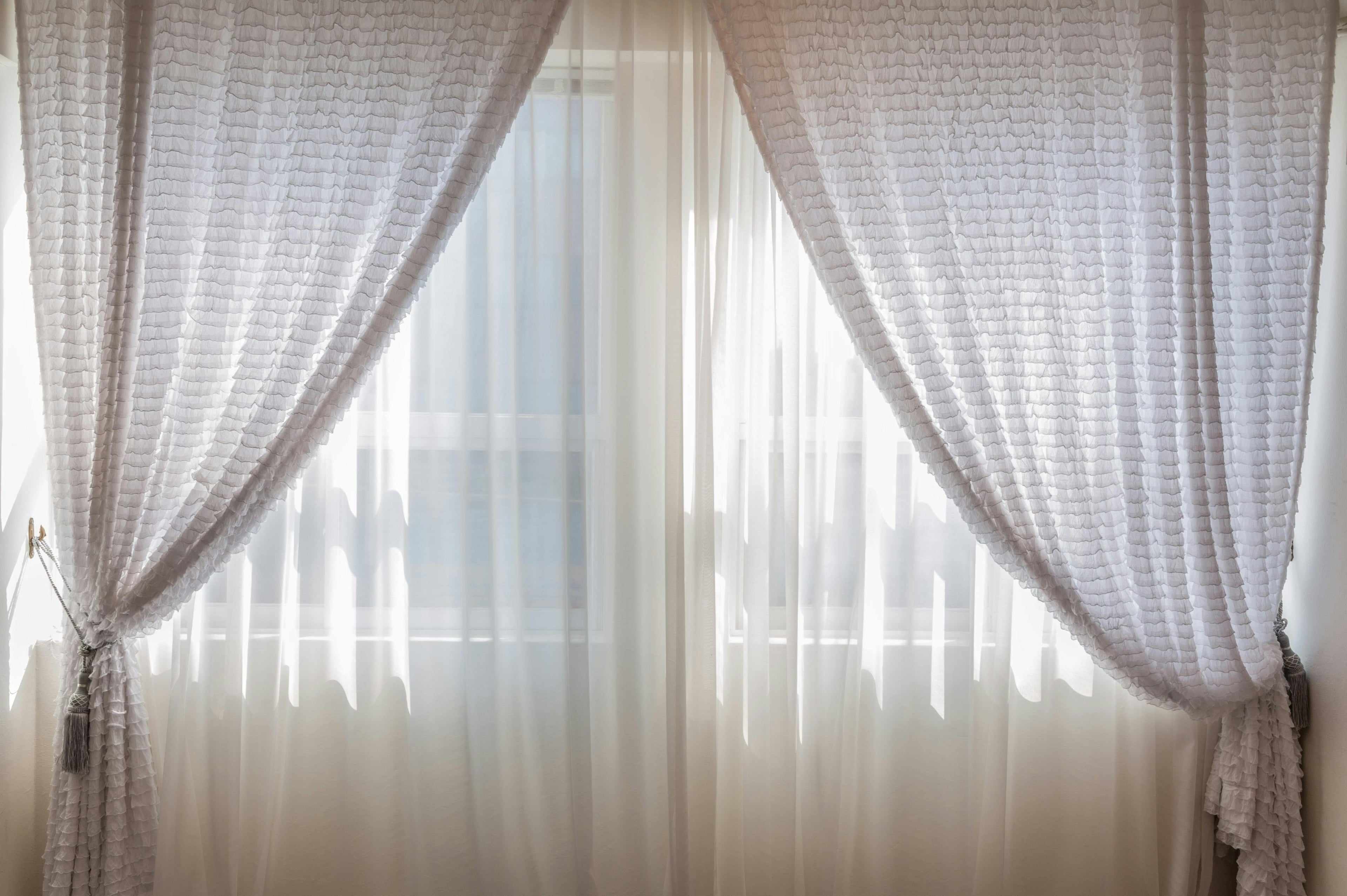
Wave curtains adapt to all trends. Currently, they are often seen in natural and textured materials. Linen, in all its forms (ecru, greige, raw), brings an organic and warm touch, perfect for a clean Scandinavian style or a bohemian chic interior. Sheer wave curtains are also a strong trend, creating an airy and luminous room divider without completely blocking the view.
In terms of colors, earthy tones (terracotta, sage green, deep beige) and neutrals remain safe bets. For a stronger impact, don't hesitate to choose a colored velvet wave curtain (midnight blue, emerald green) in a living room for a cinematic effect. The "monochrome" trend is also very suitable: choosing a fabric in the same tone as the walls, but in a different texture, for a subtle and elegant effect.
Advantages and precautions for wave curtains
Like any system, wave curtains have undeniable advantages but require some precautions.
Their advantages are numerous: high-end and structured aesthetics, silent and smooth operation, space-saving on the sides, and always perfect folds without needing adjustment. They are also very suitable for large widths and heavy curtains.
In terms of precautions, the cost is generally higher than for a classic system (specific track and fabric). The sewing requires more precision, and cleaning can be a bit more restrictive as all hooks must be removed. It is often recommended to call a professional for installing the track on very long lengths or very high ceilings.
FAQ: Answers to your questions about wave curtains
This section answers the most common questions when wanting to make wave curtains.
Can existing curtains be transformed into wave curtains?
Yes, it is possible, but under certain conditions. The fabric must be wide enough (with the required fullness) and in good condition. The main operation will involve unpicking the existing top hem (glide tape, eyelets) and sewing a new wave tape band to the exact dimensions of your track. It is often simpler to make a new curtain, but transformation can be a good option for a fabric you are particularly attached to.
What fabric should I choose for a successful wave effect?
Fabrics with good body and some weight give the best results. Linen, thick cotton, velvet, wool-cotton blends, and certain fluid synthetics like quality polyester are perfect. Avoid very light and thin fabrics (like very light chiffon) which will not have the necessary structure to form and maintain crisp folds, unless you are looking for a more airy and less structured effect.
How to maintain and clean a wave curtain?
Routine maintenance is done with a vacuum cleaner fitted with a soft brush to remove dust. For washing, always check the fabric label. Most fabrics suitable for wave curtains tolerate dry cleaning, which is recommended to preserve the shape and finishes. If hand or machine washing is allowed, carefully remove all hooks, wash the curtain cold without strong spinning, and iron it at a low temperature before rehanging, allowing it to rest again to reform the folds.
Is the wave system compatible with all types of windows?
Absolutely. This is one of its great advantages. It adapts to classic windows, bay windows, French doors, and even skylights (with an adapted track). It can be fixed to the wall, ceiling, or surface-mounted. For corners, there are curved tracks that allow you to perfectly dress a corner window or a curved bay, offering a custom and aesthetic solution.
What is the difference between a wave curtain and a pencil pleat curtain?
These are two systems of permanent folds, but their mechanism and appearance differ. The wave curtain uses a track and specific hooks creating soft and continuous folds, like "waves." The pencil pleat curtain, on the other hand, typically uses a rod and hooks that form individual, tighter, and straighter folds, resembling the shape of a pencil. The wave offers a more fluid and organic look, while the pencil pleat is more formal and structured. The wave system is also often more discreet once the curtain is open.
Conclusion: Dare the structured elegance of waves
Learning how to make wave curtains opens the door to a world of refined and contemporary decoration. Although the project requires precision and an initial investment, the result is well worth it. Perfect folds that dress your windows with grace, optimal functionality, and an undeniable touch of elegance: wave curtains transform an ordinary room into an exceptional space. Whether you are a seasoned DIYer or prefer to call a professional for installation, the "wow" effect is guaranteed.
Don't hesitate to play with materials, colors, and lengths to personalize your creation. To discover more inspiration, detailed tutorials, and expert advice on decorating your home, explore the other articles and comprehensive guides available on ombreinterieur.fr. Your home deserves this touch of design that makes all the difference. Need practical advice? Read how to uncrease blackout curtains. Visit ombreinterieur.fr to explore the full catalog.
