















How to Dress an Angled Window: Complete Guide 2026
Your angled window, with its multi-directional light and broken sightlines, is far more than a technical challenge: it is a deliberate architectural statement. Dressing it without diminishing its character, however, requires a thoughtful approach. This feature explores bespoke solutions – curved tracks, adapted blinds, fluid fabrics – that turn the difficulty into a decorative asset. You will learn to balance aesthetics, privacy and light control to enhance this singular opening. Let us guide you towards a window treatment that unlocks the full potential of your space.
Corner windows, those architectural openings that break the linearity of walls, are both a blessing and a challenge in interior decoration. They flood the space with multidirectional light, create captivating shadow plays, and offer unique panoramic views. Yet, knowing how to dress a corner window can seem like a puzzle. How can you reconcile aesthetics, functionality, and light management without sacrificing the original charm of this singularity? This article is your comprehensive guide to transforming this unique feature into a major asset for your decor. We will explore custom solutions, current trends, mistakes to avoid, and tips for every room in the house.
Understanding the specifics of a corner window
Before choosing a treatment, it is crucial to analyze the characteristics of your opening. A corner window is formed by the meeting of two perpendicular glazed walls or at an angle other than 180 degrees. This configuration generates exceptional brightness but poses technical questions for installing blinds or curtains.
The most common angle is 90 degrees, typical of bay windows or contemporary constructions. The orientation (south, southwest for maximum sunlight, north for cool light) will greatly influence the choice of materials for thermal management and privacy. Finally, you must consider the structure: is there a wall between the two panes (a solid angle) or do the panes meet directly (a glazed angle)? This distinction is fundamental for choosing the systems.
Custom solutions: the key to successful dressing
To dress a corner window with elegance and precision, custom-made is not a luxury, but often a necessity. It allows you to perfectly match the complex geometry of the opening.
Custom blinds
Blinds are excellent allies for their modernity and efficiency. Roller blinds or vertical blinds can be designed with a curved rail system at the exact angle of your window, allowing smooth movement and perfect light blocking. Custom-made Venetian blinds (aluminum, wood, or faux wood) also adapt very well, offering precise control of light.
Curtains on a curved track
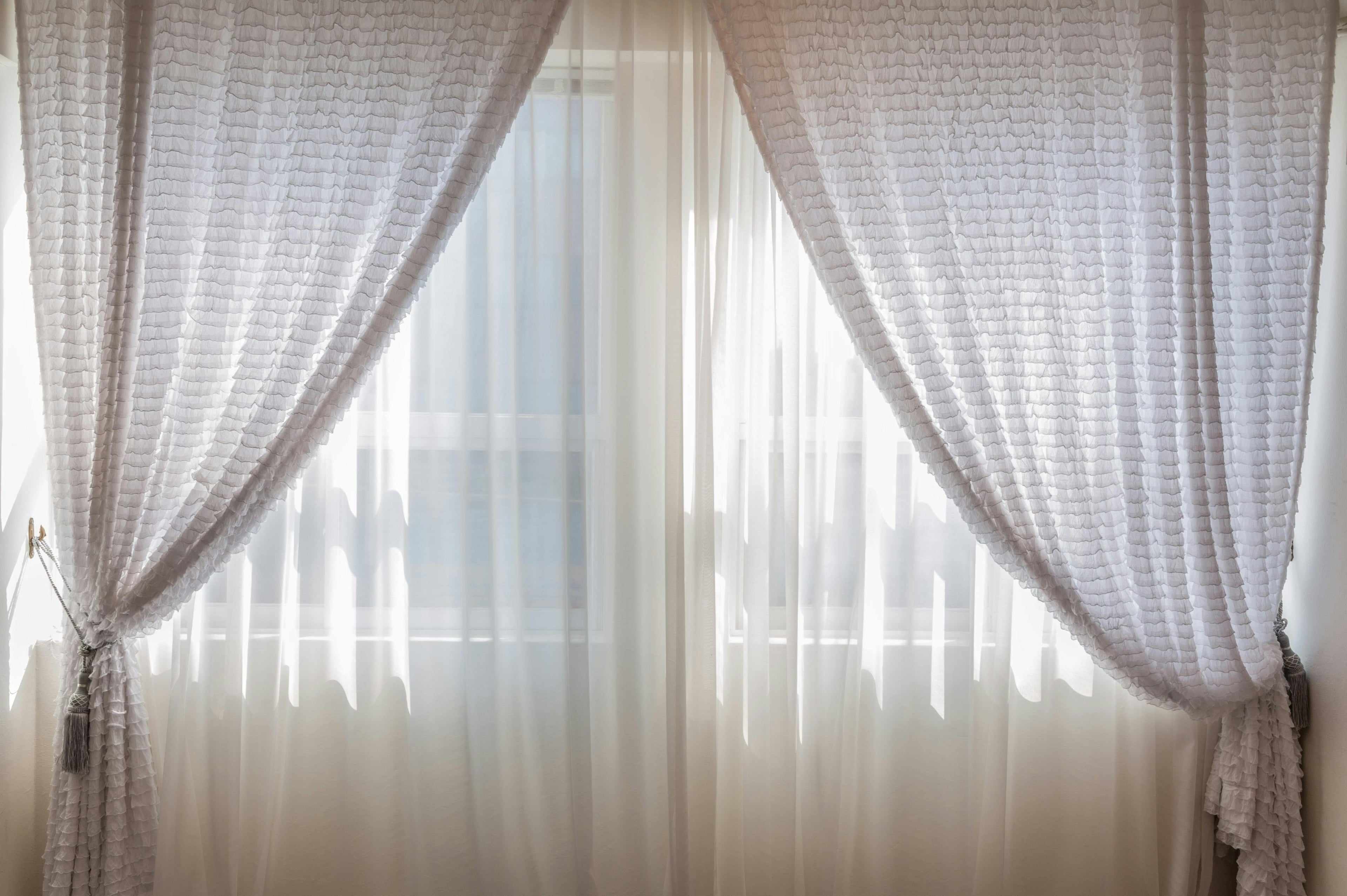
This is the premier solution for a flexible and aesthetic dressing. A curved curtain track, fixed to the ceiling or wall, precisely follows the angle of the window. You can then slide a single large panel of fabric along the entire length, creating a continuous and spectacular draped effect. Choose fluid fabrics like linen, voile, or silk for a graceful movement.
Soft treatments: curtains and sheers
Fabrics bring warmth, texture, and an incomparable feeling of softness. For a corner window, several approaches are possible.
The symmetrical option consists of treating each pane as a separate entity. Place a curtain on each side of each window, with aligned rods or tracks. This method is ideal if you want to be able to open each window independently. For a more unified effect, choose identical curtains in fabric and color.
The continuous drape option, mentioned earlier with the curved track, is the most spectacular. It transforms the corner window into a true architectural scene. A large fixed sheer along the entire length, paired with heavy opaque curtains on the same curved track, allows you to modulate light and privacy with great theatricality.
The choice of fabric is paramount. For very sunny rooms, opt for UV-treated fabrics or thermal linings that protect furniture and regulate temperature. Current trends favor natural materials (linen, thick cotton, jute) and earthy tones (ochre, terracotta, sage green) or, conversely, off-whites and neutrals to maximize light reflection.
Rigid treatments: shutters and louvered blinds
For a more structured, traditional, or contemporary style, wood or composite solutions are excellent. Hinged or louvered shutters can be custom-made for each pane of the corner window. They fit perfectly into the recess, offering optimal insulation, enhanced security, and total privacy control.
Interior louvered blinds, fixed or sliding, add a touch of interior architecture. Painted the same color as the walls or woodwork, they seem to be an integral part of the house's structure. This is a particularly elegant solution for Scandinavian, industrial, or Mediterranean styles.
Innovative materials like lacquered aluminum, composites imitating oak or walnut, or colored lacquered MDF panels allow adaptation to all decoration styles, from the most classic to the most avant-garde.
Managing light and privacy with subtlety
Dressing a corner window does not necessarily mean masking it. It's about playing with light. For rooms where modesty is required (bedroom, bathroom), a double layer is often the ideal solution: a sheer or light blind to filter light during the day, and a blackout curtain or blackout blind for the night.
Adhesive window films are a discreet and modern alternative. They come in tinted, frosted (for a frosted effect), or even decorative versions with patterns. They preserve the view while guaranteeing privacy and filtering UV rays. For very exposed angles, this is a solution not to be overlooked.
Finally, consider the orientation of the blinds. Venetian blinds with slats that can be angled towards the ceiling reflect light upwards, diffusing a soft, indirect light into the room while preserving the view outside.
Integrating the corner window into the room's decor
The window should not be an isolated element. To successfully dress a corner window, you must think of it in synergy with the rest of the room.
Create a reading nook or relaxation area: The corner is the perfect place to install a comfortable armchair, a small bookshelf, and a reading lamp. The window dressing should then be simple and not clutter this cozy space – roller blinds or light curtains drawn to the sides are perfect.
Play with colors: You can choose a curtain color that contrasts with the wall to make the window a focal point, or conversely, opt for the same shade as the wall (or even a lighter tone) to integrate it and create an impression of expanded space. Trends for 2026 see the emergence of deep colors like navy blue, forest green, or burgundy to create cocooning atmospheres.
Accent lighting: In the evening, a corner window dressed in fabric can become a dark screen. Consider installing adjustable ceiling spotlights to illuminate the curtains, or wall sconces on either side to recreate warmth and depth.
Ideas by room: from the living room to the bedroom
The Living Room
Prioritize grandeur and lightness. A curved ceiling track with large plain linen curtains, fully drawn to the sides to clear the view, is ideal. For a more contemporary style, curved vertical blinds or custom Roman shades in textured fabric will add a designer touch.
The Bedroom
The priority is blackout and comfort. Combine a perfectly fitted blackout blind (roller or Venetian) for each pane with more decorative curtains at the head of the bed. This allows for total darkness at night and an elegant dressing during the day.
The Kitchen and Bathroom
In these humid rooms, opt for practical and durable materials. Aluminum or PVC blinds for the bathroom, coated fabric roller blinds for the kitchen, or adhesive films are preferred. Simplicity and ease of cleaning are key.
Common mistakes to absolutely avoid
Certain pitfalls can ruin the effect of a beautiful corner window. First mistake: using two straight rods that meet poorly at the angle, leaving an unsightly gap or preventing the curtains from closing properly. Second mistake: choosing curtains that are too short, breaking the verticality and momentum of the window. Always prefer curtains that fall from ceiling to floor or neatly skim the windowsill.
Third mistake: overcrowding the space. A corner window is already a strong element. Avoid complex valances, heavy fringes, or large-patterned fabrics that can visually overwhelm the room. Finally, do not neglect practicality. Think about how you will open and close the treatments daily, and how you will access the window handles for ventilation.
FAQ: Your questions about dressing corner windows
What is the average budget for dressing a custom corner window?
The cost varies considerably depending on the materials and system. For a custom blind (Venetian or roller), expect between €300 and €800 per window depending on size and technology. A curved track with quality fabric curtains can range from €500 to €1500 for the whole set, including installation. Custom shutters are the most significant investment, often starting from €1000 per window. Always get multiple quotes.
Can you install grommet curtains on a curved track?
Yes, it is entirely possible. Grommets slide perfectly on a curved track, provided the curve of the latter is gentle enough. This is a modern and sleek option. Ensure the inner diameter of the grommets is compatible with the size of the track chosen by your installer.
How to clean large curtains on a corner window?
The practicality of cleaning should be anticipated. Preferably choose machine-washable fabrics or, for larger pieces, plan a track system with easily removable hooks to send the curtains to the dry cleaner. For routine maintenance, a vacuum cleaner with a soft brush is your best ally. Aluminum or PVC blinds can be cleaned with a damp cloth.
Are corner windows colder in winter?
Glazed junctions can be points of heat loss if the windows are old or poorly insulated. This is why appropriate dressing plays an insulating role. Thick double curtains with thermal lining, air-bubble blackout blinds, or hinged shutters are excellent ways to reduce heat loss and save energy, while dressing your window elegantly.
Current trends and creative inspiration
Current decoration dares to mix treatments. Imagine natural wood Venetian blinds on the lower part of the glazing for privacy, topped with a fixed fine sheer on the upper part to diffuse light. The "Japandi" style (Japanese-Scandinavian fusion) is perfect for corner windows, with its natural fiber blinds (bamboo, seagrass) and clean lines.
The use of decorative holdbacks (brass ice pins, ceramic hooks) to hold curtains to the side is also very trendy. This adds an ornamental detail while fully freeing the view. Finally, don't forget the power of green plants! A hanging planter with climbing plants (ivy, pothos) near the corner can create a living, natural dressing that perfectly complements your textile treatment or blind.
Dressing a corner window is therefore a unique opportunity to assert your style and optimize your living space. By understanding its specifics, daring to go custom, and playing with textures and light, you will transform this architectural singularity into the luminous and elegant heart of your home. Do not hesitate to consult professionals for technical installations and let your creativity run free when choosing materials and colors. To discover more ideas and advice on arranging all the unique features of your home, explore the other articles and comprehensive guides available on ombreinterieur.fr without delay. Our guide how to integrate a planter in a small 30 m studio helps you make the right choice. Browse our online store to see all our collections.
```