
















How to install curtains in a conservatory without drilling
Fitting out your veranda without compromising its structure or waterproofing is a challenge you know well. The temptation to drill for curtains clashes with the legitimate fear of damaging those delicate frames. Yet reversible, elegant solutions exist for dressing these vast glazed expanses. High-performance adhesives, tension rods or magnetic systems provide a robust, attractive fix without a single hole. Let yourself be guided towards tricks that preserve the integrity of your space while imbuing it with warmth and a sense of seclusion, softening the light and transforming the room into a cosy retreat.
Designing a conservatory is an exciting project that allows you to gain a bright living space connected to the outdoors. However, installing curtains or sheer curtains often presents a major challenge: how to attach curtain rods or tracks without drilling into aluminum, PVC, or wooden frames, which are often hollow and fragile? Drilling may seem like the most solid solution, but it carries risks of damaging the structure, causing water infiltration, and often involves irreversible work. Fortunately, there are now a multitude of ingenious, aesthetic, and reversible solutions to dress the windows of your conservatory. This article is your complete guide to discovering all the alternatives to drills, from adhesive fixing systems to tension rods, magnetic tracks, and the most creative decorative tips.
Why avoid drilling in a conservatory? The risks to know
Before exploring the solutions, it is crucial to understand why drilling is often discouraged. A conservatory is a specific structure, designed to be watertight and insulated. Intervening without caution can compromise its integrity.
The first risk is puncturing the waterproofing. The profiles of conservatories, especially on sloping parts (roof) and joints, are sealed to prevent rainwater from seeping in. A poorly sealed hole or a damaged joint becomes a potential water entry point, a source of significant long-term damage.
Next, the structure itself can be weakened. Many frames are made of extruded aluminum, lightweight but hollow. Drilling in the wrong place can weaken the profile's strength. Additionally, if the conservatory is still under warranty, any modification by drilling could void it entirely.
Finally, there is the aesthetic and reversible aspect. You might wish to change the type of curtains or even remove the entire fixing system later. Holes in the frames will always be visible and difficult to fill perfectly, leaving indelible marks on the finish, whether it is lacquered white, wood-colored, or anthracite.
High-performance adhesive systems: strength and reversibility
Adhesive technology has evolved considerably, now offering extremely powerful and clean solutions. For a conservatory, they often represent the simplest and most effective option.
Specific adhesive hooks and brackets
These are not simple adhesive tapes. Brands like 3M, Tesa, or Command offer fixing systems designed for interiors. The principle? A high-tack adhesive mounted on a hook or fixing bracket. After thoroughly cleaning the surface (isopropyl alcohol is ideal), apply the support. The key is to respect the setting time before hanging the weight.
These systems are designed to be removed without leaving residue, via a release tab that stretches the adhesive. They support varying loads, ranging from 500 grams to several kilos per hook, which is more than enough for light sheer curtains or even light fabric blackout curtains. For rounded frames, look for supports designed for curved surfaces.
Complete adhesive tracks
A major innovation is the emergence of fully adhesive curtain tracks or rods. These products, often found online or in specialized hardware stores, come in the form of a thin rod (steel, aluminum, or reinforced plastic) whose back is entirely covered with a very strong industrial adhesive.
After cutting to the desired length and degreasing the surface, remove the protective film and firmly apply the rod to the conservatory frame, pressing evenly. After a curing time (usually 24 to 72 hours), the track can support relatively heavy curtains. The great advantage is the aesthetics: you get a continuous and discreet fixing, without interruption.
Tension rods and bars: the ultimate tool-free solution
Iconic for rentals and spaces where you cannot drill, tension rods are perfectly suited for conservatories, provided you have parallel and solid walls to support them.
The principle is simple: a telescopic bar (metal, often coated with epoxy or lacquered finish) is placed between two walls or, in the case of a conservatory, between two vertical frames. By turning one end, you extend the bar until it is locked by pressure. The tension force will hold the rod in place.
For a conservatory, this method is ideal for creating space divisions or dressing a side patio door. It is crucial to measure the exact spacing between the frames and choose a rod whose telescopic length matches this measurement. For more stability, especially with heavy curtains, opt for models with spring-loaded or notched ends, which offer a better grip.
The tip for a conservatory with a sloping roof: use two tension rods. One horizontal at the top of the vertical wall, and a second, shorter one, diagonally following the roof slope, to create a modern, enveloping draped effect.
Magnetic systems: the elegance of the invisible
If the frames of your conservatory are aluminum or steel (which is very common), magnets become your best allies. This solution is exceptionally elegant, as it allows for a completely invisible fixing from the outside.
Magnetic tracks for curtains
There are specific magnetic track kits for conservatories and patio doors. They consist of a thin flexible magnetic strip that you glue to the conservatory frame, and a second magnetic strip that is sewn or attached to the top of the curtain. Simply bring the two parts together for them to assemble perfectly, holding the curtain in place even in the wind.
The advantage is twofold: ultra-fast installation and removal (perfect for cleaning windows), and a perfectly flat and taut finish, very design-oriented. This is the preferred solution for fine sheer curtains or fabric blinds that need to be frequently removed.
DIY neodymium magnets
For DIY enthusiasts, an economical solution is to buy neodymium magnets (the most powerful on the market) in disc or square shape. Fix one to the frame with strong double-sided tape, and sew or glue the second magnet, of opposite polarity, into a discreet hem at the top of the curtain. This method allows you to create precise and very discreet fixing points.
Floor-standing and freestanding solutions: total flexibility
If you absolutely do not want to fix anything to the structure, even adhesively, freestanding solutions are made for you. They also add a very personal decorative touch.
Curtain stands or arches are metal (wrought iron, brass, black steel) or wooden structures that sit on the floor. They can be simple, in an inverted U shape to frame a bay window, or more complex with several arms. You simply slide a rod into them. They are perfect for defining a seating area in the conservatory without touching the glass.
Room dividers dressed in fabric can also play this role. By placing them in front of a glass wall, they create partial shading and a beautiful play of light. Choose a room divider of suitable dimensions and dress it with thick fabric for shading or light fabric for diffusion.
Finally, floor-to-ceiling rods exist. A lesser-known system consists of a rod fixed between a weighted base on the floor and an adhesive or pressure base on the ceiling. This is a very stable and visually interesting solution that structures the space.
Choosing the right type of curtain for your conservatory
The fixing method influences the choice of curtain, and vice versa. In a conservatory, the stakes are particular: sun exposure, temperature variations, need for light regulation.
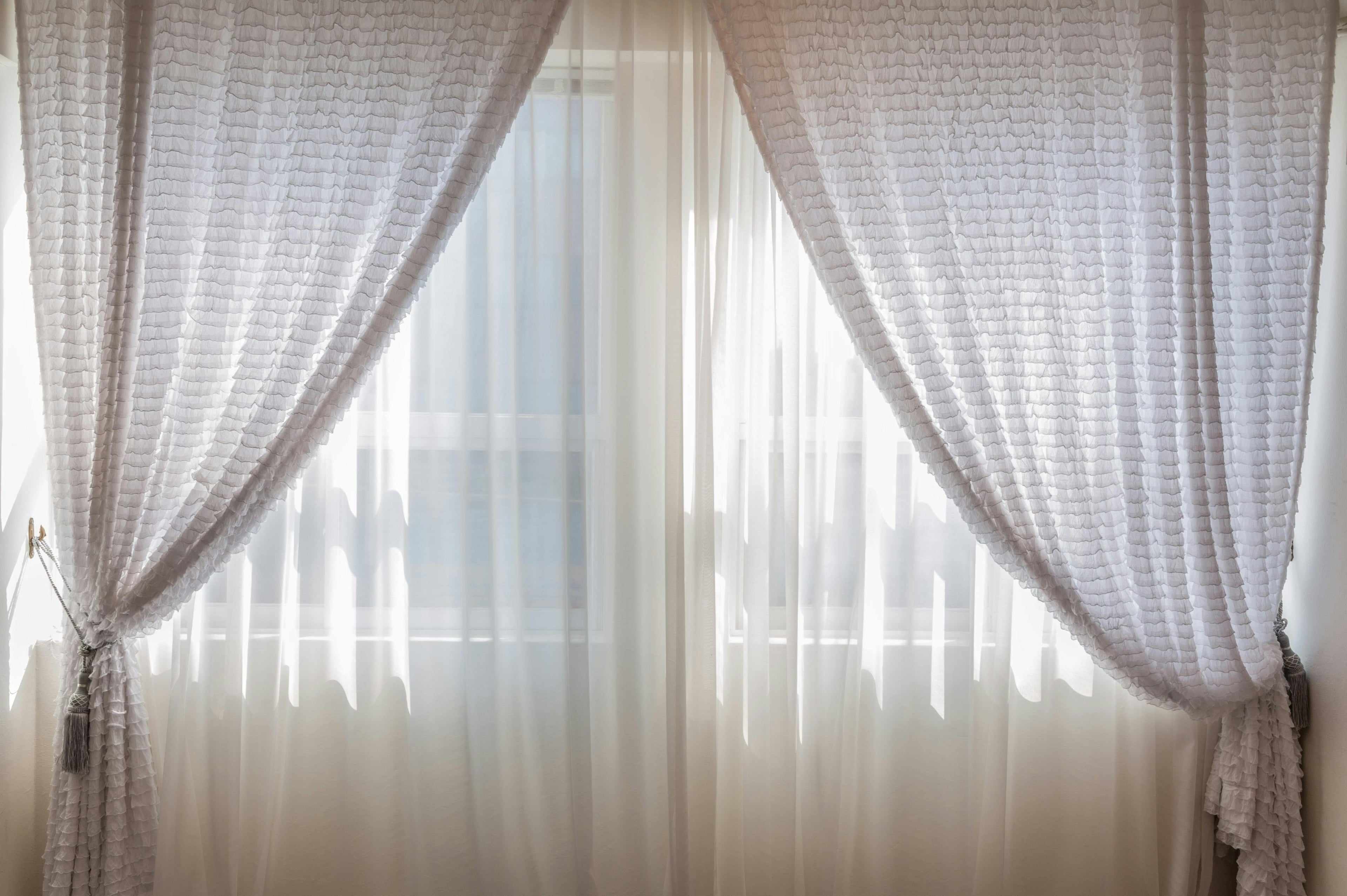
For a light fixing (adhesive, magnetic), opt for light to medium fabrics. Sheer curtains, linen, light cotton, UV-resistant polyester are perfect. They filter light without being heavy. Roman or roller blinds, designed to be fixed on specific adhesive supports, are also excellent choices for a clean look.
For tensioned or floor-standing systems, you can opt for heavier fabrics like velvet (for winter), double curtains, or thick jacquard-type fabrics, which will bring warmth and better acoustic and thermal insulation. Always consider "anti-UV" properties to prevent colors from fading prematurely under direct sunlight.
The current trend in conservatories is towards natural and textured fabrics (linen, hemp, raw cotton) for a "chic garden shed" spirit, or ultra-fine iridescent sheer curtains for a vaporous and luminous effect. Vertical panels, "Japanese" style, are also very popular for their minimalism and ease of installation on adhesive or magnetic tracks.
Step-by-step installation: mounting an adhesive track safely
Let's take the very common example of installing an adhesive track for sliding curtains on an aluminum frame.
Step 1: Preparation and cleaning. This is the most important step for the durability of the fixing. Carefully clean the aluminum surface with a lint-free cloth soaked in 90% alcohol or a specific degreasing cleaner. The goal is to remove any trace of dust, grease, or silicone residue. Let it dry completely.
Step 2: Measurement and cutting. Measure the required track length. If you need to cut it, use a fine-tooth hacksaw for a clean cut. Lightly sand the cut edges to prevent any cuts.
Step 3: Dry fit test. Without removing the protective film from the adhesive, position the track exactly where it needs to be fixed. Optionally mark the ends with an erasable pencil. Check the level with a spirit level.
Step 4: Application. Carefully remove the protective film along the entire length. Avoid touching the adhesive surface with your fingers. Quickly align the track with your marks and apply it firmly, pressing first in the center, then progressing towards the ends. Apply strong and even pressure for at least 30 seconds.
Step 5: Drying time. Strictly follow the setting time indicated by the manufacturer (often 24 to 72 hours). Do not try to hang the curtain before. This time allows the adhesive to develop its full bonding strength.
Step 6: Hanging. Once the time has elapsed, you can hang your curtains and slide the hooks into the track. Proceed gently the first few times to test the sturdiness.
Decorative tips and creative ideas without drilling
Beyond technical solutions, decorating a conservatory can rely on ingenious ideas that avoid any fixing.
Use vegetation! A series of climbing plants (ivy, star jasmine, passionflower) on light stakes or discreetly tensioned wires can create a natural, changing plant veil over the seasons, while bringing freshness.
Adhesive window films are an alternative to curtains. They come in tinted, mirror, frosted, or patterned versions. They filter light, preserve privacy, and block some UV rays, all without any fabric. Application is simple and reversible.
Create a draping effect with clips. For a bohemian and temporary look, use beautiful wooden or brass clips to hang pieces of fabric (shawls, pashminas, linen remnants) directly on a tension rod placed high up. This allows you to change the ambiance very easily.
Finally, play with furniture. A tall bookshelf or a large room divider strategically placed can obscure part of the conservatory while serving as storage or a separation, without any fixing to the windows.
FAQ: Most frequent questions about conservatory curtains without drilling
Do adhesive systems really hold on aluminum?
Yes, provided you choose products designed for it and prepare the surface correctly. Anodized or lacquered aluminum is a smooth, non-porous surface, ideal for high-bond adhesives. Degreasing cleaning is imperative to remove manufacturing residues (mold release oils) that would reduce adhesion. Professional brands like 3M VHB (Very High Bond) are specifically formulated for metals.
Can I install heavy curtains like lined ones without drilling?
This is the most delicate case. For very heavy curtains, pushed-to-the-max adhesive solutions can work, but it is often wiser to combine methods. For example, use a reinforced adhesive track along its entire length (offering maximum bonding surface) and complement it with a few additional adhesive fixing brackets placed strategically. Another option is to opt for a robust floor stand that will support the weight instead of the structure.
How to handle the sloping walls of the conservatory roof?
Sloping walls are a challenge because gravity works against the adhesive. Two main solutions: use a specific adhesive track for ceilings (even more powerful formula) and complement it with small holding adhesive hooks along the slope. The second, safer option, is to use a magnetic system if the structure is metallic, as magnetic force is not affected by gravity in the same way. Otherwise, fix the plain curtain only on the vertical wall and let a soft drape fall on the slope.
Will the curtains withstand the wind in a frequently aired conservatory?
Wind is indeed a factor to consider. For adhesive and magnetic systems, it can exert a lever force. To remedy this, choose light curtains that offer less wind resistance. You can also slightly weigh down the bottom of the curtain with a weighting rod sewn into the hem, or use ties (cords, ribbons) to keep them gathered when it is windy. Tensioned or floor-standing systems are less sensitive to this problem.
How to remove an adhesive track without damaging the aluminum?
The good news is that high-performance adhesives are designed for clean removal. The universal method is to use fishing line or a thin plastic pry tool. Slide it behind the track and gently saw through the adhesive by pulling the line horizontally. For stubborn residue, apply a specific adhesive remover (often citrus-based), let it sit, then gently rub with a cloth. Never use a metal tool that could scratch the surface.
Conclusion: Dare to personalize your conservatory with complete peace of mind
Furnishing your conservatory with curtains without drilling is no longer a compromise, but a wise choice opening up a vast realm of possibilities. Whether you opt for the discretion of an adhesive track, the flexibility of a tension rod, the ingenuity of magnets, or the freedom of a floor stand, each solution allows you to reconcile aesthetics, functionality, and respect for the structure. The key is to adapt the method to the weight of your curtains, the configuration of your conservatory, and your decorative style. Do not hesitate to mix techniques for more security and originality. Your conservatory deserves to be a perfectly controlled showcase of light and privacy. To discover more inspiration and practical guides on furnishing all your living spaces, explore without delay the other articles and complete files available on ombreinterieur.fr. Our guide how to integrate frames in a small 30 m bathroom helps you make the right choice. Browse our online store to see all our collections.
