















How to Install Day and Night Curtains: Complete Guide
Choosing day-and-night curtains means embracing an interior that is both elegant and functional, where light is tamed to your every whim. Yet once your double panels arrive, the question of installation demands careful attention. From selecting the right hardware to taking precise measurements, every detail matters if the result is to meet your expectations. This guide walks you through the essential steps, turning the process into a simple pleasure that enhances your window with a refined, airy quality.
The installation of day and night curtains represents much more than a simple decorative step. It is the promise of restful sleep, preserved privacy, and total control of natural light in your home. These double curtains, combining a blackout lining with a sheer or decorative fabric, have become a must-have for bedrooms, children's rooms, and even highly exposed living rooms. But for them to fulfill their role perfectly and enhance your window, a careful and thoughtful installation is essential. This article guides you step by step, from essential prerequisites to final adjustments, incorporating current trends and pro tips for a successful installation of your day and night curtains.
Understanding the essence and benefits of day and night curtains
Before embarking on the installation, it is crucial to understand what distinguishes this type of curtain. A day and night curtain, also called a double curtain or dual-function curtain, consists of two separate panels mounted on the same rod or on two parallel rods. The first panel, on the room side, is aesthetic: it is a linen curtain, cotton, velvet, or polyester that defines the style of the decor. The second, placed against the window, is functional: it is a blackout fabric, often thermolacquered, designed to block up to 99% of light and improve thermal and acoustic insulation.
The benefits are numerous. Besides the perfect regulation of brightness, ideal for early risers, night workers, or parents of young children, they offer enhanced insulation. In winter, they limit heat loss at the windows, and in summer, they block part of the solar heat. Privacy is total, even during the day with the sheer open. Finally, they protect decorative fabrics from UV discoloration.
Essential equipment for a solid and durable installation
An installation that lasts begins with the choice of robust materials. Avoid low-end kits whose plastic brackets eventually give way under the weight of double curtains.
Fixing systems: rods, tracks, and poles
You have several options to choose from. The classic curtain rod, in metal or wood, is aesthetic and easy to install. For heavy day and night curtains, opt for a sufficient diameter (at least 28 mm) and reinforced wall brackets spaced no more than 80 cm apart. The curtain track, discreet and sliding silently, is perfect for curved configurations or French windows. Cord or motorized systems often integrate with this type of support. Finally, the curtain pole, recessed into the ceiling or wall-mounted, offers a very clean and modern look, currently very trendy.
Hooks, rings, and other accessories
The choice of hooks depends on your curtain header. For eyelet curtains, plan for sturdy rings. For pleated curtains, pinch hooks or glider hooks are necessary. Don't forget the screws and wall plugs suitable for your wall (Molly bolts for hollow partitions, expansion plugs for concrete). A spirit level, tape measure, pencil, and drill/driver are your best allies.
Taking measurements: the crucial step to avoid disappointments
This is the most important step. A measurement error is irreversible once the fabric is cut. For perfect day and night curtains, always measure to the nearest millimeter.
Start by determining the installation height. The current trend favors a high and wide installation to visually enlarge the window and the room. Fix the rod 15 to 20 cm above the top of the window opening, and extend it 15 to 30 cm on each side. This allows the window to be completely cleared when the curtains are open and lets in maximum light.
For the fabric width, the rule is simple: the total length of the two panels (blackout + decorative) must be at least 1.5 to 2 times the width of the rod. This guarantees beautiful pleats and a generous appearance. For the length, decide if you want a floor-length drop (very elegant, leave 1 to 2 cm clearance), a sill-length drop, or a floating drop (halfway between the two). Measure from the base of the rings or hanging system to the desired point.
Preparing the wall and installing the brackets with precision
Once the measurements are marked with a pencil, prepare the holes. Use a metal and cable detector to avoid surprises. Drill at the marked locations with a drill bit suitable for your wall, insert the wall plugs, and firmly screw in the brackets for the rod or track. Systematically check the horizontality with a spirit level. This rigor is essential so that the curtains slide well and hang straight. For surface-mounted installations (on the wall), ensure the brackets are perfectly aligned. For ceiling installations, the supported load must be verified.
Hanging the curtains: blackout and decorative in harmony
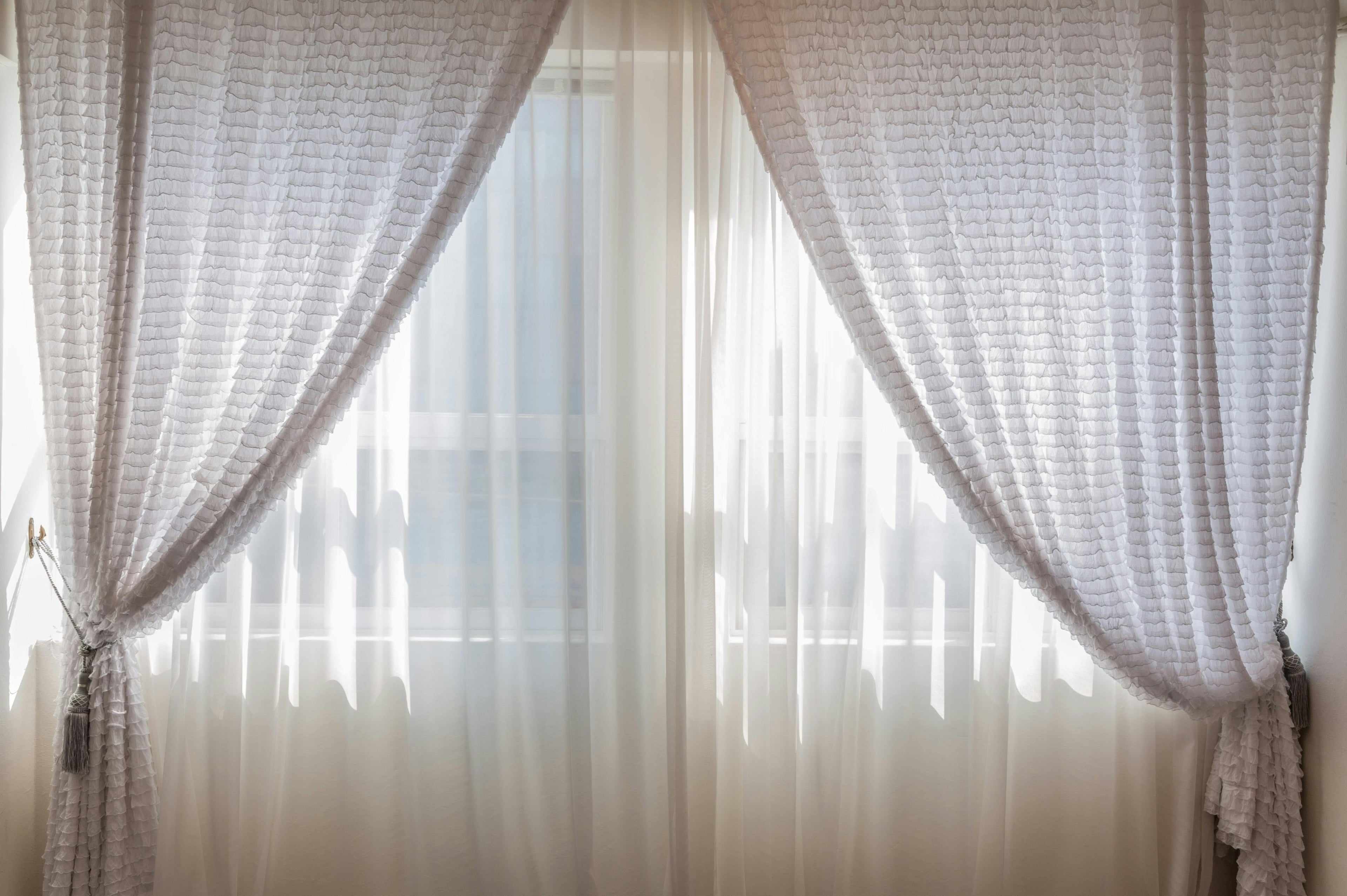
The hanging order is logical: start with the blackout curtain, the closest to the window. Hang it on the rod or inner track if you have two, or simply behind the decorative curtain on a single rod with a double row of rings. Pull it to check it slides smoothly. Then, hang the decorative curtain on the front row of rings. The trend is towards mix & match of textures: a fine and airy sheer curtain in front of a sober blackout, or a deep velvet in front of a technical blackout.
Adjust the distribution of the pleats by spacing them evenly. For eyelet curtains, ensure they glide smoothly. For ribbon or pleated curtains, pin the pleat headers to the hooks for optimal hold.
Finishing touches and adjustments for a professional result
Once hung, let your day and night curtains hang for 24 to 48 hours. Fabrics, especially natural ones, need to relax and take their final drop. After this time, make any necessary length adjustments. For a perfect floor-length drop, it may be necessary to lightly iron the bottom of the curtain to refine the line.
Consider final accessories. A magnetic tieback or a discreet cord pull system allows you to hold the curtains open elegantly. Avoid overly heavy or decorative ties that could unbalance the whole.
Solutions for specific window configurations
Not all windows are standard. For a French window or an angled window, the curved track is the ideal solution. It follows the shape of the window for continuous sliding. For patio doors, opt for curtains that open completely so as not to obstruct access, and choose a fabric heavy enough not to blow in the wind. In the case of a window with a radiator underneath, high and wide installation is even more crucial. Ensure that the curtain, once closed, falls in front of the radiator without touching it so as not to block heat diffusion.
Integrating day and night curtains into your decor: 2026 trends
Technical installation should not make you forget aesthetics. Day and night curtains fit perfectly into current trends. The Japandi style, a blend of Scandinavian minimalism and Japanese serenity, favors natural fabrics (linen, raw cotton) in neutral tones, with a sober blackout and clean lines. The cocooning trend focuses on double curtains in velvet or bouclé, with deep colors (midnight blue, forest green, terracotta) to create an intimate and warm atmosphere.
The decor tip of the moment: play on duality. A colored or patterned sheer in front of a white blackout, for a changing effect between day and night. Or the opposite: a plain, sober decorative curtain, leaving all the space to a high-performance technical blackout.
The alternative of motorization: comfort and modernity
To push the installation towards excellence, consider motorization. No more pulling on cords. A simple button, remote control, or voice command (via a smart assistant) allows you to open and close your day and night curtains. This is undeniable daily comfort, especially appreciated for large French windows or heavy curtains. Installation generally requires a specific track and a nearby electrical outlet, or integrated batteries. This is an investment that fits into a home automation and smart home approach.
Care and maintenance of your day and night curtains
To extend the life of your installation, regular maintenance is required. Regularly vacuum both panels with the soft brush to remove dust. Air out the room. Regarding washing, strictly follow the care labels. Blackout fabrics are generally cleaned with a damp sponge or dry cleaned. Decorative fabric curtains can often be machine washed cold on a delicate cycle. Iron at a low temperature if necessary, avoiding fixed creases.
Annually check the sturdiness of the wall fixings and tighten the screws if needed. Lightly lubricate the sliding track mechanism if it becomes noisy.
FAQ: Answers to frequent questions about installing day and night curtains
Can day and night curtains be installed on a false ceiling or plasterboard partition?
Yes, but with extreme precautions. Dry partitions and false ceilings do not support heavy loads. It is imperative to fix the brackets directly into the metal studs of the partition, which you will need to locate with a specific detector. Use long plasterboard screws. In the absence of a stud, you must imperatively use Molly bolts or special plasterboard expansion anchors, and distribute the load over several very close fixing points. When in doubt, consult a professional.
What is the difference between a blackout curtain and a blackout curtain?
The terms are often used synonymously, but there is a technical nuance. A blackout curtain is a very high-performance blackout, composed of several layers of fabric, often coated, designed to block 100% of visible light. It is used in cinema rooms or high-end hotels. A standard blackout curtain blocks the vast majority of light (usually 90 to 99%), which is already largely sufficient for most domestic uses. Both improve thermal and acoustic insulation.
Should I plan for two separate rods or a double rod?
Both solutions are valid. The double rod (with two sliding rails on the same support) is more compact and visually unified. It is ideal for standard windows. Two separate rods, one in front of the other, offer more flexibility. You can thus separate the decorative curtain further from the blackout layer, create a depth effect, and facilitate cleaning or changing one of the two panels. It is also the mandatory solution if the two curtains have incompatible headers (eyelets on one side, pinch hooks on the other).
How to camouflage the rod or track for a more aesthetic result?
For an integrated and clean look, several options are available to you. Installing a concealing valance (or lambrequin) above the rod is the most classic. It completely hides the system and provides an architectural finish. The recessed track in the ceiling or in a bulkhead is the most discreet and modern solution, highly prized in contemporary decors. Finally, you can opt for a designer rod (in brass, raw wood) that you embrace as a decorative element in its own right, to be highlighted.
My day and night curtains let a thin line of light through on the sides, what should I do?
This lateral light leak is common and can be corrected. The most effective solution is to install side guides or guide rails. These are thin plastic or metal strips that you fix to the wall on each side of the window, into which the edge of the blackout curtain slides. This hermetically blocks the light and also improves thermal insulation. Ensure that the width of your blackout curtain is well adapted to this addition.
Conclusion: Towards peaceful sleep and a controlled interior
Installing day and night curtains is a project within the reach of all motivated DIYers, provided you scrupulously follow the steps of measuring, preparation, and fixing. Beyond the technique, it is an opportunity to rethink the lighting layout of your room and bring a significant decorative touch to it. Whether you opt for a classic manual installation or the latest connected motorized systems, the result is worth it: perfect control of your environment, increased living comfort, and an interior where style and functionality dialogue in harmony. To discover more inspirations on the art of the window and light, explore without delay the other guides and trends available on ombreinterieur.fr. Need practical advice? Read how to uncrease blackout curtains. Get inspired on our decoration site for your upcoming projects.
```