
















Complete Guide to Ceiling-Mount Curtains
Under a standard ceiling, a room can feel oddly constrained. Yet a simple shift in how you hang your curtains can transform the entire spatial perception. By fixing the rail to the ceiling rather than the wall, you gain height and elegance, while solving practical challenges such as large French windows or open-plan volumes. This design gesture, achievable with careful preparation, reshapes your interior without major renovation. Let us guide you toward a successful installation that elevates your décor.
Hanging curtains from the ceiling is much more than a simple DIY trick. It's a powerful design decision that radically transforms the perception of a room. This approach, far from being anecdotal, addresses major aesthetic and practical challenges: creating the illusion of ceiling height, dressing imposing bay windows, or delineating spaces in open-plan volumes. While the idea may seem intimidating, rigorous planning and choosing the right materials make it an accessible project for everyone. This article guides you step-by-step, from essential preliminary considerations to the final installation, exploring current trends and helping you avoid common pitfalls. You'll discover how this architectural detail can become the key to a polished and personalized decor.
Why Choose Ceiling Mounting? The Decisive Advantages
Before drilling the first hole, it's crucial to understand the benefits of this method. The first, and most obvious, is the visual effect. A rail or rod mounted to the ceiling naturally guides the eye upward, creating an impression of verticality and grandeur. This effect is a lifesaver in rooms with low or standard ceilings, where it breaks the horizontal linearity.
On a practical level, this mounting offers an elegant solution for complex configurations. It allows you to cover wide bay windows or floor-to-ceiling windows without interruption, where multiple wall-mounted rods would create unsightly breaks. It's also the ideal technique for French doors or openings that go down to the floor, ensuring the curtains fall perfectly straight without being hindered by window sills.
Finally, in lofts or open space apartments, ceiling-mounted curtains become true lightweight partitions. They allow you to define a sleeping area, a home office, or a living room without weighing down the visual space, playing with light and fabric transparency. The flexibility is total: you can open them to regain the original volume or close them for privacy.
Preliminary Assessment: Can Your Ceiling Support Your Curtains?
The very first step, non-negotiable, is analyzing the structure of your ceiling. Your safety and the durability of the installation depend on it. There are mainly three types of supports.
The concrete ceiling or solid slab is the strongest. It allows for direct fixing with appropriate anchors (expansion anchors, chemical anchors for heavy loads). Use a metal detector to locate rebar and avoid drilling in those spots.
The plasterboard ceiling (drywall/BA13) is more delicate. Its load-bearing capacity is limited. The key is to always screw into the metal studs (the framing) and never into the board alone. A stud finder is essential here. For very heavy curtains, it may be necessary to reinforce the structure from the attic or add a wooden batten fixed to several studs.
Suspended ceilings (plaster tiles, metal, etc.) are generally not designed to support weight. It is imperative to go through the suspended ceiling to fix into the load-bearing structure above. Threaded rods of the appropriate length are then necessary.
Identifying the Nature of Your Ceiling
Several simple methods exist. The magnet test (a magnet sticks to the screws of metal studs), observing the fixing points of existing light fixtures, or a small test drill in a discreet corner can give you information. In case of doubt, consulting the apartment plans or seeking a professional's opinion is prudent.
Choosing the Fixing System: Rail, Rod, or Cable?
This choice is decisive for the final aesthetics and functionality. Each system has its specificities.
Track systems with gliders are the most discreet and modern. Concealed by a valance, they offer ultra-smooth sliding, even for heavy or very long curtains. They are perfect for curves or angles. Current models, often in anodized aluminum, are lightweight and resistant. This is the preferred solution for a sleek, contemporary look.
Rods with rings bring a more decorative and traditional dimension. Available in a multitude of finishes (brass, aged copper, wood, matte black), they become a decorative element in their own right. Ensure the hooks or rings are suitable for the rod's thickness. For a ceiling, opt for models with reinforced fixing brackets.
Tension cable systems embody the industrial and minimalist aesthetic. A steel cable is tensioned between two fixing points. It's visually very light and ideal for linen curtains or lightweight cotton. Be careful, this system handles heavy weights less well and may require a tensioner to prevent sagging over time.
The current trend leans towards sober finishes: matte black, anthracite, brushed brass, or white lacquer, which integrate without competing with the rest of the decor. The "seamless" aspect and silent sliding systems are highly sought after.
Materials and Tools: The Essential Checklist
For a successful installation, you need to be well-equipped. Here is an exhaustive list of necessary materials.
- For marking and measuring: A long tape measure, a long spirit level (or a laser level for more precision), a carpenter's pencil, chalk, or a chalk line.
- For fixing: A powerful drill/driver, a set of drill bits suitable for your ceiling (concrete bit, wood/metal bit), a metal detector and/or stud finder, a hammer.
- Consumables: High-quality wall plugs and screws, suitable for the supported weight. For concrete, expansion anchors like Fischer SX; for drywall, Molly anchors or long drywall screws. Fixing brackets for the rail or rod.
- For assembly: A hacksaw or angle grinder to cut the rail/rod to the right dimension, end caps, corner connectors if needed.
- Safety: Safety glasses, a stable and sturdy stepladder, possibly a vacuum for drilling dust.
Investing in quality materials, especially for anchors and screws, is the guarantee of a lasting and safe installation.
Key Steps for a Successful Installation
Follow this rigorous methodology to avoid mistakes.
Step 1: Taking Measurements and Marking
Measure the total length to cover. For optimal visual effect, extend the rail or rod at least 20 to 30 cm on each side of the opening. This allows the curtains, when open, to let in maximum light without obstructing the window. On the ceiling, using the level, trace the perfectly straight axis where the system will be fixed. Clearly mark the location of each fixing bracket (generally every 50 to 60 cm, and imperatively at each end).
Step 2: Drilling and Fixing the Brackets
At each mark, drill a hole of the exact diameter recommended for the anchor. The depth should be slightly greater than the anchor's length. Insert the anchors by tapping gently. Then screw the fixing brackets firmly, but without overtightening to avoid deforming the rail. Check the alignment one last time.
Step 3: Installing the Rail or Rod
Prepare your rail/rod by cutting it to the correct length. For rails, insert the internal gliders and any curve connectors. Place it on the fixed brackets and screw it according to the manufacturer's instructions. For a rod, simply place it in its brackets and tighten the locking mechanism. Once installed, apply slight downward pressure to test the overall sturdiness.
Step 4: Hanging the Curtains and Finishing
Hang your curtains according to the chosen system (hooks, rings, gliders). Let them hang for a few hours, even a day, for the folds to form naturally. For a perfect drape, especially with thick fabrics, a slight weighted hem or a visit to a tailor for a straight hem can make all the difference. Add the finishing touches: end caps, a valance to conceal rails.
Inspiration and Trends: From Minimalism to Theatrical
Ceiling mounting opens up an infinite field of possibilities in decoration. The current trend explores two main paths.
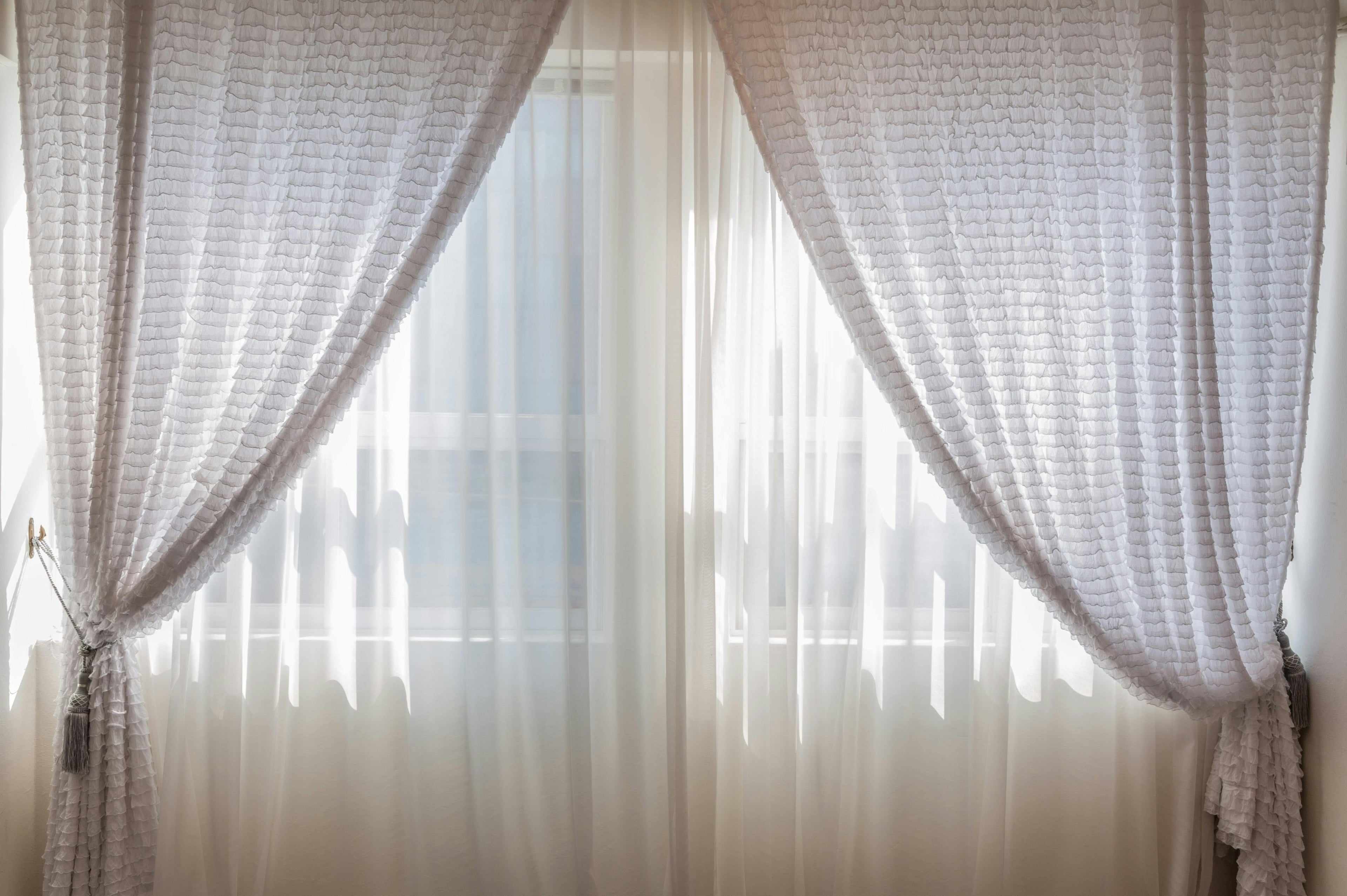
On one side, radical minimalism. A thin matte black rail, almost invisible, supporting an ecru linene or a thick sheer curtain that diffuses soft, uniform light. Here, the curtain becomes a vaporous wall, a texture rather than an object. It's the "quiet luxury" spirit applied to the window.
On the other, a more scenographic and organic approach. We see double rails appearing, allowing the layering of two fabrics with contrasting textures (a velvet and a tulle, for example). Exposed metal hangers, ceramic or rattan artisan rings become ornamental details. The trend is towards natural and textured fabrics: raw linen, handwoven cotton, bouclé wool, which gain depth when illuminated.
The idea of the "drapery" is also making a comeback. A single very wide curtain, hung on a curved rail that opens it laterally, creates a spectacular and sculptural draped effect, like a textile artwork. It's an ideal solution for a bedroom or bathroom.
Mistakes to Absolutely Avoid
Certain pitfalls can compromise your project. Knowing them allows you to avoid them.
- Underestimating the weight: Not adapting the fixings to the actual weight of the curtains (fabric + lining) is the main cause of sagging or falling. Weigh one square meter of your fabric and do the calculation.
- Skimping on fixing points: Spacing the brackets too far apart causes sagging in the center of the rail. Scrupulously follow the manufacturer's recommendations, even if it means adding an extra bracket.
- Neglecting the level: A rod even slightly off-level is immediately visible and gives an impression of carelessness. Always use a level.
- Forgetting the clearance space: Curtains that bump against the wall or window frame when opened are unsightly and damage the fabric. Plan for ample lateral overhang.
- Choosing a system unsuitable for the fabric: Rings too small for a thick rod, poor-quality gliders for heavy velvet... Compatibility between the fixing system and the type of curtain is paramount.
FAQ: Answers to the Most Frequent Questions
Can heavy curtains be hung on a drywall ceiling?
Yes, but with extreme precautions. It is imperative to locate and screw directly into the metal studs of the framing, never into the plasterboard alone. For a very heavy load (double layer of velvet, for example), installing a wooden batten fixed to several studs, itself concealed by the rail valance, is highly recommended to distribute the weight.
What is the ideal height between the ceiling and the top of the curtain?
For the most elegant "floor-to-ceiling" effect, the curtain should just graze the floor (at 1 or 2 cm maximum) or even form a slight "pooling" (a controlled puddle of a few centimeters) for a more romantic and luxurious style. The rail is therefore fixed to the ceiling, and the curtain length is calculated accordingly.
How to dress a corner window with a ceiling rail?
This is one of the great advantages of track systems with gliders. There are corner connectors (at 90° or other degrees) that allow you to connect two sections of rail. The gliders pass from one to the other without snagging, allowing a single curtain to slide all along the corner or two curtains to meet perfectly at the angle. Marking and leveling must be surgically precise for this type of installation.
Should lining be planned for ceiling-mounted curtains?
Lining is advised for several reasons. It protects the main fabric from UV rays, improves thermal and acoustic insulation, and ensures a heavier, more structured drape. For room-divider curtains in a loft, an opaque lining is essential for privacy.
What budget should be planned for a professional installation?
The cost varies enormously depending on complexity (length, angles, height), the chosen system (custom rail, designer rod), and labor prices. For a simple installation on a standard window, budget between 150 and 400 euros including supply and installation. For a large bay window or a custom project, the budget can rise to 1000 euros or more. Always get several quotes.
Conclusion: Dare Verticality to Transform Your Interior
Hanging curtains from the ceiling is a design approach that combines spatial intelligence and aesthetic expression. Far from being a simple question of fixing, it's a choice that influences the ambiance, light, and the very perception of volumes. By mastering the technical aspects – evaluating the support, choosing the system, meticulous installation – you open the door to a much wider decorative universe. Whether you seek the purity of a linene floating in the light or the character of a velvet structuring the space, this solution offers total freedom. Don't hesitate to experiment with textures, lengths, and sliding systems to create an interior that is uniquely yours. To discover other bold ideas and expert advice for every room in your home, continue your exploration on ombreinterieur.fr. Before choosing, browse how to dye blackout curtains. Browse our online store to see all our collections.
