














Complete Guide to Hanging a Pleated Curtain
Hanging curtains with hooks is far more than a simple technical task: it is the gesture that determines the elegance of a fabric’s fall and the harmony of your room. Whether you opt for classic rods, discreet tracks or eyelet poles, each support comes with its own rules. You will learn how to choose the right hooks for your system and fabric, achieving perfect pleats and a smooth installation. Let yourself be guided towards a finished wall decoration where every detail matters.
Hanging a curtain with hooks might seem like a simple technical step, almost trivial, in the process of installing your sheer curtains or your double curtains. Yet, this step is crucial for the final result. A successful installation not only guarantees smooth and durable operation, but it is also the secret to a perfect drape, discreet elegance, and a polished wall decoration. Whether you're dealing with a classic rod, a trendy eyelet rod, or a discreet track, mastering the art of hanging your curtains with the right hooks transforms the ambiance of a room. This article is your comprehensive guide to everything about hook types, hanging techniques, mistakes to avoid, and professional tips for impeccable interior decoration.
Understanding the curtain ecosystem: rods, tracks, and hooks
Before choosing your hooks, it is imperative to understand the system they will slide on. Each support has its specificities and requires adapted accessories for optimal and aesthetic hanging.
Classic curtain rods and their hooks
Cylindrical rods, often made of metal or wood, are the most common. For these, you will mainly use pinch-pleat hooks or glider hooks. Pinch-pleat hooks clip directly onto the top hem of the curtain, a simple solution but one that can mark the fabric. Glider hooks, more professional, attach to a glider tape sewn onto the back of the curtain, offering regular pleating and great ease of installation.
Tracks and their sliding carriers
Tracks, often concealed by a valance, are preferred for a modern and minimalist look. They work with carriers (or gliders) that move along the track. The hooks then attach to these carriers. There are cord-operated systems to open and close the curtains without touching them, a must-have for large bay windows or rooms with meticulous decoration.
Eyelet rods, the contemporary option
Very trendy, the eyelet rod does not require hooks per se. The curtain is equipped with metal or plastic eyelets that slide directly onto the rod. However, to avoid friction and facilitate handling, spacers or separators can be used. The choice of eyelet diameter relative to the rod diameter is paramount here.
The complete panorama of curtain hook types
The market offers a diversity of hooks designed to adapt to each type of curtain, support, and desired decorative effect. Choosing them wisely is the key to a successful installation.
Pinch-pleat hooks (or clip-on hooks)
Ideal for temporary installation or for lightweight curtains like sheers, pinch-pleat hooks are the simplest to use. They clip directly onto the fabric. For a clean result, space them evenly every 10 to 15 cm. Be careful with delicate fabrics like silk or fine linen, as they can leave marks or damage the fibers.
Glider hooks (for glider tape)
This is the most common and recommended solution for lined curtains or thick fabrics. A pocket tape, often called glider tape, is sewn onto the back of the curtain. The hooks are inserted into the pockets of this tape. They allow for creating different types of pleats (flat pleat, pencil pleat, French pleat) depending on the pocket spacing. The density of the hooks directly influences the richness of the pleating.
S-hooks (or curtain ring hooks)
Shaped like an "S", these hooks are essential for ring systems. On one side, they hook onto the ring that slides on the rod, on the other, they attach to the glider tape of the curtain. They come in different heights, a crucial detail for determining the final height of your curtain relative to the floor and the rod.
Specific hooks for tracks
These hooks attach mechanically to the track carriers. They are often supplied with the system. Their particularity is their low profile and their ability to support significant loads, making them perfect for large blackout curtains or thick double curtains.
The hanging height: the secret to an elegant drape
The lacquer height at which you fix your hooks is one of the most important parameters, yet often underestimated. It determines the silhouette and presence of your curtain.
A golden rule in interior decoration states that to visually enlarge a room and create an impression of ceiling height, you must hang the rod or track well above the window opening. Place it halfway between the top of the window frame and the ceiling, or even only 10-15 cm from the ceiling for a dramatic effect.
Regarding width, the rod should extend beyond each side of the window by at least 15 to 20 cm. This allows the curtains to be pulled completely to the sides and let in maximum natural light when open, while preventing them from covering part of the glass.
For curtain length, the current trend leans towards "floor-kissing" or "floating lightly". A curtain that just grazes the floor (at 0.5 or 1 cm) offers a modern and neat look. The "floating" style (curtain stopping 1 to 2 cm above the floor) is practical and avoids dust accumulation. The "puddled" style (curtain that pools on the floor forming a fold) is more traditional and theatrical but requires extremely precise measurements.
The step-by-step guide to hanging a curtain with hooks perfectly
Now let's move on to practice. Follow this methodical guide for a flawless installation, whether you use glider tape or pinch-pleat hooks.
Preparation and measurement: the foundation of success
Start by securely installing your rod or track according to the height and width recommendations mentioned. Then measure the distance from the top of the rod (or the bottom of the rings) to the desired floor height. This is the finished height of your curtain. Transfer this measurement to the curtain, taking into account the hook height.
Attaching hooks to the glider tape
If your curtain is equipped with a pocket tape, insert the hooks into the pockets starting from the ends. Typically, you place a hook in the first pocket at each end, then distribute the intermediate hooks evenly. For rich pleating, use all the pockets. For a more spaced pleat, space the hooks by one or two pockets. Ensure all hooks are oriented in the same direction.
Hanging on the rod or rings
Once all hooks are in place on the curtain, gently hook them onto the rod rings or track carriers. Proceed from one side to the other, lifting the curtain to avoid pulling on the fabric. After hanging everything, let the curtain hang naturally for 24 to 48 hours. The fabric, especially if heavy, needs to "take its drape." You can then possibly adjust the hook distribution for perfectly uniform pleating.
Finishing: ironing and adjustments
For an ultra-professional result, a light steam ironing of the curtain pleats once hung can work wonders. This removes storage creases and refines the drape. Use a garment steamer, holding the nozzle a few centimeters away from the fabric.
Common mistakes to absolutely avoid
Some common faults can ruin the decorative effect of your most beautiful curtains. Knowing them allows you to avoid them.
- Using hooks that are too short or too long: Poorly sized hooks can cause the curtain to touch the wall or rod, or conversely, let it hang in an unsightly way.
- Spacing hooks irregularly: This creates chaotic pleating, with pleats too tight in some places and too loose in others.
- Neglecting the curtain's "resting time": Wanting to adjust the pleating immediately after hanging is a mistake. The fabric needs to adjust to its new position.
- Overloading rings or carriers: Too many hooks on the same ring can hinder smooth movement. Follow the manufacturer's recommendations.
- Forgetting hook/tape compatibility: Ensure the width of your hook prongs matches the size of the pockets on your glider tape.
Current trends and decor inspiration
The way curtains are hung also follows interior decoration trends. Approaches are evolving towards more simplicity and effect.
The minimalist style is very fashionable. It favors invisible tracks, discreet hooks, and curtains in a single solid color, falling straight without excessive pleating. Neutral tones like anthracite gray, deep beige, or off-white dominate.
Conversely, the return of vintage brings renewed interest for visible brass rods, large decorative rings, and ornate S-hooks. It's an opportunity to make the rod a decorative element in its own right.
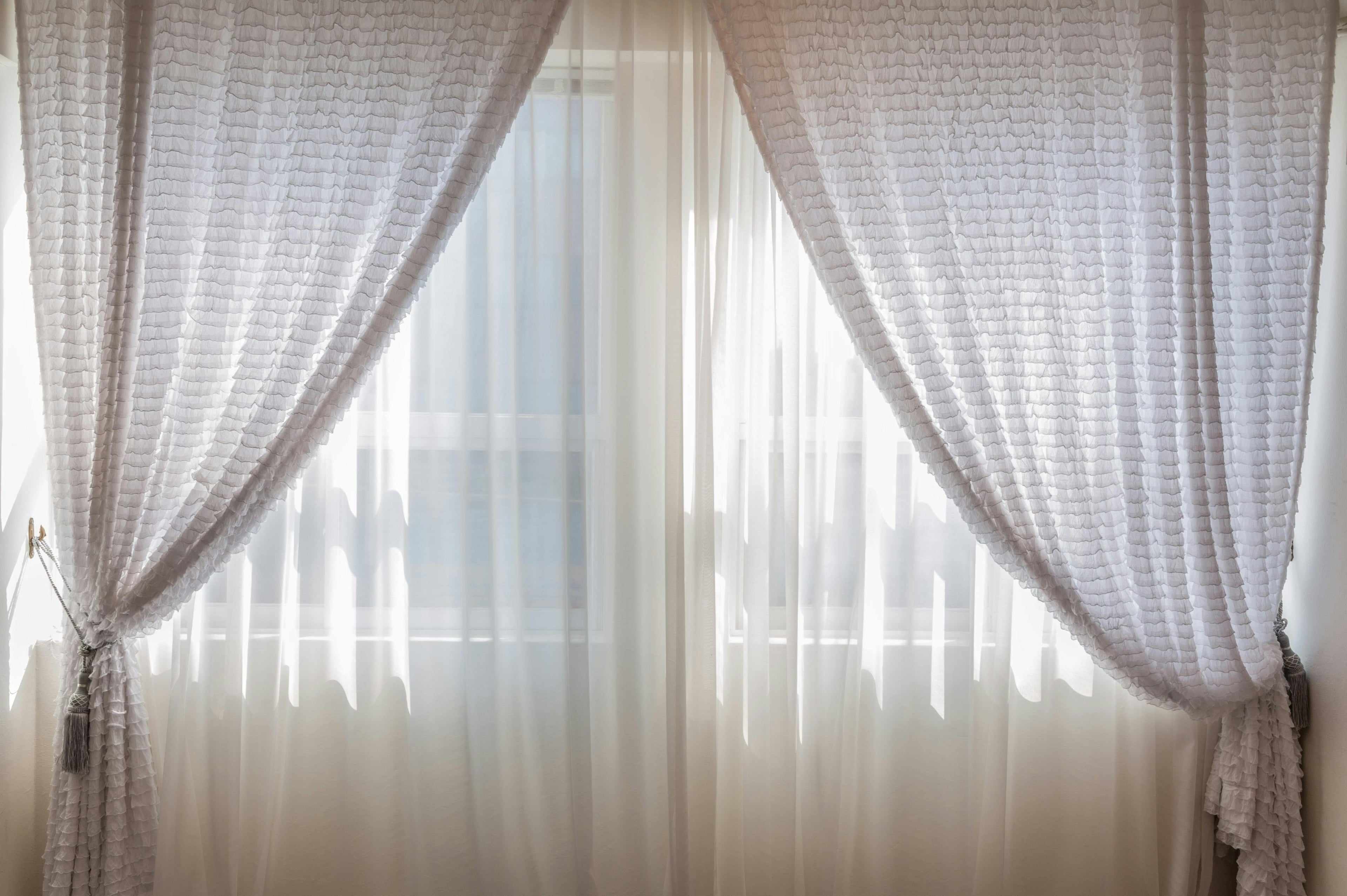
Double curtains remain a timeless classic for their versatility. Hang a translucent sheer curtain on a first set of hooks to filter light, and an opaque, thick curtain on a second set, behind, for privacy and thermal insulation. Using hooks of different heights can create a very elegant relief effect.
Choosing your accessories: where to find the right hooks?
The quality of hooks has a direct impact on the longevity of your installation. Always prioritize robustness.
For lightweight curtains, plastic hooks are sufficient. For heavy curtains (velvet, thick linen, thermal-lined), invest in metal hooks, more resistant to pulling and deformation. Specialized home furnishing and decoration stores, as well as quality haberdasheries, offer a wide choice. Don't hesitate to bring a sample of your glider tape to ensure compatibility.
Also consider complementary accessories: rod stops to prevent rings from falling off, decorative pull-backs to facilitate opening and closing, or spacers for eyelet rods for perfect sliding.
FAQ: Answers to the most common questions about hanging curtains
How many hooks should be used per curtain?
There is no universal number, but a distribution rule. For standard pleating, space hooks 10 to 15 cm apart. A curtain 140 cm wide will therefore need about 10 to 12 hooks. For more generous pleating (like "triple pleat"), put a hook in every pocket of the tape, which can give a spacing of 5 to 8 cm.
Can you hang a curtain without glider tape?
Yes, several solutions exist. Pinch-pleat hooks are the simplest. You can also use decorative curtain clips, which are wider and often ornamental. Finally, for a bohemian look, you can create pleats by tying the curtain directly to the rod with cords or ribbons at regular intervals.
How to make a curtain hung with hooks that sticks slide?
Several causes are possible. First, check that the hooks are well aligned and not catching on each other. Clean the rod or track of accumulated dust. Ensure the rings or carriers are not overloaded. As a last resort, lightly lubricate the rod with a suitable product (like candle wax) or check the track alignment.
Are the hooks visible from the outside?
With a well-executed installation, the hooks should be concealed by the top fold of the curtain once it is in place. This is particularly true with glider tape systems. With decorative rings, the hooks (often S-shaped) may be partially visible but are an integral part of the chosen style.
How to wash a curtain equipped with hooks?
It is imperative to remove all hooks before any washing, whether by hand or machine. The hooks could damage the fabric, the washing machine, and become deformed. Remove them carefully, wash the curtain according to the label instructions, and reinsert the hooks once the curtain is dry and, if possible, lightly ironed.
Conclusion: The discreet but essential art of hanging
Hanging a curtain with hooks is much more than a simple manual task. It is the final touch, the decisive step that brings your decoration project to life. A wise choice of hooks, precise measurement, and patient installation are the pillars of curtains that will dress your windows with grace and elegance for years to come. They define the silhouette of your room, play with light, and greatly contribute to the atmosphere of your interior.
By mastering these techniques, you gain autonomy and can give free rein to your creativity, making each window an integral part of your decor. To discover more inspiration, detailed tutorials, and expert advice on window decoration and beyond, feel free to explore the other comprehensive articles available on ombreinterieur.fr. Transform your home, one room at a time. Among our favorites, find Bohemian Crochet Curtain. Before choosing, browse how to separate two rooms with a curtain. Discover our entire decor universe on Ombre Interieur.
