















Hanging curtains in a caravan: drill-free and durable methods
In a caravan, fitting curtains is as much about privacy as practicality, yet thin walls rule out standard fixings. Still, dressing your windows without drilling or compromising the structure is entirely achievable. From adhesive solutions to tension rods, you’ll discover sturdy, reversible tricks suited to life on the road. The challenge is considerable: turning your mobile space into a cosy haven where every curtain contributes to atmosphere and comfort. Follow the thread of these lasting methods for a result that is both beautiful and functional.
Hanging curtains in a caravan or motorhome is much more than just a question of decoration. It's a practical challenge that touches on privacy, light management, thermal and acoustic insulation, and above all, optimizing a limited and mobile living space. The walls are often thin, curved, and made of composite materials that cannot support traditional fixings. Yet, successfully installing them transforms a rolling home into a true cozy, personalized, and functional nest. This article guides you step-by-step, from the simplest solutions to the most professional installations, so that your caravan curtains are beautiful, sturdy, and adapted to the vibrations of the road.
Why Curtains Are Essential in Your Nomadic Home
In a house, curtains are often an aesthetic choice. In a caravan, they become a multifunctional necessity. Their role goes far beyond simply blocking the view.
They are your first barrier to preserve privacy, whether you're on a crowded campsite or in the middle of nature. They allow you to finely regulate daylight for naps or sleeping in, and protect from prying eyes at night once the interior is lit.
From a technical standpoint, good curtains contribute to insulation. They create an additional layer of air at the windows, limiting heat loss in winter and overheating in summer. They also dampen outside noises, like rain on the roof or neighbors' conversations, for more peaceful sleep.
Finally, from a decor perspective, they are the major textile element that allows you to assert your style, bring color and warmth to an interior often dominated by industrial materials. Well-chosen, they unify the space and create a unique ambiance.
Preliminary Analysis: Understanding Your Caravan's Structure
Before drilling the first hole or buying the first accessory, an observation phase is crucial. Modern caravans are complex assemblies.
The walls are generally sandwich panels: a core of polyurethane foam or cork, sandwiched between two thin skins of fiberglass, aluminum, or rigid plastic (ABS). These walls are light and insulating, but they have no load-bearing capacity. Screwing directly into them without precaution is doomed to fail.
Locate the studs, these structural elements made of wood or metal integrated into the walls. They are located at the corners, around windows, doors, and at regular intervals along the walls. It is on these studs that you can securely fix. Use an electronic stud finder suitable for thin materials. If not, the good old tapping test can give an indication (the sound is duller on a stud).
Also note the shape of the windows. Are they straight-edged or rounded? Is the surrounding surface flat or curved? These observations will determine the type of rail or pole to choose.
Necessary Equipment for a Successful Diagnosis
For this analysis, equip yourself with a tape measure, a spirit level, a pencil, and especially, the technical manual of your caravan if you have it. It often contains diagrams of the structure.
No-Drill Hanging Methods: Ideal for Renters or Hasty DIYers
If you don't want to drill, or if you have a rental caravan, several effective solutions exist. They are reversible and generally simple to implement.
Tension rods are perfect for rectangular spaces like side windows. Choose adjustable models and ensure they are well-tensioned to withstand vibrations. Opt for rubber or foam ends to avoid damaging the walls.
High-strength adhesive hooks (like 3M's Command™) are a revolution. They support surprising loads and remove without a trace. The trick is to perfectly degrease the surface (with isopropyl alcohol) and respect the setting time before hanging the load. They are suitable for light curtains or for fixing rings onto which a thin pole will slide.
Specific adhesive rails are also available. These are small plastic rails with a powerful double-sided adhesive on the back. They allow standard curtain hooks to slide on. Check the maximum load indicated by the manufacturer carefully.
Finally, the Velcro® solution (hook-and-loop fastener strips) is very popular in the motorhome world. One adhesive strip on the wall, the other strip sewn onto the curtain. It's discreet, adjustable, and allows you to easily remove the curtains for washing. Ensure the adhesive strip is designed for smooth, clean surfaces.
Drill Hanging Methods: The Durable and Robust Solution
For a permanent installation capable of supporting heavy curtains or large panoramic windows, drilling is often necessary. The key to success lies in preparation and choosing the right anchors.
The first rule is to always drill into a stud when possible. Use a variable speed drill and a drill bit suitable for the material (wood or thin metal). Mark the location precisely.
When you must drill into the wall alone (outside a stud), hollow wall anchors are essential. Nylon expansion anchors (Molly type) are excellent. They expand behind the thin wall and offer a very solid grip. Blind rivets (pop rivets) in aluminum are also widely used in marine and caravanning for their hold in thin materials.
For the heaviest fixings, like a long rail above a panoramic window, it may be necessary to install a wooden fixing batten (a piece of wood) screwed into several studs, then fix the rail onto this batten. This distributes the load and guarantees rock-solid strength.
The Toolbox for Successful Drilling
Drill, drill bits of various diameters, laser or spirit level, tape measure, pencil, screwdriver, suitable anchors, and a bit of silicone sealant to fill old holes if necessary.
Choosing the Suspension System: Rails, Poles, or Bars
This choice is strategic, as it influences aesthetics, functionality, and ease of installation.
Glide rails are the most professional and common solution in original installations. Discreet, they can follow curved shapes and allow very smooth sliding of hooks. Anodized aluminum models are light and resistant. Installation often requires drilling.
Classic metal poles, with their rings, bring a more "homely" and warm style. They are ideal for curtains separating the sleeping area from the living area (the cabin). They can be fixed to the ceiling or side walls. Choose lightweight models.
Telescopic rods are the no-drill version of poles. They wedge by tension between two walls. Practical, but best reserved for well-leveled spaces and light to medium-weight curtains.
Tensioned cable systems are very trendy for a sleek, modern look. A steel cable is tensioned between two solidly fixed eyelets. Curtains are hung via hooks or clips. It's aesthetic, but less suitable for heavy blackout curtains.
Selecting the Perfect Curtains for Your Caravan
The choice of fabric is paramount to combine performance and aesthetics. In a reduced space, every detail counts.
Prefer lightweight fabrics like linen, fine cotton, viscose, or fluid synthetic blends. They take up less space when drawn and weigh less on the fixing systems.
For the bedroom or if you are sensitive to light, opt for opaque fabrics or those with a thermal-backed lining. Integrated interior "blackout" blinds are another option, sometimes as a complement to a more decorative curtain.
On a practical level, fabrics that are wrinkle-resistant, stain-treated, and easy to wash (machine washable at 30°C) are a real plus for nomadic life. Avoid fabrics that are too thick or have heavy fringes.
Regarding style, small to medium patterns, vertical stripes, or solid colors visually enlarge the space. Light tones reflect light, dark tones create coziness. Think about harmonizing with cushions and the carpet.
Current Trends in Caravan Decoration
Vanlife and caravanning decor is evolving rapidly, mixing practicality and personal style. The rolling "home sweet home" is in the spotlight.
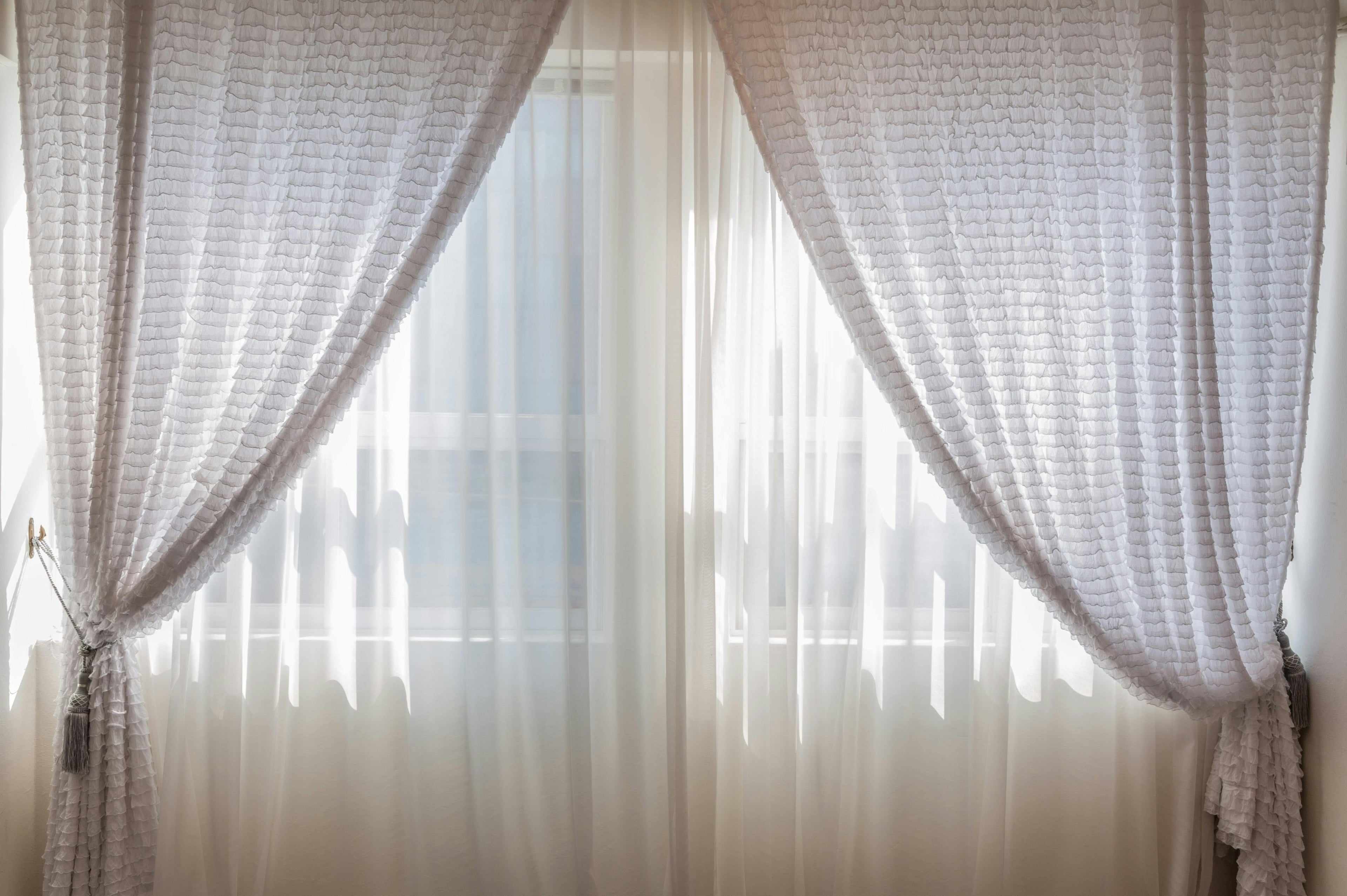
We see a lot of ring-top curtains on thin poles, for a Scandinavian or bohemian look. Sheer curtains are also making a comeback, layered over a blackout blind, to preserve privacy while letting in soft, filtered light.
The trend of zoning with textiles is strong. Using curtains to separate the cabin from the living area, creating a proper bedroom at night. Sliding curtains on a ceiling rail are perfect for this.
Custom prints are very popular. Curtains printed with geometric patterns, world maps, or natural landscapes to travel even when parked.
Finally, DIY and upcycling are central. Many nomads create their own curtains from sheets, pareos, or thrifted fabrics, adding a unique and economical touch to their interior.
Step-by-Step Installation: A Concrete Example with an Adhesive Rail
Let's take the example of a standard caravan window with an adhesive rail, a popular and accessible method.
1. Thorough Cleaning: Clean the surface around the window with a cloth soaked in 90° alcohol or isopropyl alcohol. Let it dry completely.
2. Measuring and Cutting: Measure the width of the window. Cut the adhesive rail to the correct length using a hacksaw.
3. Rail Preparation: Insert the glider hooks into the rail before sticking it. Count one every 10-15 cm.
4. Level Installation: Remove the adhesive backing. Using a spirit level, carefully place the rail, pressing firmly, starting from the center towards the ends. Maintain pressure for 30 seconds.
5. Respect the Setting Time: Do not load the rail immediately. Let the adhesive cure for at least 24 hours, even 48 hours for full strength, as recommended by most manufacturers.
6. Hanging the Curtains: Finally, hang your curtains on the hooks. Adjust the length if necessary.
FAQ: Answers to the Most Frequent Questions About Caravan Curtains
What is the best fabric for caravan curtains?
There is no universal "best" fabric, but a choice to make according to your priorities. For an ideal compromise, opt for a lightweight polyester-cotton blend that is wrinkle-resistant and stain-treated. It is durable, easy to maintain, and dries quickly. For total blackout, add a removable blackout lining attached with press studs or Velcro®.
How to fix securely without damaging the thin walls?
The strongest solution without unnecessary drilling is the use of hollow wall anchors (Molly type) when you must drill outside a stud. They expand behind the wall and offer a very robust mechanical grip, far superior to a screw alone. For small loads, high-strength adhesive hooks are surprisingly effective if the surface is perfectly prepared.
My curtains slide poorly on the rail while driving, what should I do?
This common problem is due to vibrations. Several solutions: use gliders or hooks with a stop system or a clip that holds them in place on the rail. You can also opt for curtains fixed with Velcro® at the top and bottom, or install discreet attachments (elastic bands with snap buttons) on the sides to hold them against the wall during travel.
Can curtains be installed on rounded windows or panoramic windows?
Absolutely. For rounded windows, a flexible and bendable rail (in plastic or thin aluminum) can be curved to follow the shape. It is usually fixed with small screws. For large panoramic windows, a straight rigid rail is necessary. It must be fixed very securely, ideally onto a fixing batten itself screwed into several studs in the roof or walls, to distribute the weight.
How to wash and maintain curtains while traveling?
Prefer fabrics that are machine washable at low temperatures. On the road, many automatic laundries are equipped in campsites. For quick maintenance, regular dusting with a vacuum cleaner with a soft brush and spot cleaning with a damp sponge is often sufficient. The great advantage of Velcro® or ring fixings is being able to remove the curtains in seconds for washing.
Conclusion: Create Your Custom Rolling Nest
Hanging curtains in a caravan is a project within reach of all DIYers, even beginners, provided a few key principles are respected: analyze its structure, choose the hanging method adapted to your need for strength and reversibility, and select textiles that are both beautiful and practical. Whether you opt for the discreet elegance of an adhesive rail, the robustness of a fixing into studs, or the cleverness of Velcro®, the result will transform your vehicle. Your curtains will become the guardians of your privacy, the regulators of your light, and the ambassadors of your personal style on your travels.
Feel free to consult the other practical guides and decor inspirations on ombreinterieur.fr to discover how to arrange every square centimeter of your nomadic home, from choosing floor coverings to ambient lighting. Your caravan is just waiting for your personal touch to become a true home, wherever you are. Among our favorites, find Thick Curtains. For more tips, discover how to integrate wall sconces in a rustic dining room on the blog. Browse our online store to see all our collections.
