














How to Hang a Curtain Rod: Complete Guide and Tips
Hanging a curtain rod may seem straightforward, yet a poorly planned fixing can throw off the entire balance of your window. Before reaching for the drill, you need to consider the weight of the fabric, the wall type, and the visual effect you want. This guide reveals the precise steps for a straight, sturdy installation with no unpleasant surprises. From preparation to selecting the right wall plugs for your surface, every stage matters. Follow these benchmarks to turn your fitting into a confident, lasting gesture.
Hanging a curtain rod may seem like a simple task, but it's often the step that makes all the difference between a wobbly installation and a professional finish that enhances your window. A poorly fixed rod can sag, twist, or even fall, jeopardizing your beautiful fabrics and your interior's safety. Whether you're a tenant hesitant to drill or a homeowner wanting a lasting solution, mastering hanging techniques is essential. This article guides you step-by-step, from crucial preparations to choosing the right fixings for your wall, including tips for a perfectly straight and sturdy installation. We will also explore increasingly popular no-drill alternatives and current trends in brackets and finishes to perfectly integrate your curtain rod into your decor.
Preparation: The Crucial Step Before Drilling the First Hole
Rushing for the drill is the biggest mistake. Meticulous preparation guarantees a clean and lasting result. Start by gathering all the necessary tools: a tape measure, a spirit level (a laser level is a plus), a carpenter's pencil, a drill-driver, drill bits suited to your wall, and of course, your complete curtain rod kit with its screws and wall plugs.
The first decision concerns the hanging height and width. For an elegant effect and light optimization, the current trend is to place the rod well above the window frame, between 15 and 30 centimeters. For the width, the brackets should extend at least 15 to 20 cm beyond each side of the opening. This allows the curtains, when drawn back, to fully uncover the window and let in maximum natural light.
Use your pencil to mark the precise location of the brackets on the wall. Measure meticulously so that both marks are at the same height and equidistant from the window. This marking step is fundamental to avoid unpleasant surprises.
Identifying Your Wall Type: The Key to Choosing Fixings
Not all walls are equal, and an unsuitable fixing is doomed to fail. Identifying the nature of your support is therefore imperative before choosing your wall plugs.
Plasterboard Partition (Drywall/BA13)
Very common in modern constructions, this is a delicate support because it's hollow. Standard screws won't hold. It is imperative to use plasterboard anchors. The most reliable are expansion anchors (Molly type) or self-drilling anchors. For light to moderately heavy rods, metal self-drilling screw anchors offer good hold. Ideally, aim for a wooden or metal stud behind the board. Use an electronic stud finder to locate them precisely; fixing into a stud offers incomparable strength.
Solid Brick or Concrete Block Wall
These are solid, robust supports, ideal for bearing weight. To hang a curtain rod that is heavy or large, use nylon (S) or metal expansion wall plugs. Drill with a concrete drill bit of a diameter suited to the plug. The hole depth should be slightly greater than the plug's length to prevent dust from blocking insertion.
Concrete Wall
Extremely hard, it requires a tungsten carbide drill bit (concrete bit) and often a hammer mode on the drill. Chemical anchors (resin) offer the strongest fixing possible for very heavy loads, but for most rods, quality metal expansion plugs are sufficient.
Old Stone or Earth Walls
They can be irregular and crumbly. Caution is advised. Test the wall's hardness in a discreet area. For these supports, hammer-in plugs or universal plugs for fragile materials are often recommended. In very delicate cases, consulting a professional may be wise.
The Different Fixing Methods Step-by-Step
Traditional Fixing with Drilling
This method offers the best strength. After locating and marking your holes, equip your drill with the bit suited to your wall. Drill straight, to the required depth. Insert the wall plug by tapping it gently until it is flush with the wall. Position the rod bracket over the holes and screw firmly, without excessive force to avoid stripping the screw head. Repeat the operation for the second bracket.
Before placing the rod, it is imperative to use a spirit level placed on it to check perfect horizontality. Adjust if necessary by slightly loosening one bracket. A straight curtain rod is visually essential.
No-Drill Solutions: Ideal for Tenants
The market has evolved considerably, offering serious alternatives to drilling. These systems use pressure or adhesion.
Tension rods wedge between the two walls of the recess via a spring or screwing system. They are perfect for small windows (bathroom, kitchen) or rentals. Ensure the ends are well padded with protection to avoid damaging the paint.
High-performance adhesive brackets, like command strips (VELCRO® Brand or other brands), can surprisingly support weight on smooth, clean surfaces (tiles, smooth paint). Success depends on perfect cleaning of the wall with isopropyl alcohol and respecting the setting time.
Adhesive hooks or pressure hooks specific for curtains also exist, but are generally reserved for very light curtains or sheer curtains.
Choosing the Rod and Its Accessories: Style and Functionality
Hanging isn't just about the wall. The choice of the rod itself and its finishes impacts decoration and ease of use.
Metal rods (steel, brass, copper) are very trendy, adding an industrial or vintage touch. They are sturdy and often offered with anti-rust finishes. Wooden rods (teak, oak, walnut) bring warmth and naturalness, perfect for Scandinavian or bohemian atmospheres. Anodized aluminum rods are lightweight and discreet.
Think about curtain rings. Sliding rings with silent rollers greatly facilitate opening and closing, especially for heavy curtains. Current trends favor wide glide rings for a design effect, or rings with clips to attach the fabric directly without a pole pocket.
Decorative finials are the final touch. Balls, cones, sculpted ornaments… they allow you to completely personalize your installation and harmonize it with the room's style.
Special Cases and Common Problems
Hanging a Curtain Rod in a Corner
To dress a corner window or a bay window, angled rods or flexible rail systems are the solution. They often require an additional central support to prevent sagging at the bend. A sturdy fixing at the end of each branch is crucial.
When the Wall Isn't Sturdy or is Inaccessible
If your wall is too fragile or if you have aluminum joinery (like a French door), fixing to the ceiling can be an excellent alternative, also creating an impression of ceiling height. Use appropriate ceiling fixings and, once again, check the nature of your support (concrete slab, drywall…).
For roof windows or skylights, specific skylight rods exist, which fix directly onto the roof window frame without drilling, via an adjustable clamping system.
The Rod that Sags in the Middle
This is classic for large widths (beyond 2 meters). The solution is simple: add a center support. Most long rod kits include one. It fixes to the wall, like the end brackets, and supports the rod in its middle, eliminating any deformation.
Current Trends in Curtain Hanging
Interior decoration evolves, and the approach to curtains too. A clear movement towards installations that amplify space and light is observed.
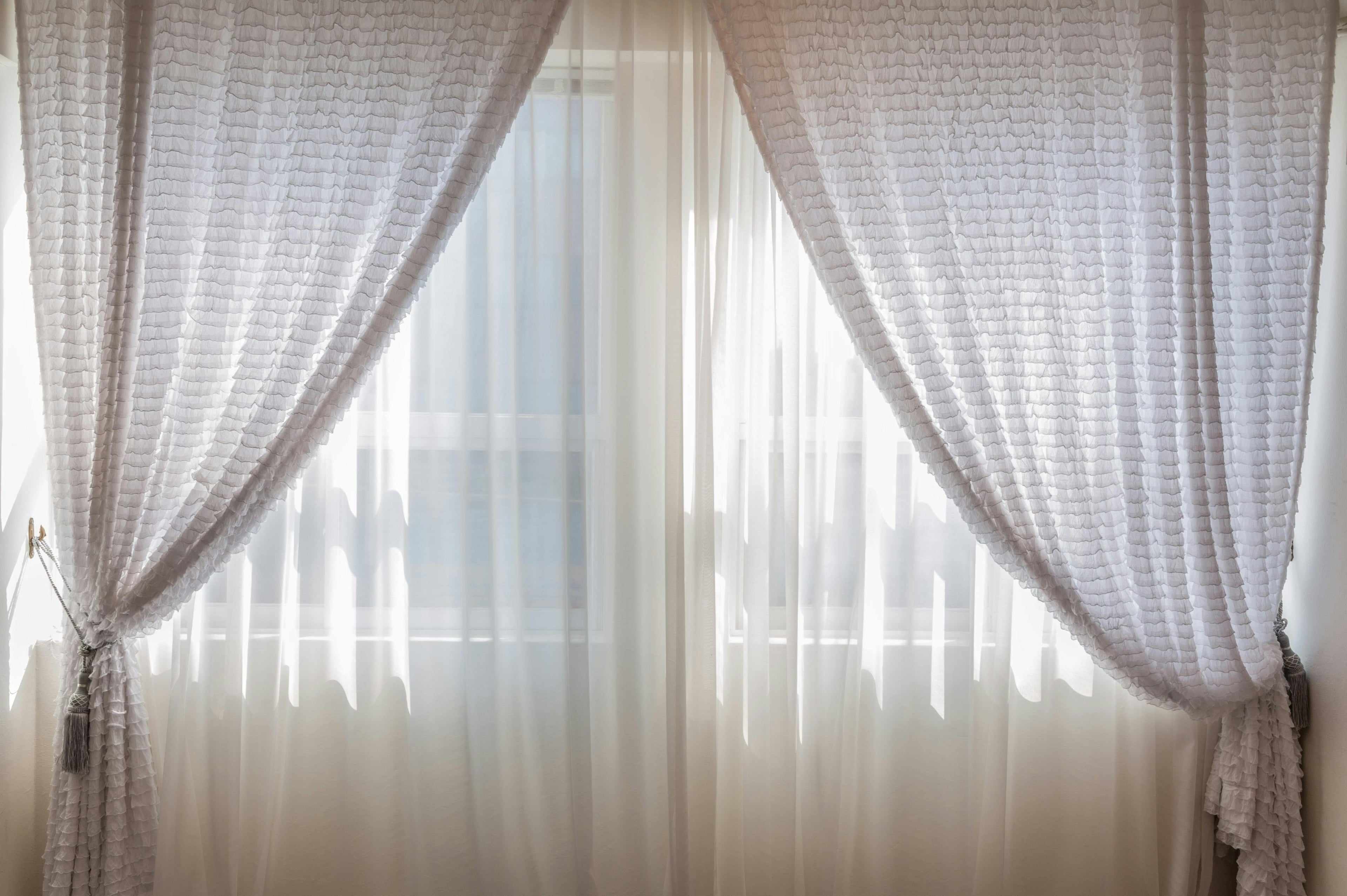
The "high and wide" trend mentioned above is more relevant than ever. Placing the rod very high, sometimes halfway between the top of the window and the ceiling, and very wide, gives a monumental impression to the window and makes ceilings appear higher.
Double rails or double rods allow layering two types of fabric: a sheer curtain to filter light during the day and an opaque curtain for privacy and night. This is both practical and aesthetic, offering volume and texture.
Finishes in raw or patinated materials are popular. Wrought iron black, aged brass, raw wood, or simply painted satin black integrate into contemporary, industrial, or rustic-chic decors.
Finally, the functional and technological aspect is developing with the appearance of discreet motorized systems, controllable by smartphone or voice assistant, for ultimate comfort, especially on large bay windows or heavy curtains.
FAQ: Answers to the Most Frequent Questions
Which wall plug should I use to hang a heavy curtain rod in drywall?
For a heavy rod and heavy curtains in a plasterboard partition, a standard wall plug is not enough. You must choose a specific anchor. Metal expansion anchors (Molly type) are excellent. The best solution, if possible, is to locate a stud using a detector and screw directly into it with a long screw (minimum 4x40 mm). This is the strongest possible fixing in drywall.
Can you really install a sturdy curtain rod without drilling?
Yes, under certain conditions. For light to medium curtains, well-adjusted tension rods are very effective. For heavier curtains on a smooth wall (tiles, smooth non-textured paint), heavy-duty adhesive fixing strips (capable of supporting several kilos per set) are a viable option, provided you scrupulously follow the cleaning and setting time instructions. However, for very heavy curtains or a permanent installation, drilling remains the most reliable method.
At what height should I fix my curtain rod brackets?
There is no absolute rule, but aesthetic principles. To visually enlarge your window and the room, fix the rod between 15 and 30 cm above the window frame. You can even go up to halfway between the top of the window and the ceiling. The important thing is that the curtains, once hung, graze the floor or form a slight "break" (a floor puddle of 1-2 cm) for an elegant effect. Avoid them stopping abruptly above the floor.
How to repair a hole that's too wide or a bracket that came loose?
If a wall plug spins in a hole that has become too wide, don't force it. Remove it. You can fill the hole with wall filler, let it dry, then re-drill in the same spot with a drill bit of a diameter suited to a slightly larger new wall plug. Another trick is to insert wooden matches or plastic plugs into the existing hole with a bit of wood glue, then re-screw the original screw. For an invisible and sturdy repair on drywall, a drywall repair kit can be used.
What is the difference between a curtain pole and a curtain rod?
The terms are often used interchangeably, but there is a technical nuance. A curtain pole often refers to a thin system, usually metal, where the curtain slides directly on the pole via a pole pocket or integrated rings. A curtain rod is often thicker, decorative, and requires separate rings that slide on the rod. Today, "rod" is the most commonly used generic term to designate the entire supporting system.
Conclusion: For a Successful and Aesthetic Installation
Hanging a curtain rod is much more than a simple DIY operation. It's the foundation of your window decor, an element that combines technical robustness and stylistic expression. By taking the time to identify your wall, choose the appropriate fixings, measure and mark precisely, you guarantee an installation that will last and showcase your curtains. Whether you opt for the strength of drilling or the flexibility of adhesive solutions, the essential thing is to adapt the method to your context and needs. Don't forget that current trends encourage you to play with heights and widths to transform a room's ambiance. To discover more inspiration and practical guides for arranging every corner of your home, explore other articles dedicated to interior decoration on ombreinterieur.fr. Our guide how to choose the color of your curtain rod helps you make the right choice. Browse our online store to see all our collections.
