















How to Hide a Window: Elegant and Trendy Solutions for 2026
Does your window frame a view you would rather forget, or break the harmony of a wall you dream of unifying? Concealing a French door without blocking it is a subtle art, blending aesthetics with practicality. Generous curtains, lightweight partitions or thoughtfully placed greenery: solutions are being reimagined to meet your need for privacy or visual continuity. Let us guide you towards the 2026 trends, where masking becomes a decorative asset in its own right, and rediscover the hidden potential of your openings.
In the world of interior decoration, the window is often considered a major asset, a source of light and a precious link to the outdoors. Yet, there are times when one wishes to mask it, conceal it, or simply redefine its presence. The reasons are numerous: an unappealing view, a heightened need for privacy, an optimization of wall space, or a purely aesthetic desire to create a particular ambiance. Masking a window does not necessarily mean condemning it, but rather integrating its existence into a broader decorative project, where it becomes a fully modular element. This art of intelligent concealment opens up a vast field of possibilities, ranging from classic textile solutions to the most daring architectural tricks.
Whether you are looking to soften the impact of a poorly placed window, create an accent wall for an art collection, or transform a room into a home cinema, the methods to achieve this are numerous and adapt to all styles. This article guides you through current trends and proven techniques for masking a window with elegance and functionality. We will explore in detail temporary and permanent solutions, preferred materials, and pitfalls to avoid to successfully carry out this transformation without sacrificing the charm of your interior.
Why would you want to mask a window? Analyze your needs
Before embarking on any work or purchases, it is crucial to clearly define the objective. Masking a window is rarely a decorative whim; it is often the answer to a real constraint. Understanding the root of the problem will allow you to choose the most suitable and durable solution.
The first and most common reason is an unwanted view. Whether it's a party wall, a dark inner courtyard, or an unappealing urban landscape, a window can sometimes become a source of visual nuisance rather than an asset. In this case, the goal is to block the view while preserving, if possible, the light intake.
The need for total privacy is another important driver, especially in bedrooms, ground-floor bathrooms, or apartments facing each other. Here, the solution will often need to combine concealment and aesthetics.
Sometimes, the window itself is perceived as a disruption in the harmony of a wall. To create a dedicated space for video projection, install an imposing bookshelf, or hang a large-scale art gallery, a continuous wall surface is essential. Masking the window allows you to recreate this continuity.
Finally, thermal and acoustic reasons may come into play. An old, poorly insulated window may justify a masking solution that also improves the room's sound and thermal insulation. Identifying your primary motivation is the foundational step of any successful project.
Classic textile solutions and their modern evolutions
The curtain remains the most obvious and flexible solution for masking a window. But far from simple sheers, current trends push textiles to their limits to make them a full-fledged architectural element.
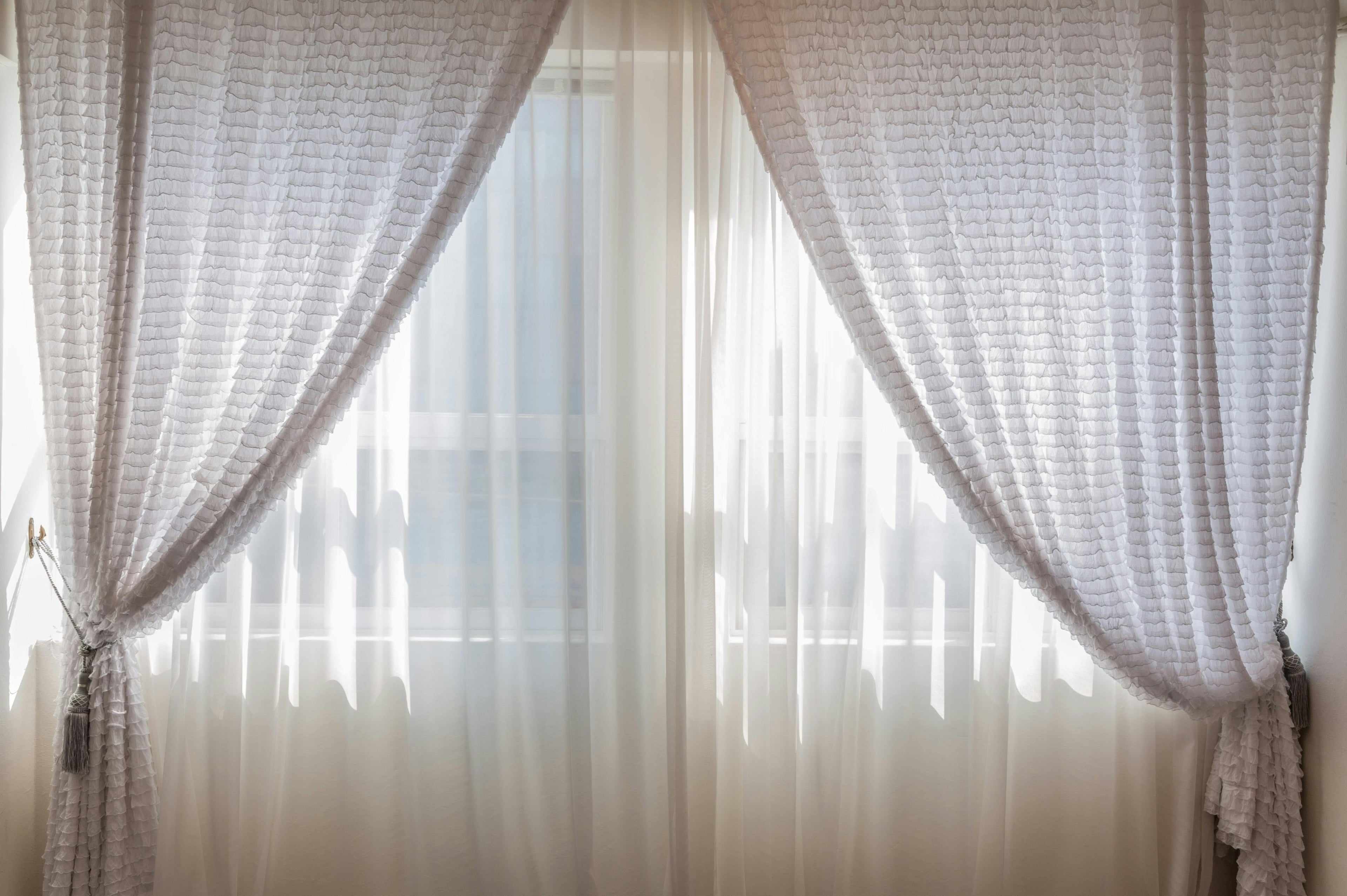
The most radical option is the full-length curtain, sliding on a rod that extends well beyond each side of the window. By closing it, you not only mask the glazing but transform the entire wall into a cascade of fabric. Choose heavy, draping textiles like velvet, thick linen, or thermal double-curtains for a luxurious and effective effect.
The trend of the ceiling-mounted curtain or French style (where the rod is fixed to the ceiling) accentuates this effect. The curtain starts from the ceiling and falls to the floor, creating a perfect vertical line that completely erases the presence of the window behind it. This is an ideal solution for rooms with high ceilings.
For a more graphic and contemporary effect, Japanese sliding panels or vertical roller fabric blinds are very popular. Their clean lines and operation with independent panels allow for the creation of light, modular partitions. They are perfect for masking a sliding glass door or a large window in a minimalist way.
Don't forget the back of the curtain! For perfect blackout and optimal insulation, consider lining your curtain with a thermoreflective lining or installing a blackout blind directly on the window frame before putting up the decorative curtain. This combination is unbeatable.
Transforming the space: partitions and room dividers
When the window is located in a place that complicates the layout, the solution may be to create a new partition in the room. Masking the window behind a partition or a divider unit allows for an intelligent reconfiguration of the space.
A lightweight partition, made of wood, metal, or frosted glass, can be installed in front of the window. The trick is to leave a gap of a few centimeters between the partition and the wall so as not to obstruct the shutters or hinder the window's opening. This partition can then serve as a support for shelves, become an original bed headboard, or simply be dressed with a beautiful paint or wallpaper.
The bookshelf unit is a doubly winning solution. An open bookshelf, the same width as the wall, placed in front of the window, allows you to store your books while completely masking the view. To avoid losing all the light, choose an airy structure and avoid filling all the shelves. Light can filter through the objects and create interesting shadow plays.
For smaller spaces, a decorative screen offers total flexibility. You can move it according to your needs and choose it in a material that matches your style: reed canes for a bohemian vibe, lacquered wood panels for a modern look, or fabric stretched over a frame for a softer effect. It is the ideal solution for temporarily masking a window in a guest room or office.
The illusion through decoration: trompe-l'œil and wall coverings
Masking a window can also involve artifice and the creation of an optical illusion. This very creative approach allows you to keep the window functional while integrating it spectacularly into the decor.
The trompe-l'œil technique on shutters or a blind is a bold option. An artist can paint directly onto hinged shutters or a bay blind a scene that seems to extend the room (a library, a garden) or creates a false perspective. Once closed, the shutters become a painting.
More accessible, covering the entire wall with a large, repeating patterned wallpaper can drown the window in the decor. By continuing the wallpaper over the window frame and onto the shutters or a Roman blind, you create a unified surface where the window blends in. Large-scale botanical patterns or vertical stripes are particularly effective for this.
Another strong trend is to use the window as a frame. Install a blind or adhesive film that covers the entire glazing, then hang in front, a few centimeters away, a piece of art or a decorative object (a macrame, a loom). The window then becomes a highlighted niche, and its opening is no longer the central subject.
Bold structural and architectural solutions
For those ready for more profound transformations, architectural solutions offer a definitive and often very aesthetic masking. These projects generally require the intervention of professionals.
Building a false bookshelf or built-in closet is the queen of structural solutions. This involves constructing a wooden or veneer structure in front of the window, incorporating sliding or hinged doors that imitate the shelves of a library. The back of the structure is arranged to allow access to the window if needed (for maintenance or a potential emergency exit). It is an investment that also adds storage.
Replacing the glazing with an opaque material is another avenue. You can substitute clear glass with frosted glass, sandblasted glass, stained glass, or even resin or wood panels. The window still lets light through, but the view is completely obstructed. This solution is very elegant and modern.
Finally, as part of a major renovation, one might consider moving the window or professionally sealing it up. This last option, very radical, must be carried out according to best practices (respecting ventilation, reinforced insulation) and in accordance with local regulations (especially for living spaces). It then allows you to treat the wall like any other wall.
Focus on materials: from wood to metal, what to choose?
The choice of materials is decisive in the effectiveness and aesthetics of your masking project. Each material brings its own properties and ambiance.
Wood remains a safe bet. Warm and robust, it is suitable for partitions, bookshelves, shutters, or sliding panels. Oak or walnut bring character, while painted pine or birch plywood fit into more contemporary decors. Think of wooden slats for claustras that poetically filter the light.
Metal, in the form of wrought iron, corten steel, or brass, offers an industrial or refined look. A perforated metal partition in front of a window creates a beautiful play of shadows and light while ensuring a certain privacy. Metal slatted blinds (Venetian type) are also a very design option.
Innovative textile materials should also be considered. Acoustic fabrics stretched over frames can be used to create panels that mask a window while improving the room's sound insulation. Natural fibers like jute or raw linen add texture and warmth.
Finally, don't neglect translucent materials like frosted glass, polycarbonate honeycomb panels, or sandblasted adhesive films. They allow you to maintain diffuse brightness and a sense of space while erasing the details of the outside view. Perfect for bathrooms or kitchens.
Practical cases: masking a window in each room of the house
The ideal solution varies greatly depending on the room in question, as the constraints of use and ambiance are not the same.
In the bedroom
The challenge is privacy and total darkness for quality sleep. The winning combination is often a rigid blackout blind (aluminum or PVC) coupled with thick curtains. To completely mask the window during the day, opt for dual-purpose curtains with an integrated blackout lining, or install a fixed valance that hides the rod and the top of the window.
In the living room or dining room
Here, flexibility is key. You want to be able to open up to the outside sometimes, and create a cozy ambiance at other times. Sliding panels on a rail (wood, stretched fabric, or rattan) are perfect. They move like partitions and can let filtered light through. A large bookshelf in front of the window can also work if space allows.
In the bathroom
Humidity and the need for privacy are paramount. Permanent masking with frosted glazing or adhesive film is often the simplest and most hygienic solution. For more style, hinged shutters in exotic wood (like teak) or wood-effect PVC resist humidity well.
In the office or library
The goal is to minimize distractions. A cork or bulletin board partition installed in front of the window allows you to create a functional wall for pinning notes and inspirations, while masking the view. A textured wall hanging can also create a studious and focused atmosphere.
Mistakes to absolutely avoid
Masking a window has a few pitfalls that are best anticipated for a professional and regret-free result.
The first mistake is forgetting access and functionality. Never block a window that serves as an emergency exit. Also, ensure you can still access the window for cleaning, seal maintenance, or occasional airing. Always leave a space or plan for an easily removable system.
Neglecting humidity regulation and ventilation is a risk. A window masked by a too-tight partition can promote condensation and mold on the hidden glazing. Ensure effective mechanical ventilation (MVHR) or plan for discreet air vents.
Aesthetically, avoid solutions that are too small or disproportionate. A curtain that is too narrow, leaving the window outlines visible, will look miserable. For successful masking, you often need to cover a larger surface area than the window itself to create a new visual composition.
Finally, be wary of materials unsuitable for direct light. Some fabrics, wallpapers, or woods will fade quickly if exposed to sunlight all day behind glass. Choose UV-resistant materials for maximum longevity.
Trends 2026: masking a window with style
Interior decoration evolves, and so do the ways of masking a window. Here are the current top trends that combine innovation and aesthetics.
"Indoor winter garden": rather than hiding the window, frame it with a jungle of hanging green plants or plants placed on shelves. The lush vegetation eventually obscures the view while creating a living and soothing decorative element. Climbing plants on light structures are perfect for this.
Extra-wide and curved slatted blinds: a new generation of Venetian blinds, their slats over 10 cm wide, sometimes curved, offer a sculptural light play and very effective blackout. They become a graphic element in their own right on the wall.
Use of felted wool: a natural material and excellent acoustic insulator, thick felt is used to create acoustic panels or heavy curtains. Its soft texture and deep colors bring a cocooning and contemporary touch.
The return of the tab-top curtain and exposed rod in an industrial or rustic style. The simplicity of the system is highlighted, and the curtain, in raw linen or thick cotton, seems to slide heavily to cover the window with nonchalant elegance.
FAQ: Your questions about window masking
Can you mask a window without losing natural light?
Absolutely. This is even one of the main challenges. Prioritize solutions that filter or diffuse light rather than those that block it completely. Translucent adhesive films, frosted glazing, openwork partitions (claustras), light fabric blinds like blackout sheers, or open shelves in front of the window allow you to maintain pleasant natural lighting while masking the direct view.
What is the most economical solution to hide a window?
DIY textile solutions are often the cheapest. A curtain made from a large piece of fabric bought by the meter and a simple rod can transform a room for a modest budget. Decorative or sandblasted adhesive films are also a very affordable and easy-to-install option. Finally, a large screen bought second-hand or customized can serve as a lightweight partition at a lower cost.
How to mask a window in a rental without drilling holes in the walls?
The constraint of renting requires reversible and non-invasive solutions. Several options are available to you: tension rods for curtains (which lock between the floor and ceiling), blinds with adhesive or suction cup fixings, large decorative panels (like screen prints on stretched canvas) simply leaned against the wall in front of the window, or freestanding bookshelf units you can take when moving. Adhesive films generally come off without leaving marks.
Is it legal to permanently seal a window?
Regulations vary by country and municipality, but in France, for a residential dwelling, it is generally forbidden to remove the only source of natural light and ventilation from a main room (bedroom, living room, dining room). A room must have a window area at least equal to 1/6th of its floor area. Sealing a window can also cause problems for building permits during a sale. It is essential to check with the town hall or an architect before any definitive sealing project. Reversible masking solutions are therefore almost always preferable.
How to thermally insulate a window that you are masking?
Masking is an opportunity to improve insulation. For a textile solution, choose curtains lined with a specific thermal lining, often aluminized, which reflects heat. For structural solutions like a bookshelf or partition, ensure you fill the space between the new panel and the wall with rock wool or expanded polystyrene. Also, install weatherstripping around the window frame itself before concealing it. Each added layer helps reduce heat loss.
Conclusion: Redefining the boundaries of your interior
Masking a window is much more than a simple camouflage trick. It is a design act that allows you to regain control over the layout of your space, the quality of light, and the overall ambiance of a room. Whether you opt for the softness of a floor-to-ceiling curtain, the ingenuity of an integrated bookshelf, or the character of a raw wood partition, each solution tells a story and meets a specific need.
The essential thing is to always combine aesthetics with functionality, without losing sight of practical aspects like access, ventilation, and light preservation. By following the advice and trends detailed in this article, you now have a complete toolkit to transform what might have been a constraint into a major decorative asset. Don't be afraid to experiment and personalize these ideas so they perfectly match your lifestyle and vision for your home.
To discover more inspiration on space planning, light optimization, or creating custom ambiances, feel free to explore the other articles and comprehensive guides available on Ombre Intérieur. Your interior deserves to be the exact reflection of your desires and personality. Our guide how to integrate a planter box in a small 30 m studio helps you make the right choice. Visit ombreinterieur.fr to explore the full catalog.
```