















How to Make Curtains for Sloped Windows
Sloping windows bring undeniable architectural charm, yet dressing them often becomes a technical puzzle. Gravity pulls at the fabric, while you must also safeguard precious daylight, making every choice deliberate. If you are seeking to balance beauty with practicality without getting lost in measurements or mounting systems, this guide points the way to elegant, custom solutions. These angled openings can become a major decorative asset, transforming awkward spaces into highlights. Let professional insights inspire you, from clever rail systems to softly draped linen that follows the pitch with grace.
Sloping windows, these architectural openings full of character, transform a room by offering it light and volume. Yet, when it comes to dressing them, they often become a headache for homeowners and decoration enthusiasts. How do you dress these angled bays, skylights, or roof windows without sacrificing light or aesthetics? The solution lies in the design of custom-made curtains for sloping windows. This article is your complete guide to understanding the specifics of these openings, choosing the right systems and fabrics, and mastering installation techniques for a professional result. We will explore current trends, pro tips, and answer all your questions so that your slanted windows become the highlight of your interior decor.
Understanding the specific challenges of slanted windows
Before diving into making or purchasing, it is crucial to grasp the particularities of sloping windows. Unlike a standard window, the angle introduces unique technical and aesthetic constraints. Gravity acts differently on the fabric, potentially causing unsightly sagging if the system is not adapted.
Light tightness and thermal insulation are also major issues, especially for skylights and roof windows. Poor installation can create thermal bridges. Finally, accessibility is a practical point: the opening and closing mechanism of the curtains must remain simple despite the angle, for easy maintenance and daily use.
The different types of sloping windows and their solutions
Not all slanted windows are the same. Their configuration directly influences the choice of curtain solution.
Velux® and standard roof windows
These models, often equipped with a crank or remote control opening system, require integrated solutions. Specific blinds or curtains, designed to fit the window's own rails, are ideal. They are often operated by a rod or cord and perfectly follow the shape, maximizing insulation.
Angular bay windows or bow windows
Here, the slope is part of a larger structure. The goal is to create decorative continuity. An elegant solution is to install a straight curtain rod or track above the highest part of the bay, allowing the curtains to fall in front of the entire structure. This unifies the look and simplifies installation.
Isolated sloping windows (in attics)
These openings, without an integrated system, offer the most creative freedom. You can opt for curtains fixed directly to the wall or ceiling following the line of the slope, creating a spectacular architectural effect. It is for this type of window that custom-made curtains are most common and rewarding.
Choosing the ideal fixing system: track, rod, or bar
Choosing the fixing system is the most technical step in creating curtains for sloping windows. It determines the smoothness of movement, the fabric's hold, and the ease of installation.
Curved and curvilinear tracks
This is the premier solution for a perfect result. A metal or plastic track can be custom-bent to exactly match the angle of your window. The gliders slide smoothly, even in tight curves. Concealed rack tracks are particularly aesthetic and modern, offering ultra-silent gliding. They are perfect for complex bays.
Custom curtain rods
For gentle slopes, a wooden or metal rod fixed following the roof line can be a beautiful, more traditional option. You will then need rings wide enough to slide easily on the rod. The effect is more rustic or industrial, depending on the chosen material.
Tension rod systems
A simple, no-drill solution for small sloping windows. The tension rod is placed inside the frame. However, it is only recommended for very light curtains and small widths, as the pressure may not be sufficient to hold significant weight over time, especially with the angle.
The step-by-step guide to taking precise measurements
A measurement error is irreparable. For curtains on sloping windows, precision is even more critical. Here is the professional method.
Start by sketching your window on paper. You will measure three main dimensions: the width, the height at the lowest point, and the height at the highest point. For the width of the track or rod, always add an overhang of 15 to 20 cm on each side to ensure good lateral coverage and allow the curtain to be fully drawn without obstructing light.
For the curtain length, it all depends on the desired effect. For a straight drop along the glass, measure from the track to the bottom of the frame. For a more theatrical effect that touches the floor, measure to the floor following the slope. Use a spirit level and a metal tape measure. Note all measurements at several points, as walls and ceilings are never perfectly straight.
Selecting the perfect fabric: weight, texture, and opacity
The choice of fabric is both aesthetic and technical. For a sloping window, the weight of the fabric is paramount. A fabric that is too heavy will be difficult to slide and will pull on the system. A fabric that is too light will lack structure and may sag.
Linens, thick cottons, and natural fiber blends offer a good compromise. Fabrics with a tight weave, such as twills or jacquards, have good structure. For the bedroom, prioritize total opacity (blackout fabrics) for quality sleep. In the living room, a light linen or a lined sheer curtain allows you to preserve privacy while diffusing beautiful light.
Current trends favor natural materials and textures. Corduroy velvets bring warmth and depth, while raw linen canvases offer a contemporary style that is both soothing and stylish. Don't forget to allow a little extra fabric for hems and seams, especially if the pattern requires matching.
Construction techniques: hems, linings, and finishes
The construction of curtains for slanted windows requires special attention to detail. The bottom hem, which follows the slope, must be cut and hemmed on the bias. This requires cutting the fabric at the precise angle of your window. One tip is to create a pattern using kraft paper before cutting the final fabric.
Lining is not optional for sloping windows. It improves structure, thermal and acoustic insulation, and protects the main fabric from the sun. For an optimal result, the lining should be cut in the same way as the main curtain and assembled with a "closed" seam. For bedrooms, opt for a heat-bonded blackout lining.
For the curtain header, systems with eyelets or a sewing channel (for sliding a rod) are the simplest. For a track with hooks, a pocket header tape (like a "hook tape") is essential. It is sewn to the top of the wrong side of the curtain and allows you to insert the hooks at the desired spacing.
Installation and fitting: professional tips
Installation is the final step. For a curved track, start by assembling the sections on the floor according to the plan. Mark the location of the fixings on the wall, using a laser level for perfect horizontality, even if the ceiling is sloped. The wall plugs and screws must be suitable for the nature of your wall (drywall, concrete, wood).
Hang the curtains before permanently fixing the track for a trial run. Check the smoothness of movement along the entire length. Once satisfied, firmly fix the track. For long curtains, it may be necessary to add weights in the bottom hem to guarantee a perfect drape despite the slope. These small sew-in weights are hidden in the corners of the hem.
2026 decor trends for dressing character windows
Contemporary decoration sees sloping windows not as a constraint, but as an asset to be showcased. The trend is towards minimalism and texture. Curtains for roof windows in neutral and natural tones (off-white, linen grey, earth) create a serene atmosphere.
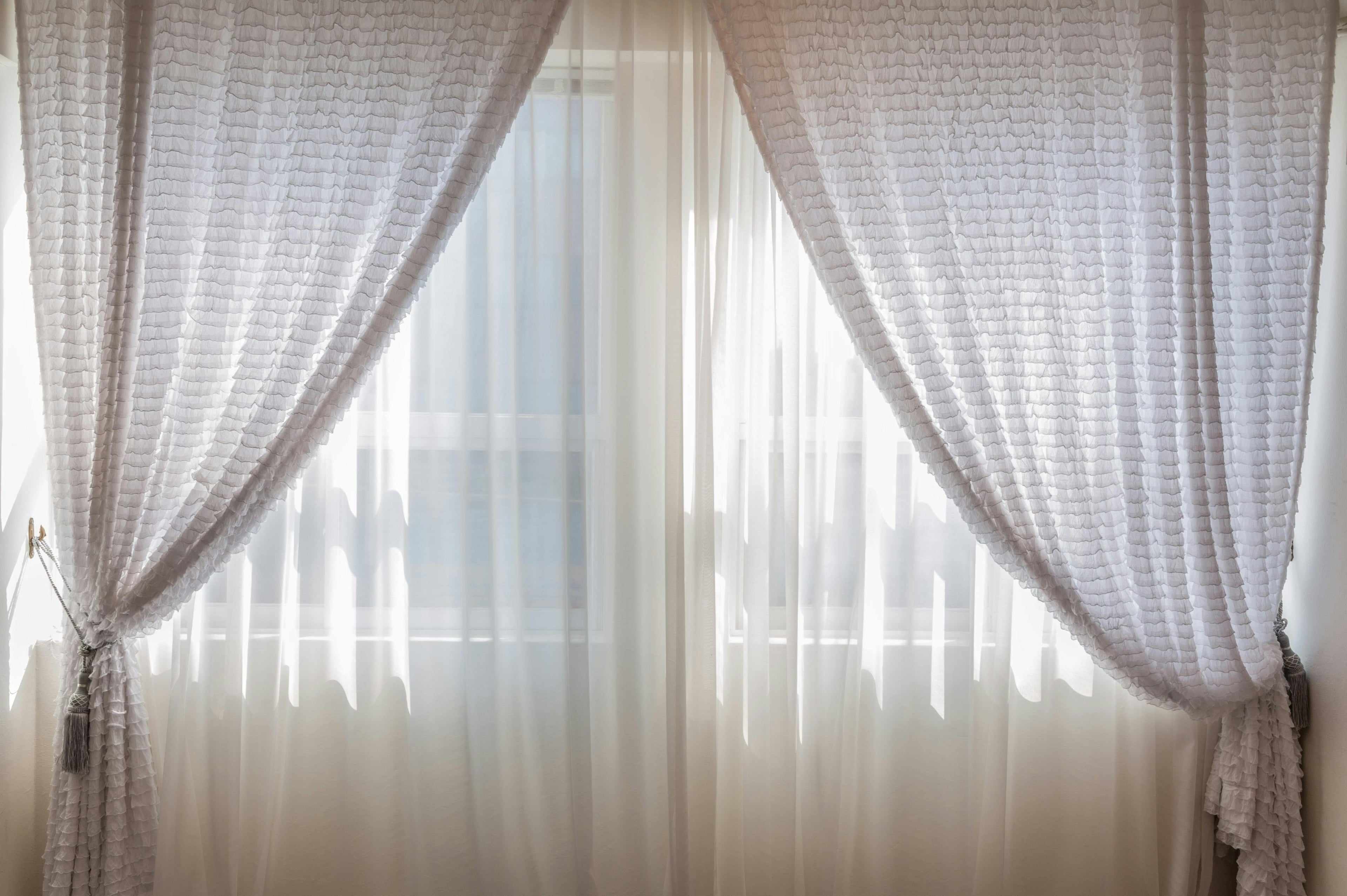
The "draped" style is making a comeback: a single plain curtain, ample and fluid, fixed only at a few strategic points along the slope, creating organic and sculptural folds. Mixed materials are also in vogue: combining raw linen with a natural silk lining for a subtle play of reflections.
The idea is to play with light. Thick sheers or technical solar-filtering fabrics (screen) are perfect for south-facing rooms, allowing you to enjoy the view without glare or excessive heat.
FAQ: Answers to your questions about sloping curtains
Can ready-made curtains be used for a sloping window?
It is very difficult to find standard curtains suitable for a specific slope. Straight lengths will not work. However, for a temporary or budget-friendly solution, you can buy longer curtains and hem them yourself on the bias. But for an optimal and aesthetic result, custom-made remains the best option.
How to clean and maintain curtains fixed at height?
Choose machine-washable fabrics at low temperature. For regular dusting, use the brush attachment of your vacuum cleaner. For removal, choose a track system with easily detachable hooks. Also consider anti-stain and anti-dust treatments when purchasing the fabric.
What budget should be planned for custom sloping curtains?
The cost varies greatly depending on the system (a custom curved track is an investment), the quality of the fabric (from €20 to €200 per meter), and labor if you use a professional. Expect a minimum budget of €300 to €500 for a standard-sized window with entry-level fabric, potentially rising to several thousand euros for complex bay windows with high-end materials.
Are there alternatives to curtains for these windows?
Absolutely. Roller blinds or vertical blinds specifically for skylights are excellent. Adhesive solar films provide privacy without blackout. For a modern style, claustras or sliding panels in wood or metal can be considered, although their installation is heavier.
How to guarantee good thermal and acoustic insulation?
The secret lies in the combination: a perfectly adjusted track that follows the window's contour, a dense and thick fabric, and a quality thermal lining (blackout or quilted type). Ensure the curtain fully covers the entire opening and touches the wall or frame on the sides to limit heat loss.
Conclusion: Transform your constraint into a major decorative asset
Dressing a sloping window requires careful thought, meticulous measurement, and a wise choice of materials. But it is well worth the candle. Well-designed curtains for sloping windows are not just a simple accessory; they become an architectural element in their own right, sculpting light, adding warmth, and completing the identity of a room. By following the detailed advice in this guide, you have all the keys to successfully meet this decorative challenge.
Whether you opt for a high-tech track or a rustic rod, for a wispy linen or a cozy velvet, the important thing is that your solution reflects your style and meets your practical needs. Feel free to explore more inspiration and technical guides on ombreinterieur.fr, where you will find a wealth of ideas to make every detail of your home a source of harmony and beauty. Go ahead, and let the light in, on your terms. Need practical advice? Read how to choose posters for the hallway in a minimalist style. Visit ombreinterieur.fr to explore the full catalog.
