
















How to Install Curtains on the Ceiling: Complete Guide
Hanging your curtains from the ceiling rather than the wall is a decorative gesture that transforms a room, lending it height and visual flow. Far more than a passing trend, this approach addresses practical concerns: concealing an architectural flaw, enlarging a space, or dressing a bay window without wall constraints. To ensure your project is both beautiful and secure, careful preparation is essential. Let us guide you through the key steps that will make this installation a defining asset for your interior.
Installing curtains from the ceiling is far more than a simple alternative to classic wall-mounted curtain rods. It is a bold decorative solution that radically transforms the perception of a room, creating an impression of ceiling height, structured elegance, and visual fluidity. Whether you wish to conceal an architectural flaw, create a room divider, or simply adopt a contemporary and minimalist aesthetic, suspending your curtains from the ceiling offers unparalleled versatility. However, this operation requires careful preparation and adherence to certain rules to guarantee both the safety and aesthetics of the final result. In this article, we will detail each step, from crucial preliminary considerations to choosing hanging systems, as well as current trends in fabrics and styles, to ensure your ceiling curtain installation project is a complete success.
Why opt for ceiling-mounted curtains? The decisive advantages
Before starting the work, it is essential to understand how this method stands out. Ceiling installation is not merely an aesthetic whim; it addresses concrete issues and offers tangible benefits. Firstly, it creates a powerful optical illusion by guiding the eye upward, making walls appear taller and the room more spacious—a valuable asset in modern homes with sometimes low ceilings.
Secondly, it allows for optimal light and privacy management, as the curtain can cover the entire window, from floor to ceiling, without interruption. Finally, it is the ideal solution for difficult, fragile walls (such as stone or drywall), or non-existent ones, as in open-plan spaces where you want to define an area without building a partition. The effect is both graphic, modern, and timeless.
Essential preliminary step: analyzing your ceiling
The nature of your ceiling is the most critical factor for the safety and durability of the installation. A mistake at this stage can lead to a complete pull-out. It is imperative to identify the load-bearing structure.
Drywall ceiling (BA13)
This is the most common configuration in recent constructions. Drywall alone cannot support the weight of a curtain, especially if it is heavy and large. You must absolutely screw into the joists (or rafters), the wooden or metal beams that support the ceiling. Use a quality material detector to locate them precisely. In their absence, using drywall-appropriate anchors, such as expansion anchors like Molly bolts or self-drilling anchors, is mandatory, strictly respecting their maximum load capacity.
Concrete ceiling
More solid but harder to drill, concrete requires a hammer drill and chemical or steel expansion anchors. This is the safest option for very heavy curtains or large sliding doors. Take the time to mark and drill straight.
Ceiling with a false ceiling
Caution: a false ceiling (suspended tiles or panels) is never load-bearing. You must absolutely go through the structure to fix the supports into the concrete slab or joists above. This may require moving a tile or working with threaded rods lowered from the load-bearing structure.
Choosing the hanging and gliding system: complete guide
Once the ceiling structure is identified, choosing the hanging hardware is paramount. It determines the style, ease of operation, and overall robustness.
Straight ceiling curtain rod: classic and effective
This is a bar, often made of metal (steel, brass, aluminum) or wood, fixed parallel to the wall with brackets spaced about 50 to 80 cm apart. This is the simplest solution for a straight window. Current trends favor discreet finishes (matte black, white, anthracite) or, conversely, very bold ones (brushed copper, aged gold). Ensure the rod comes with mounting brackets suitable for ceiling installation.
The track or ceiling track: the professional and discreet solution
The track is a recessed or surface-mounted system in which silent wheeled carriers glide. This is the ideal option for heavy curtains, wide widths, or angled windows (bent). It is perfect for a minimalist style, as it is almost unnoticeable. Tracks can also be curved to follow rounded shapes, a strong trend in current interior design.
Tension cables: the design and airy option
For a clean, industrial, or Scandinavian ambiance, stainless steel cables tensioned between two ceiling fixing points are perfect. The curtain rings or hooks glide directly on the cable. This system supports less weight than a track, but its light visual effect is incomparable. Check the cable tension and the strength of the end fixings.
Ceiling rings and hooks
For a more relaxed or bohemian style, you can directly fix sturdy rings or hooks to the ceiling and pass a wooden or metal tension rod through them. This is a less formal solution, often used for sheers or lightweight fabric curtains.
Step-by-step technical installation steps
Now let's move on to the practical execution. Prepare a long spirit level, a tape measure, a pencil, a suitable drill/driver, and, of course, your hanging system.
1. Precise marking and tracing
Determine the exact location of your rod or track. Generally, it is installed 10-15 cm above the top of the window and extending 15-20 cm on each side of the window to allow the curtain to be fully drawn without blocking light. Draw a perfectly level straight line along the entire length. This line will guarantee the professional finish.
2. Marking the fixing points
Position the first bracket at the end of your line, following the manufacturer's instructions. Mark the hole locations. Then measure the recommended spacing between each bracket (this depends on the curtain weight and rod length) and mark all other points. One extra bracket is always better than one too few to prevent sagging.
3. Drilling and fixing
Drill at the marked locations with a drill bit suitable for your wall (concrete bit, wood bit, etc.). Insert anchors if necessary. Firmly screw all brackets to the ceiling, ensuring they are well aligned and straight. This step is crucial for safety.
4. Installing the rod or track
Attach the rod or track to the previously installed brackets. For a rod, this may require screwing it into the brackets. For a track, it usually clips onto the carriers or screws directly. Check the overall sturdiness by applying slight downward pressure.
5. Hanging the curtains
Finally, hang your curtains on their attachment system (rings, hooks, clips). Let them hang for a few days before hemming them definitively so they stretch naturally under their own weight.
Choosing the right curtains for ceiling installation
The choice of fabric and style is inseparable from the installation method. A ceiling installation showcases the curtain as an architectural element.
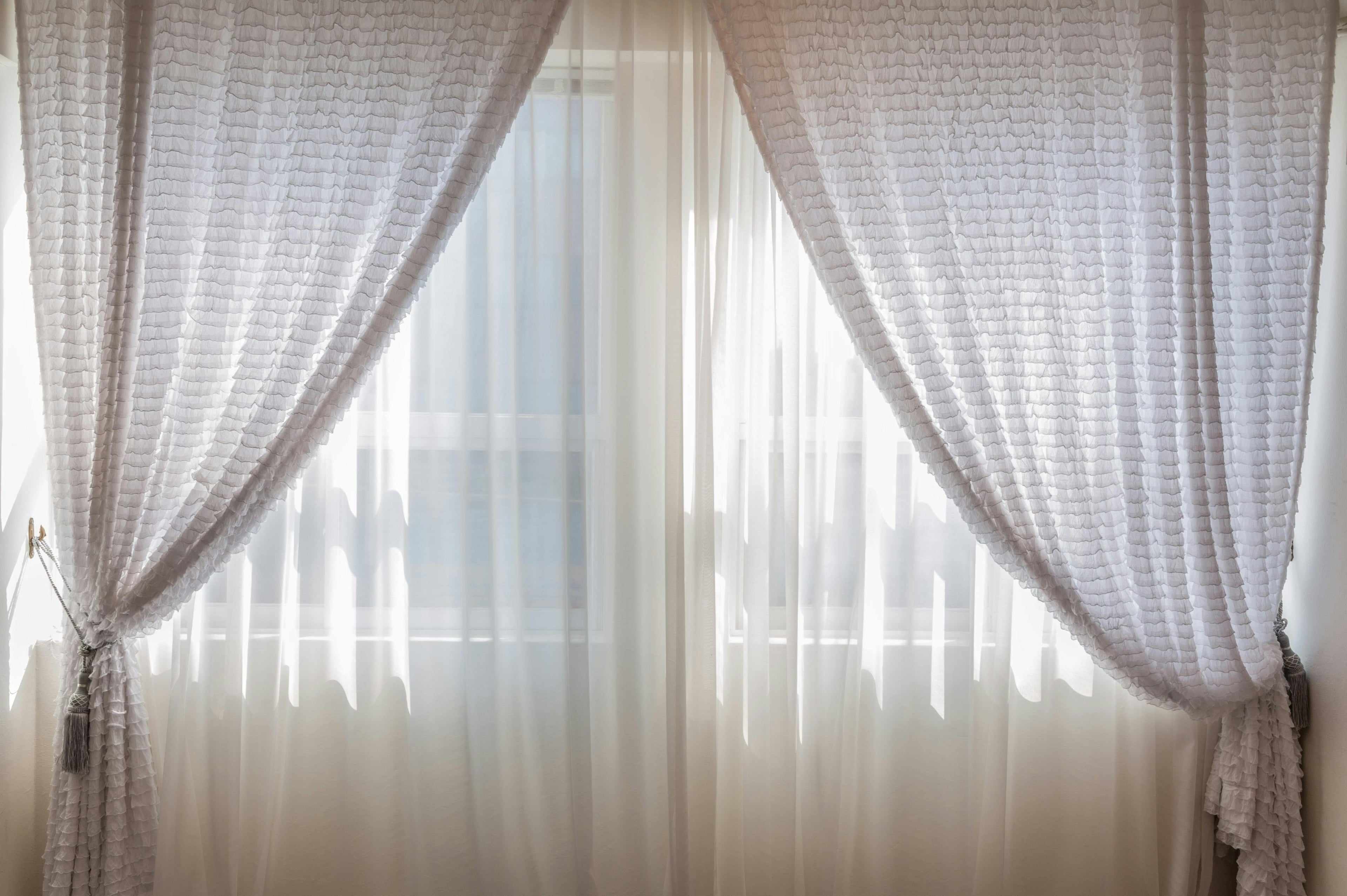
Opt for fabrics with noble and fluid drapes like linen, thick cotton, canvas, or velvet for a structured and luxurious effect. Light sheers will create a vaporous and luminous effect. The current trend is towards natural materials, textures (slub, jacquard), and deep colors (midnight blue, forest green, terracotta) or, conversely, neutral and raw tones.
Regarding length, the "touching the floor" effect or slightly "floating" (1 to 2 cm above) is most pleasing. "Pooling," where the fabric spreads generously on the floor, is making a strong comeback for a bohemian-chic and very dressed look. For a ceiling installation, the height is perfect for playing with these spectacular effects.
Decorative ideas and creative staging
Ceiling installation opens up an infinite field of possibilities in interior decoration.
- Room divider in a loft: Use a large curved track or a double rod to create a flexible partition between the living room and bedroom, or the kitchen and living area. Choose an opaque fabric for privacy or a filtering fabric to preserve light.
- Theatrical framing of a bed: Fix a U-shaped rod above the bed to create a romantic and intimate canopy. Curtains can be drawn at night for a cozy cocoon.
- Dressing an angled bay window: A bent track allows you to perfectly follow an angled window or conservatory, offering a custom-made and ultra-functional dressing.
- Playing with double curtains: On a double ceiling rod, combine a sheer to filter light during the day and a heavier blackout curtain for the night. This is the perfect combination of functionality and aesthetics.
Mistakes to absolutely avoid
To guarantee the success of your project, here are the most common pitfalls:
- Fixing only into drywall: This is mistake number one, a source of accidents. Always screw into the load-bearing structure or use drywall-appropriate anchors with a wide safety margin.
- Neglecting the level: A non-straight rod or track is immediately visible and gives a sloppy appearance to the installation.
- Underestimating the weight: A 4-meter wide velvet curtain with lining is very heavy. Choose a system and fixings accordingly.
- Forgetting clearance space: Curtains that bump against the wall or window frame when drawn are unsightly and ineffective. Think about the overhang.
- Hemming before installation: Always let curtains stretch for a few days after hanging before determining the final hem height.
FAQ: Answers to your questions about ceiling curtains
What type of anchor to use for a drywall ceiling?
For a solid fixing in drywall without accessible joists, metal expansion anchors (like Molly bolts) or self-drilling drywall anchors are most recommended. They expand behind the board to offer a large gripping surface. Always respect the maximum load indicated by the manufacturer and multiply safety by adding fixing points.
Can you install ceiling curtains in a rental?
Yes, but with caution. Opt for systems that require minimal drilling (lightweight tracks) and use easily fillable anchors. In some cases, a tension rod installed at the ceiling (though rarer and less stable) or a high-resistance adhesive track system for smooth surfaces can be a temporary alternative, though less reliable for heavy curtains.
How to conceal the rod or track for a more integrated look?
Several solutions are available. You can install a finishing strip or ceiling molding that forms a niche to hide the track. Another decorative option is to add a curtain valance or pelmet, a strip of fabric fixed above the rod that falls elegantly to conceal it. Finally, choosing a track the same color as the ceiling will make it much less visible.
What is the ideal height for hanging curtains from the ceiling?
The height is generally dictated by the architecture. If your ceiling is standard (2.50m), fix the rod 5-10 cm from the ceiling to avoid a "squashed" effect. If you have very high ceilings, you can lower the rod by 20-30 cm to create a more proportionate frame for the window, while still maintaining the height effect thanks to the space above.
Are ceiling curtains suitable for all decoration styles?
Absolutely. The trick lies in choosing the system and fabric. A discreet track and plain linen curtains fit into a minimalist style. An aged brass rod and velvet curtains suit a classic or glamorous interior. Tension cables and raw cotton curtains embrace an industrial or Scandinavian style. It is a universal solution that can be adapted infinitely.
Conclusion: Dare vertical elegance
Installing curtains from the ceiling is a project within reach of all motivated DIYers, provided you scrupulously follow the preparation and fixing steps. Beyond the technical aspect, it is a fantastic opportunity to rethink the layout and ambiance of your interior. This architectural approach to curtains brings character, height, and a touch of custom design to any room. By following this complete guide, you are equipped to avoid pitfalls and achieve an installation that is as safe as it is aesthetic. Do not hesitate to explore more inspiration and expert advice on ombreinterieur.fr, where you will find all the resources to make every detail of your home an expression of your personal style. Before choosing, browse how to whiten curtains. Visit ombreinterieur.fr to explore the full catalog.
